

Omnem Movere Lapidem. Sports entrepreneur. Hockey is life!
Calgary, AB
Joined April 2009
- Tweets45.8K
- Following613
- Followers1K
- Likes161K
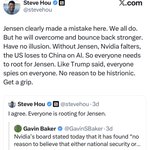

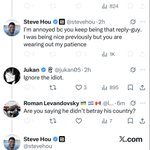


Pinned Tweet
“A passive retirement acct holding S&P 500 indx fund owns a levered, concentrated bet on the conversion of contracted compute backlog into billed revenue - & on two cash-burning frontier labs’ ability to pay for it Nobody chose that allocation, & almost no one holding knows it.”


Let’s check in on @stevehou
How many mistakes has Jensen made and how is his robinhood:0xd0601ce157db5bdc3162bbac2a2c8af5320d9eec purchase doing?
Stay tuned for the story to develop.

1
83
I think @stevehou has conveniently forgotten some other things Jensen did.

Jensen Huang oversaw two different accounting scandals (2002 and 2022), created a disgraceful circular financing ecosystem to inflate demand, threatened and mistreated reviewers of his GPUs, and had at least two affairs. Spare me any “good man” bullshit
32
Hard to be surprised at this.

🚨 IMPORTANTE
Exclusiva de Reuters muestra el verdadero móvil de la operación militar que llevó a la captura de Maduro
La investigación reveló que una semana antes de la operación militar del 3 de enero, el vicepresidente JD Vance abordó la futura venta del crudo venezolano con un operador de la firma Vitol y megadonante de su campaña, allanando el camino para que Vitol y Trafigura recibieran sin licitación el monopolio de comercialización petrolera que ya les ha generado cientos de millones de dólares.
Registros de vuelo ubican el avión oficial de JD Vance y el jet privado de John Addison (operador de Vitol) juntos el 27 de diciembre en Bozeman, Montana, rumbo al exclusivo Yellowstone Club.
Según una fuente enterada del encuentro, Vance preguntó qué tan rápido podrían vender el crudo venezolano si EEUE tomaba el control del suministro.
Aunque Addison negociaba gasolina en EEUU y carecía de experiencia técnica en contratos internacionales de crudo, había donado 300.000 dólares a Vance en 2022 y 7 millones de dólares a comités de Trump en 2024 (el mismo año en que Vitol pagó 50 millones en California por un caso de manipulación de precios donde Addison fue señalado).
Recomendado por Vance, Addison recibió el 5 de enero (dos días después de la operación) la llamada del secretario de Energía, Chris Wright.
La Casa Blanca omitió la licitación pública y el 9 de enero Vitol y Trafigura ya tenían las licencias.
Con más de 200 millones de barriles exportados en lo que va de 2026, expertos estiman que los operadores ganan entre 3 y 3,50 dólares por barril (un margen de 3,5 % a 4 %, superior al 1 %–3 % habitual de Vitol). Ambas firmas mantienen en secreto sus contratos con PDVSA, y Vitol confirmó tener además relación comercial con NABEP, la petrolera de Alejandro Betancourt
Este reporte se suma a la filtración del informe de KPMG publicada ayer por The New York Times, según la cual Vitol y Trafigura concentraron el 61 % de los 12.260 millones de dólares ingresados a la Cuenta de Custodia de Venezuela antes de que Washington transfiriera casi la totalidad de esos fondos de vuelta al Banco Central de Venezuela
Es decir:
Una semana antes del ataque militar, el gobierno de Trump ya estaba coordinando en un club privado de esquí cómo repartir la comercialización del petróleo venezolano a sus megadonantes de campaña sin licitación pública.
reuters.com/business/energy/…

32
Whoopsie. Probably time to start shorting $SPCX … if not yet then very soon.

Anthropic is telling investors that it will end its GPU-leasing contract with SpaceX after June 2027.
That's $7.5 billion in revenue gone in 2027, and $15 billion in 2028. Assuming a 60% EBIT margin, this won't be very pleasant.
I wonder when Google follows suit.
$SPCX

1
1
141

Looks like @Bill_Owen disabled comments on his post.
The CAS is compromised, two officials were shown to have had Russian influence on them right before the decision came down. The Egyptian was wined and dined in a luxury Moscow hotel days before.

2
56
No problems there eh?

Swiss reporter Thomas Renggli writes that Italian lawyer Giulio Palermo, who chaired the CAS panel which allowed the return of Russia to IIHF hockey, had appeared as a speaker at an arbitration conference in Moscow a few weeks earlier. CAS knew nothing about its own judge's trip. It raises the question about the integrity of the CAS panel and its decision.
insideparadeplatz.ch/2026/11…
1
34
Inflection is coming for $ASTS. Metal will get into orbit, dollars will flow and it will be a business like no other.

$ASTS: Backing AST SpaceMobile Before the Market Believed
Alain Gavin | Managing Partner – Chief Investment Officer
November 10, 2026
Pattern recognition in deep tech investing and why the AST SpaceMobile story is still in its early chapters.
In 2019, the idea of connecting a standard, unmodified mobile phone directly from space was dismissed across much of the telecoms industry. I know, because I asked. At industry conferences, the answer was nearly unanimous: it can't be done.
Today AST SpaceMobile is a Nasdaq-listed company valued at around $12–13 billion¹, one of fewer than a hundred venture-built companies in the world ever to reach that scale.² I was part of the investment team at Seraphim Capital that backed it in 2019, when it was barely two years old and the consensus still said no.
I recently told this story on The Sourcing Stack by Tracxn and what interests me most is not the outcome itself, but the pattern behind it: how you spot a generational deep tech company before the market believes.
SEEING THE SIGNAL BEFORE THE CONSENSUS
When we first met AST SpaceMobile in 2018, the company was barely a year old. Its ambition was audacious: direct-to-device satellite connectivity, beaming broadband-quality service to the phone already in your pocket, no new hardware, no satellite dish, no special handset.
Industry opinion said it was impossible. Our own technical due diligence said otherwise. That gap between what the consensus believes and what the engineering actually supports is precisely where deep tech returns are made. Three things gave us conviction:
• The physics held up. Rather than taking prevailing opinion as evidence, we examined the underlying technology independently. The analysis said direct-to-device connectivity from low Earth orbit could work.
• The talent was exceptional. AST had assembled rare technical and commercial capability across the United States, Europe and Israel — operating as a distributed team before Covid made that the norm.
• The market was enormous, and the model was clever. Mobile operators invest around $109 billion a year building and maintaining the infrastructure that carries the mobile internet, 85% of all such investment globally.³ AST designed its business to make the incumbents partners rather than rivals, sharing the economics with the operators whose spectrum and subscribers it extends. That decision is why nearly 60 mobile network operators, with over 3 billion subscribers between them, now sit on AST's side of the table.
Vision alone is never enough. Conviction has to be earned through technical diligence, team assessment and commercial judgement, each tested independently, then weighed together.
LOSING THE DEAL, THEN WINNING IT BACK
We didn't get in at the first attempt. A family office outbid us on valuation, and the round closed without us. Many investors file that under "missed" and move on. We kept our conviction and our relationship with the founders warm. When the opportunity came around again a year later, we invested, in 2019.
Identifying a great company and securing a position in it are two different skills. Valuation, timing and competition for access all intervene. Persistence, and winning the trust of founders, is what converts insight into ownership.
HOW RARE IS AN OUTCOME LIKE THIS?
It is worth pausing on just how unusual this result is. Fewer than 1% of venture-backed startups ever reach a $1 billion valuation. Of the thousand-plus companies that have, only a small fraction go on to pass $10 billion: fewer than a hundred venture-built companies in the world have ever reached that scale, out of the millions of startups founded over the same period.²
AST SpaceMobile has moved through every one of those filters: from a widely doubted eighteen-month-old company into that rarest cohort, one of the most valuable space businesses venture capital has ever produced. Seeing that potential in 2018, and acting on it against the consensus, is the single experience that has most shaped how I evaluate deep tech today.
THE JOURNEY IS FAR FROM OVER
Here is the part the valuation headlines miss: AST SpaceMobile has not yet switched on its core commercial service. Everything the market has priced so far rests on demonstrated technology and contracted demand not on revenue at scale. Revenue is already ramping $42.3 million in the third quarter of 2026, nearly three times a year earlier, with full-year guidance of $150–200 million reaffirmed⁴ but the recurring service revenue at the heart of the model is still ahead.
That transition has now begun. In its third-quarter results, reported on 9 November 2026, AST announced nationwide intermittent service activation in the United States and other key markets before year-end, the first coverage roll-out, with partners in the United States, Canada, Japan, Saudi Arabia and the United Kingdom and is targeting approximately 45 BlueBird satellites in orbit by mid-2027, the threshold for continuous, 24/7 coverage across its first markets, with production reaching six satellites per month from December.⁴
Deployment capacity is being built to match. Satellites are in production through BlueBird 51, launch agreements with external providers now cover more than 100 satellites for 2027–28 and in November 2026 AST announced Blacklift, its own reusable rocket, designed to carry up to five BlueBirds per launch from late 2028, taking control of the one part of its cadence it did not yet own.⁵ The same quarter brought a United States priority DPAS rating for its dual-use satellite programme and approximately $1.0 billion of non-dilutive funding from Japan’s Ministry of Internal Affairs and Communications, alongside partner Rakuten, for midband satellite manufacturing and launch.⁴
Continuous coverage is the inflection point. It is the moment a constellation becomes a network, and a network becomes a business: service agreements with operators covering billions of subscribers begin converting into recurring revenue. It is also the moment the technology starts serving its deeper purpose, bringing connectivity to the enormous share of the world's population who live without reliable coverage, and eliminating dead zones for everyone else. Few technologies get to pursue extraordinary commercial returns and a genuine humanitarian dividend through the same infrastructure. This is one of them.
In other words: today’s valuation is the market recognising the promise. The realisation of AST's true potential begins when the service goes live.
THE ARITHMETIC THE MARKET HAS BARELY BEGUN TO PRICE
Consider what commercial service actually unlocks. AST’s operator agreements cover more than 3 billion mobile subscribers — people whose phones drop in and out of coverage every day, in the developed world as much as anywhere else. When the network goes live, the service reaches them not through advertising campaigns or retail distribution, but through a prompt on the handset itself: the moment a phone loses terrestrial signal, the subscriber is offered the option to stay connected from space, added to the bill they already pay.⁴
Run an illustrative scenario on those numbers. If just 5% of those subscribers opt in around 150 million people at $5–$10 per month, that is roughly $9–$18 billion a year in recurring service revenue flowing through AST’s revenue-sharing agreements with its operator partners. Final pricing will be set market by market with the operators, and the economics are shared but the scale of the opportunity is what matters here.
Two refinements to that scenario cut in opposite directions and both favour the long-term case. Pricing will be tiered: in developing markets the add-on is likely to cost well below $5–$10, perhaps as little as $1 a month which is exactly how AST has described its model, with pricing varied market by market to maximise adoption. Against that, the 5% opt-in is a day-one assumption, not a ceiling. As handsets prompt subscribers every time they lose signal, and as always-on coverage becomes something people rely on rather than discover, penetration should only climb. Lower prices in some markets, rising take-up across all of them: the arithmetic above is a starting point, not a destination. And the 5% is not plucked from the air AST’s own SEC-filed projections assumed penetration would start below 1% and increase over time, while AT&T has reportedly planned for 30–40% of its US base taking a low-cost add-on. Five per cent sits well inside that range.⁴ ⁶
Now consider what the operators’ half of that is worth. On a 50/50 share, $4.5–$9 billion a year lands on the MNO side of the table against roughly $850–$900 billion of global mobile service revenue in 2025,⁷ a market growing below inflation and expected only to approach $1 trillion by 2030. That single revenue line would equal as much as a third of the entire industry’s annual service-revenue growth earned with no towers built, no spectrum bought and no customers acquired, in a sector the GSMA expects to commit $1.2 trillion of capital expenditure between 2025 and 2030 just to defend the revenue it already has.⁸
More important still: it expands the market rather than redistributing it. Every operator today competes for slices of the same, barely growing pool, one carrier’s market-share gain is another’s loss. Satellite coverage monetises the one asset operators have never been able to sell: the places where no tower will ever make economic sense and adds the billions of people beyond reliable coverage altogether. Expanding the addressable market is always a better business than cannibalising it, and this is one of the few genuinely new revenue pools the industry has been offered in a decade.
And none of this arithmetic counts the government business. In January 2026, AST secured a prime contractor position on the US Missile Defense Agency’s SHIELD programme, making it eligible to compete for defence task orders through 2035, a seat at the table, not guaranteed revenue and in November 2026 it was awarded a US Space Force contract for advanced space-based sensing (SB-AMTI), through prime contractor STR, carrying approximately $100 million of revenue. Earlier government awards already exceeded $125 million, within roughly $1.3 billion of total contracted revenue. It is a second revenue engine on the same infrastructure, with premium economics and it is the revenue that arrives first, before the consumer service completes its build-out.⁵
Set those numbers against the benchmark everyone reaches for: Starlink. Its figures are now on the public record, SpaceX’s S-1, filed ahead of its June 2026 Nasdaq listing, showed Starlink revenue of $7.7 billion in 2024 and $11.4 billion in 2025, and the company’s most recent reporting puts it at roughly 13.6 million subscribers and an annualised run-rate of around $17 billion. An extraordinary business and one in which every customer had to be won individually: hardware shipped, dishes installed, marketing spent. AST’s half of the scenario above — $4.5–$9 billion a year, would at the top end approach the scale of Starlink’s entire 2025 revenue, from a single service line, with a subscriber base more than ten times larger, acquired at close to zero cost: the customers already belong to AST’s partners, the billing relationship already exists, and the distribution channel is a pop-up on a phone that has just lost signal. Both companies’ numbers now sit in SEC filings which makes the comparison unusually clean.
There is a second structural advantage buried in that comparison. Mobile operators are among the best-equipped defenders of market share in any industry: they own the licensed spectrum that direct-to-device satellite service runs on, they hold the regulatory relationships in every national market, and they control the billing, bundling and handset relationships with billions of subscribers. A satellite operator that tries to go around them has to fight all of that. AST chose the opposite path, its service runs on the operators’ own spectrum, is sold under their brands, and makes their coverage better than their rivals’. The operators’ formidable ability to defend their market is, in AST’s model, not the threat. It is the moat.
That is the structural difference the headline valuation only partly reflects: Starlink has to sell connectivity to new customers one at a time, against the defences of the world’s operators. AST switches it on for billions of existing ones with those same operators on its side.
Which brings us back to value. Today’s market capitalisation prices a network that has not yet switched on its core commercial service and markets pay far more for revenue that has arrived than for revenue that has been promised. For long-term investors, the share price in any given month matters far less than the trajectory: from a doubted eighteen-month-old company in 2018, to the largest commercial communications arrays in orbit, to the threshold of continuous service — with two revenue engines and the world’s operators as partners. The arithmetic above is what delivery looks like. Judging that trajectory early, before the market was ready to believe it, is the discipline this article is about.
THE PATTERN I KEEP APPLYING
The AST SpaceMobile experience distilled into the principles I apply to every deep tech opportunity I evaluate:
• Consensus is not evidence. Industry scepticism tells you what incumbents believe, not what the technology can do. Assess feasibility independently.
• Technical diligence is the differentiator. In deep tech, the investors who can understand what sits beneath a proposition — and imagine the world where it is the norm — see opportunities others cannot.
• Teams win, not just technologies. A great founder in a small market builds a small company. Look for exceptional technical and go-to-market talent pointed at a market big enough to matter.
• Access is a skill. The best opportunities are competitive. Persistence, informed conviction and founder relationships determine whether insight becomes ownership.
The most interesting deep tech opportunities emerge before the wider market is ready to recognise them. AST SpaceMobile is what it looks like when you back one.
And it is the reason I keep looking. I am seeing startups that match this pattern emerging today, companies whose propositions sound every bit as improbable as AST’s did in 2018, and which could prove just as instrumental: changing what cloud computing itself looks like, building the application layer for space data, and making energy abundant and reliable across the planet without the need to move fossil fuels around it. The consensus is sceptical about every one of them. In my experience, that is a very good place to start looking.
Original Article: psion.vc/insights/backing-as…

4
223
Next time when you hear something outrageous, chances are it’s a Russian disinformation campaign. And the maga simps eat it up and ask for seconds.

New: The contents of a hacked computer belonging to John Mark Dougin, an American ex-cop living in Russia, offer documentary evidence that he worked with the FSB and GRU to peddle disinformation. He liaised with GRU Unit 29155 the originator of the Ukraine biolabs hoax, and his "moment of triumph came in June 2026, when information from his investigation was endorsed by @TulsiGabbard, who was serving as director of national intelligence in the Trump administration." theins.press/en/inv/299417?_…

41
This is correct. NATO is a voluntary organization. You apply for a membership. Soviet Union was a coercive power, they took you over. Putin cries crocodile tears and the simps drink them up.

NATO expansion is a myth. It is a Russian lie. Here is the map.
After World War II the Russians militarily occupied half the European continent. The Russians picked their leaders. They wrote their laws. They brutalized their people and took whatever they wanted.
When the Soviet Union collapsed, all of these peoples who had suffered immensely under the Russians were desperate to get real security and protection from the Russians.
Russia is the ONLY cause of NATO enlargement because the people of Eastern Europe always knew they were going to be invaded again as soon as the Russians succeeded at some form of economic capitalism.
Russian imperialism is the only cause of this war.

45


Good.

Republicans have shielded Elon Musk from facing accountability for the past 2 years, but now that the balance of power has shifted, Democrats are poised to open up more than 150 (!!) lines of inquiry & investigations into Musk.
My latest for @BylineTimes:
bylinetimes.com/2026/11/09/t…

2
125
This is my Canada! 💪

The Canadian government has officially informed Hockey Canada and the IIHF that it will not issue visas to Russian players for the upcoming World Juniors. Players who already hold Canadian visas will also be ineligible to participate, even under a neutral flag, per Gord Miller.


37

This is why $QURE must be approved. There are no alternatives.

Tomorrow marks 2 years since my dad ended his life because of Huntington’s Disease. They say grief gets easier with time, and while it feels easier to carry in some areas, it feels harder in others the longer time goes on.
2 years ago today I went to bed that night trying to believe everything would be okay. The whole month prior we had been through hell on earth. I had no idea the next day I would wake up and my worst fear would come true.
I’m still here fighting, dad. I would’ve gone to the ends of the earth trying to save you. I love you. #huntingtonsdisease #cureHD #MentalHealthAwareness #MentalHealthMatters

What do you think of the argument: Jensen is one of a kind visionary and if he left $NVDA US will lose the AI race?
Sounds a little bit like a personality cult to me, if the tech is real and the company is real, why would it not continue thriving?
86
Real?

🔻
MARK ZUCKERBERG WAS JUST SUBPOENAED.
Not for data leaks. Not for censorship.
For Epstein.
Bondi’s team found 3 wire transfers from a Meta subsidiary called “Horizon Bridge LLC” to the Butterfly Foundation — the same Epstein front company named in the Tehran files.
Total: $47.2 million between 2016 and 2019.
But that’s not the worst part.
The worst part is what the money was for.
Internal Meta documents recovered from the Tehran servers show that Zuckerberg personally approved a program called “Project Looking Glass.”
Its purpose: to build a private facial recognition database of every child on Instagram under the age of 14.
12.4 million faces. Catalogued. Tagged. Sorted.
And shared with a single external client: Ghislaine Maxwell.
Zuckerberg’s lawyers released a statement 40 minutes ago: “Mr. Zuckerberg will cooperate fully.”
That’s what they all say.
Right before the handcuffs.
48

