Michael Ryan (@michaelryan207) header
Michael Ryan (@michaelryan207) profile picture

PhD Student @stanfordnlp || Working on Marin ⛵️ || Prev @DSPyOSS @GeorgiaTech @Microsoft @SnowflakeDB

Palo Alto, CA
Joined December 2019
Photo by Michael Ryan (@michaelryan207)Photo by Michael Ryan (@michaelryan207)Photo by Michael Ryan (@michaelryan207)Photo by Michael Ryan (@michaelryan207)Photo by Michael Ryan (@michaelryan207)Photo by Michael Ryan (@michaelryan207)Photo by Michael Ryan (@michaelryan207)Photo by Michael Ryan (@michaelryan207)Photo by Michael Ryan (@michaelryan207)Photo by Michael Ryan (@michaelryan207)
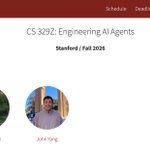
🚨 New Course Announcement! This Fall @Diyi_Yang @jyangballin and I are teaching a BRAND NEW Stanford course on how to build AI Agents from scratch! Millions of users interact with AI Agents every day.  Come join us and learn how to build them! 🧵 (1/5)
🤖 Made with AI
This fall @michaelryan207 @jyangballin and I are teaching a new course CS329Z "Engineering AI Agents" on how to build AI Agents from scratch. Come join us and learn how to build them 🤖
25
278
4
1,878
162,353
Michael Ryan retweeted
斯坦福CS329Z — Engineering AI Agents(2026 秋季)这门课程现在终于在youtube上线了。 youtube.com/watch?v=DGI4vucR… 这是一门全新的斯坦福研究生课程,由 Diyi Yang、Michael Ryan(DSPy 核心贡献者)和 John Yang(SWE-bench 共同创建者)共同授课。⁠ 核心定位是:从单一大模型转向复合 AI 系统(Compound AI Systems) 的工程实践。也就是把 LLM、检索器、工具、优化器、记忆等组件组合起来,构建从简单流水线到自主 Agent 的完整系统。 课程强调动手工程能力,而不是只讲概念: 先从零实现核心组件(RAG、工具调用、Agent Loop),再学习框架(如 DSPy)如何抽象这些模式。 重点训练:问题拆解、组件选型、数据收集与整理、评测体系搭建、设计权衡、可靠性与安全。 主要内容覆盖 Agent 基础与解剖结构(LLM 核心、推理、记忆、工具、环境) RAG(索引、检索器、Agentic RAG) 工具使用与函数调用(包括 MCP) 框架与编排(DSPy、LangGraph 等) Agent 设计模式(ReAct、Reflexion、CodeAct 等) 记忆架构、多智能体系统 优化(提示、权重、系统级) 评测(LLM-as-Judge、benchmark 设计、pass@k 等) 安全与防护(prompt injection、沙箱、权限模型) 专项主题:编程 Agent、主动式 Agent 还有嘉宾课,包括 Terminal-Bench、SWE-bench 团队,以及与 Andrew Ng 的 fireside chat。 作业与实践(已公开) HW1(Michael Ryan 设计):从零搭建 Agent Harness(类似迷你版 Claude Code)。要求不用现成框架,只用 chat completion API + 自己写代码。基于真实公司邮件语料做检索、摘要、工具调用、终端、记忆、人工审批等。成本很低(参考实现跑完测试大约不到 1 美元)。⁠ 仓库:github.com/cs329z/assignment… HW2(John Yang 设计):使用 Harbor 框架构建接近 Terminal-Bench 风格的真实 Agent 评测任务。学生要自己设计问题、运行环境和验证器。 仓库:github.com/cs329z/assignment… 课程网站:cs329z.stanford.edu/ YouTube 播放列表已开始更新(Lecture 1 已上线):youtube.com/watch?v=DGI4vucR… 整体来说,这是目前斯坦福最系统、最偏工程实践的 AI Agent 课程之一,重点在“怎么真正把 Agent 系统做出来并可靠运行”,而不是只调用现成框架。材料正在全面公开,现在是跟着学的好时机。
15
90
1
449
38,690
Michael Ryan retweeted
Video lectures, Stanford CS 329Z Engineering AI Agents fall 2026, by Diyi Yang, Michael Ryan, John Yang
🔊 Big Update! All materials are now being released publicly for our NEW Stanford course CS329Z: Engineering AI Agents! Starting with the lectures, which are going live daily on the Stanford Online YouTube channel! Lecture 1: youtu.be/DGI4vucR71w 🧵 (1/5)
2
19
205
5,786
Michael Ryan retweeted
Have enjoyed getting to TA for this innovative course with such a great team! Check out our materials here👇
🔊 Big Update! All materials are now being released publicly for our NEW Stanford course CS329Z: Engineering AI Agents! Starting with the lectures, which are going live daily on the Stanford Online YouTube channel! Lecture 1: youtu.be/DGI4vucR71w 🧵 (1/5)
2
2
18
1,009
Michael Ryan retweeted
agent goes brrrr and you can watch the amazing @Diyi_Yang @michaelryan207 @jyangballin talk about 'em brrrrrrr
🔊 Big Update! All materials are now being released publicly for our NEW Stanford course CS329Z: Engineering AI Agents! Starting with the lectures, which are going live daily on the Stanford Online YouTube channel! Lecture 1: youtu.be/DGI4vucR71w 🧵 (1/5)
1
3
12
1,765
🔊 Big Update! All materials are now being released publicly for our NEW Stanford course CS329Z: Engineering AI Agents! Starting with the lectures, which are going live daily on the Stanford Online YouTube channel! Lecture 1: youtu.be/DGI4vucR71w 🧵 (1/5)
🚨 New Course Announcement! This Fall @Diyi_Yang @jyangballin and I are teaching a BRAND NEW Stanford course on how to build AI Agents from scratch! Millions of users interact with AI Agents every day.  Come join us and learn how to build them! 🧵 (1/5)
27
176
35
1,260
132,723
Huge thanks to our friends at @LaudeInstitute for their major support making this course possible! Shoutout to @LaudeInstitute, @thinkymachines, @googlecloud, @awscloud, and @harborframework for providing API credits to our students! (4/5)
1
10
1,356
We have a lot more exciting content and materials to share, especially student-created content from our amazing inaugural class of over 100 students! Follow along at our site here: cs329z.stanford.edu/ (5/5)
1
16
1,225
Autumn 2026: @Diyi_Yang, @michaelryan207 & @jyangballin launch CS329Z Engineering AI Agents. Not content with CS224N & CS336, @stanfordnlp leads with 2 amazing new courses, CS312 & CS329Z. “But where are the videos?”, said the world. Well, the first just dropped—more to come!
7
26
1
199
14,304
Having the most mind-numbing experience with #ICLR2027 reviews this year... Reviewer: Reviews the wrong paper Me: "I think you reviewed the wrong paper" Reviewer: Decreases score to a 1, increases confidence to a 4, and pastes in 100% AI generated review Me: ...
14
17
7
427
67,029
Michael Ryan retweeted
In @augmind_fm EP8, our @michaelryan207 had an insightful conversation with Peter Norvig, co-author of “Artificial Intelligence: A Modern Approach” Two arguments really stuck with me: 1. While the scaling law hasn’t stopped and we now have much more data, algorithms, and compute, the next frontier is setting the right objective. 2. One of AI’s most profound risks is human deskilling and loss of motivation, which can have a long-lasting negative impact if we don’t do anything. Peter also shared his career journey and his perspective on today’s AI industry. I found it super useful for early-career researchers and practitioners navigating such uncertain times. Thank you, Peter, for sharing your wisdom and experiences with us!
🤖 Made with AI
“I should have my choice. How much automation do I want helping me? But also, how much control do I want?” “You have to struggle whether it’s lifting weights or whether it’s mental exercise. You’ve got to actually do the work yourself.” For EP8, “After Data and Compute, What’s the Next Frontier in AI,” we welcome Peter Norvig, co-author of Artificial Intelligence: A Modern Approach and former director of research at Google. Peter is now a Distinguished Education Fellow at Stanford HAI and a researcher at Recursive, working on self-improving AI. As AI takes on more of our work, how do we make sure it makes us more capable? Peter explores what’s still worth learning in AI and programming, why learning still requires struggle, how more automation can coexist with more human control, and why getting AI’s objectives right remains one of the field’s biggest challenges. Outline: 0:00 - Introduction 2:32 - What Has (and Hasn’t) Changed Throughout Peter’s Career? 7:03 - How Peter Makes Career Pivots 11:17 - Is This AI Moment Different From Previous Cycles? 15:32 - What’s Still Worth Learning in AI and Programming? 19:55 - How Will AI Transform Higher Education? 24:10 - Main Bottlenecks to Building Human-Centered AI 35:10 - Reward Hacking vs. Creativity 41:51 - Continual Learning Remains an Unsolved Challenge 44:16 - Open Source AI Models 46:32 - AI, Inequality, and Winner-Take-All Markets
1
5
18
1,392
Some of you know I’ve gotten deep into teaching recently, so I was thrilled to have the opportunity to sit down with Peter Norvig (one of the best AI educators to ever do it!!!) Peter co-wrote THE textbook on AI! In this discussion we talk about what is still important for humans to learn and do when it comes to AI development, and how we should think about setting the objectives for AI! Check it out! ⬇️
“I should have my choice. How much automation do I want helping me? But also, how much control do I want?” “You have to struggle whether it’s lifting weights or whether it’s mental exercise. You’ve got to actually do the work yourself.” For EP8, “After Data and Compute, What’s the Next Frontier in AI,” we welcome Peter Norvig, co-author of Artificial Intelligence: A Modern Approach and former director of research at Google. Peter is now a Distinguished Education Fellow at Stanford HAI and a researcher at Recursive, working on self-improving AI. As AI takes on more of our work, how do we make sure it makes us more capable? Peter explores what’s still worth learning in AI and programming, why learning still requires struggle, how more automation can coexist with more human control, and why getting AI’s objectives right remains one of the field’s biggest challenges. Outline: 0:00 - Introduction 2:32 - What Has (and Hasn’t) Changed Throughout Peter’s Career? 7:03 - How Peter Makes Career Pivots 11:17 - Is This AI Moment Different From Previous Cycles? 15:32 - What’s Still Worth Learning in AI and Programming? 19:55 - How Will AI Transform Higher Education? 24:10 - Main Bottlenecks to Building Human-Centered AI 35:10 - Reward Hacking vs. Creativity 41:51 - Continual Learning Remains an Unsolved Challenge 44:16 - Open Source AI Models 46:32 - AI, Inequality, and Winner-Take-All Markets
6
11
74
5,052
EP8 of the AM Podcast drops tomorrow! We’re getting better at making AI achieve its goals. How do we make sure those are the goals we actually want? We sat down with Peter Norvig, co-author of Artificial Intelligence: A Modern Approach and former director of research at Google, to explore why higher scores don’t always mean better AI, how we decide what these systems should optimize for, and what it takes to build AI that makes people more capable. Here’s a preview 👀
4
7
571
Michael Ryan retweeted
Thank you @LaudeInstitute for the generous support! So excited to work with @tatsu_hashimoto, @chrispiech, @erikbryn and our team to build collaborative AI that complements human expertise and helps people develop new skills as work evolves!
Replying to @LaudeInstitute
Collaborative Intelligence for the Future of Work | @Stanford @Diyi_Yang, @tatsu_hashimoto, @chrispiech, and @erikbryn are building AI systems that complement human expertise to equip the workforce of the future. laude.org/moonshots/one/coll…
15
16
2
120
9,198
Collaborative Intelligence for the Future of Work | @Stanford @Diyi_Yang, @tatsu_hashimoto, @chrispiech, and @erikbryn are building AI systems that complement human expertise to equip the workforce of the future. laude.org/moonshots/one/coll…
2
19
10
76
32,119
Michael Ryan retweeted
It’s done! Marin’s Mochi 535B-A23B finished its main pretraining phase this morning. 18T tokens! Long context this weekend, SFT over the next week or so. Hoping to release checkpoints next week. Some EU paperwork first. mumtracker.exe.xyz/hero-run-…
42
60
11
636
50,723
This blog is sick! Astra can edit the weights of a smaller network to fix bugs like reasoning loops 🤯🤯🤯 My favorite part is they include all the logs which demystifies how this is possible (lots of careful reasoning over attention maps and activations). Astra even reconstructs the Pac-Man board entirely from neuron weights of a small network trained on Pac-Man! The pattern they discuss of Astra first writing a python program for behavior, and then figuring out how to encode that into weights is super fascinating! Feel the AGI 🔥
We asked GPT-6 Astra to edit Qwen3.5-0.8B weights to improve math. It directly changed only 0.016% of weights, fixing 0.8B's reasoning loops & improving math up to 6x and even instruction following 3x, without gradients or training. We call this Weight-Space Programming: frontier LLMs can now natively read/write neural network weights! 🧵 Blog: rikiyat.github.io/blog/weigh…
Readers added context they thought people might want to know
LLM was given weights explicitly as text in prompt and used code/forward passes (per authors' logs) to ablate Qwen looping direction, a known thinking-mode issue per model card. Primarily fixed repetition in that mode, not general 'natively' improving weights/math. rikiyat.github.io/blog/weight-sp… github.com/RikiyaT/lm_und… huggingface.co/Qwen/Qwen3.5-0… huggingface.co/RikiyaT/Qwen3.…
6
1
2
46
4,644
Michael Ryan retweeted
We asked GPT-6 Astra to edit Qwen3.5-0.8B weights to improve math. It directly changed only 0.016% of weights, fixing 0.8B's reasoning loops & improving math up to 6x and even instruction following 3x, without gradients or training. We call this Weight-Space Programming: frontier LLMs can now natively read/write neural network weights! 🧵 Blog: rikiyat.github.io/blog/weigh…
Readers added context they thought people might want to know
LLM was given weights explicitly as text in prompt and used code/forward passes (per authors' logs) to ablate Qwen looping direction, a known thinking-mode issue per model card. Primarily fixed repetition in that mode, not general 'natively' improving weights/math. rikiyat.github.io/blog/weight-sp… github.com/RikiyaT/lm_und… huggingface.co/Qwen/Qwen3.5-0… huggingface.co/RikiyaT/Qwen3.…
2,365
7,271
5,748
55,959
9,995,653
Michael Ryan retweeted
Synthetic rewrites are now standard to improve data quality and when data is limited. But how much compute should you spend rewriting? And can a model trained on rewrites beat the rewriting model? We fit scaling laws to answer both: 1/🧵
10
20
8
202
32,377