

Cineasta de mentiras · Escritor frustrado · Software engineer
Joined November 2008
- Tweets34K
- Following7.5K
- Followers868
- Likes114K




Kevin Vicent retweeted

try this next “use /create-formal-verification-skill to model these state machines, one skill per subsystem. and use /statechart to visualize my most important user flows”
both skills are in pstack
github.com/cursor/plugins/tr…


Kevin Vicent retweeted

The future CEO of agentic organizations will not be a charming white side who is tall, firm handshake and McKinsey alumni.
Instead, it will be someone who designs agentic system, refine agents with harness engineering and leadership combined.
Agents are the future employees and managing agents is more like PM/architect than executive presence.
Kevin Vicent retweeted

It's actually even worse than that, I think. What if the eval itself comes from a data vendor?
Suppose you found a way to generate RL tasks in some domain. You can generate 10k tasks, turn the highest quality 100 ones into an eval and sell the rest as training data.

jammed with @HamelHusain a bit and since then, i cannot unsee of the state of evals as being similar to the military-industrial complex

Kevin Vicent retweeted

I've recently started hiding the bulk of my AI-generated GitHub PR descriptions behind a collapsed <details><summary> HTML tag (thankfully supported by GitHub Markdown) and I think it's a useful pattern for making PR slop a little bit less exhausting simonwillison.net/2026/Nov/9…




Kevin Vicent retweeted

Eval-driven development is a great approach especially when you have to use SLMs on your project or have strict budget. I am using it atm on a project with European bank where all models have to be self-deployed.
More about:
- Evals:
xitter.twitterapi.xyz/sermakarevich/status/2…
- SLMs vs LLMs:
xitter.twitterapi.xyz/sermakarevich/status/2…


Kevin Vicent retweeted

NVIDIA just fixed text-to-SQL’s biggest problem!
the release is called Auto Ontology, and it targets the reason an agent can write valid SQL against a company database and still return the wrong number.
the database stores columns, and the agent has to guess what they mean. a column called extendedprice might hold revenue, and two systems in the same company can define revenue differently.
Auto Ontology gives the agent an ontology, a schema that maps business concepts to the columns that hold them and defines how they relate, before any query is written. it drafts that schema from your database metadata instead of making you write it, and a human certifies it.
the ontology holds three things:
→ terms: business concepts like customer, order, or revenue, with descriptions and synonyms, mapped to the exact columns that store them.
→ SQL attributes: reviewed expressions like a margin or a rolling total, reused so every measure is computed the same way each time.
→ relationships: how tables join, including bridge tables, inferred from keys and the data itself.
to draft these, it profiles columns, samples values, extracts terms table by table, and mines past query history for SQL attributes. everything lands in Postgres, with embeddings in pgvector.
at query time, the agent maps the question to certified terms, follows relationships to find the joins, and writes SQL. it checks filter values against the real data, repairs the query if a check fails, and returns the answer with its SQL and steps.
when the data can't support a question, the agent says so. in NVIDIA's demo, a question about return on ad spend on a sales database with no ad data gets a clarifying reply offering revenue instead of an invented number.
so the ontology tells the agent how to compute an answer and also which questions have one at all.
as the architecture in the image shows, an ingestion service compiles the ontology from your source databases, and any agent harness reaches it through MCP, CLI, or REST API. it supports ten engines including Postgres, Snowflake, Databricks, and DuckDB, runs on Nemotron by default or any OpenAI-compatible endpoint, and is Apache 2.0.
check it out on GitHub: github.com/NVIDIA/auto-ontol…
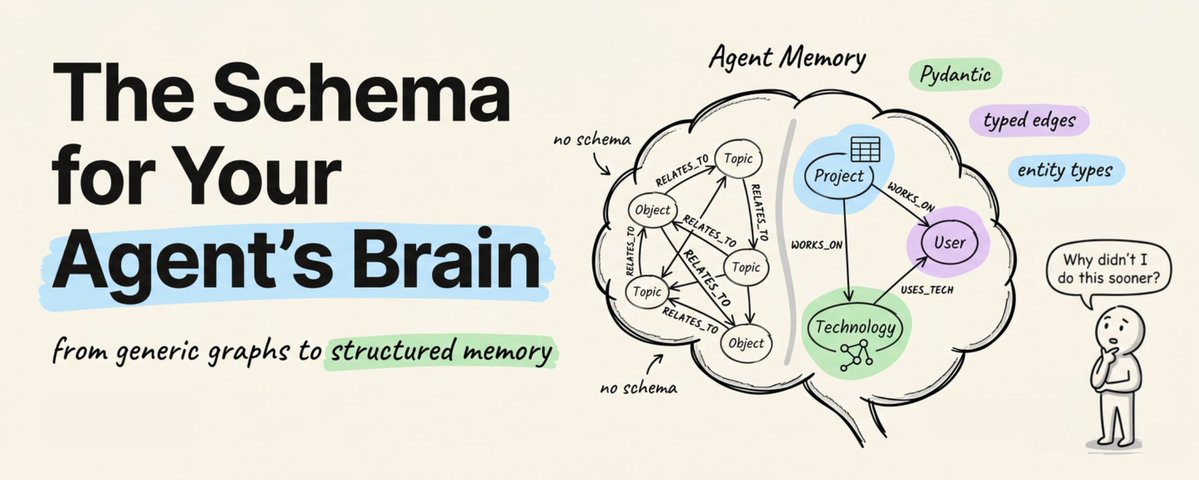
the same principle of defining a schema before the model extracts anything also decides whether agent memory works. I wrote about that in the article quoted below.

ALT NVIDIA Auto Ontology GitHub README: green NVIDIA mark, shortened intro, Discover and Ground, key features, and the AI-Q agent harness architecture diagram

Kevin Vicent retweeted

TanStack AI’s Sandbox API
Part 3 of this intro to TanStack AI covers the Sandbox API: spinning up a remote sandbox on Vercel or Railway, running Claude Code inside it with GitHub access, and having it clone your repo, add a feature, and open a pull request. blog.master.dev/tanstack-ai-…


Kevin Vicent retweeted

I'm a broken record about this, but AI will be server-client. Rob is saying he wants to use his own client LLM, the companies will continue to offer endpoints via their server LLMs. The future of AI isn't a singleton AI mind, or even an autonomous multi-agent civilization. It's the ability to map-reduce the entire internet and everything in it. You send your prompt to a billion sources, their servers respond, and your client LLM synthesizes the result.
It's the end of the attention economy, because finally you'll be able to listen at scale.

Kevin Vicent retweeted

Omarchy is forever free. There's no monetization scheme coming. I'm already rich and the Omacom Foundation is a well-founded nonprofit.
The only ulterior motive here is to make Linux win on the desktop and create the perfect, malleable computer for all to enjoy!
Kevin Vicent retweeted

Claude Code can build your entire LLM evaluation pipeline.
But don't let it decide what GOOD looks like.
Your rubrics need human judgment.


Kevin Vicent retweeted

frontier models, with lots of test time compute, are becoming the engine of scientific discovery

Kevin Vicent retweeted

I switched my mobile orchestrator to Slack, and I’m getting way more done on the go
Slack on an iPhone Duo + @eve agent with access to GitHub and Vercel. It can update any repo, analyze production logs and agent runs through Vercel
each thread is a separate session. I can fork sessions by starting a new thread and pointing it at any message in an existing thread
switching between mobile and desktop is seamless. especially on weekends, I can’t be on the laptop the entire time, so I can kick off investigations and continue them on mobile
I can also flip it into multiplayer anytime to collaborate on projects


