

ICXC ☦️ NIKA | Lives of the Saints ~ Sayings of the Holy Fathers ~ To the Glory of the Holy Triune God
Joined November 2024
- Tweets5.2K
- Following33
- Followers29.9K
- Likes2.1K





Pinned Tweet
US Secretary of War Pete Hegseth talking in 2018 about the 'miracle' of reconstructing the 3rd Temple of Solomon, the place where the Antichrist will be worshiped according to our Orthodox Christian faith.
Moral freedom leads man along the straight path laid out by God for him, guiding him towards the purposeful and rational end that he was called to attain.
— Saint Nektarios of Pentapolis (On the Morally Transformative Power of Moral Freedom)

🔸 November 11 - Saint Victor of Damascus and Saint Stephanie 🗡️🌴🔸
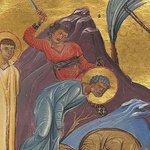
Today, we also commemorate the Holy Soldier and Martyr Saint Victor of Damascus. He was martyred during reign of the Roman Emperor Marcus Aurelius (161-180) along with the pious widow Saint Stephanie who was so inspired by Saint Victor’s willingness to suffer for Christ that she joined him in confessing her faith. Saint Victor was a soldier in the Roman army, and was stationed in Damascus of Roman Syria. When the Emperor began a persecution against Christians, Victor refused to offer sacrifice to the pagan gods.
Since these obligatory sacrifices were a test of a soldier’s loyalty to the pagan gods, the emperor and the state, Victor was arrested by the authorities and sentenced to be tortured. First his fingers were cut off, and then he was placed in a fiery furnace for three days. After emerging from these tortures unharmed, he was forced to drink deadly poison. Again, he remained unharmed, and this caused the sorcerer who administered the deadly poison to believe in Christ.
Unable to break the resolute faith of Saint Victor, the torturers then burned him in boiling oil, and forced to drink ash mixed with vinegar. This was followed by the gouging out of his eyes, and hanging him upside down for three days. After this, he was skinned alive and beheaded, and thus he received his crown of eternal glory. Seeing the Saint willingly endure his torments for the sake of Christ, a young widow named Stephanie was inspired to openly confess her faith, and she too was condemned to a cruel death.
She was tied to two palm trees bent to the ground which, when released, sprung back and tore her apart. She was just 16 years old.


🔸 November 11 - Saint Theodore the Studite 🔸
Today, we commemorate the Holy Confessor Saint Theodore the Studite, one of the great Iconodules (defenders of holy icons) during the Byzantine Iconoclasm. St Theodore was born in 759 in Constantinople to a pious and noble Byzantine family, and received an excellent education from the best rhetoricians, philosophers and theologians. At this time, the empire was suffering from the heresy of iconoclasm during which the imperial authorities sought to ban and destroy icons.
The First Iconoclasm (726–787) was ended by the decision of the Seventh Ecumenical Council in 787. Among the Fathers who defended Orthodoxy at this council was St Platon, an ascetic and uncle of Theodore. St Platon persuaded Theodore and his family to embrace the monastic life. Together with his father and brothers, Theodore accompanied Platon to Bithynia in 781 where they converted the family estate into the Monastery of Sakkudion. In 794, Theodore became the abbot of this monastery.
When the iconophile Empress Irene of Athens made Theodore the abbot of the famous monastery of Studios in Constantinople (today in ruins), he initiated much needed restoration works. This included the construction of a library which turned the monastery into a major scholarly centre. He also composed the “Studite Rule” to govern the monks. During the Second Iconoclasm (814-842) initiated by Leo V the Armenian, St Theodore continued to write letters condemning the iconoclasts despite repeated warnings from the emperor.
On Palm Sunday, he also made a procession with the brethren raising icons high. Not long after this provocation, he was exiled to Bithynia and later to the Anatolic Theme where he was imprisoned and cruelly flogged. Enduring his trials, the Saint was sent to Smyrna where he was kept inside a foul prison with his feet locked in stocks. After the death of Emperor Leo, the new Emperor Michael II released and freed from exile many confessors including St Theodore.
He reposed shortly after in 826. His steadfast confession was vindicated at the Council of Constantinople in 843 when icon veneration was restored under the Empress St Theodora.


🔸 November 11 - Saint Menas the Great-Martyr 🗡️🔸
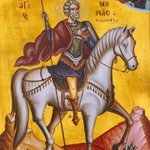
Today, we commemorate the Great-Martyr Saint Menas of Egypt. The holy military officer suffered for Christ during the reign of the Emperor Diocletian (284-305). St Menas was born in Egypt in 285 AD to ascetic Christian parents. His father, a ruler of one of the administrative divisions of Egypt, died when Menas was 14 years old. At the age of 15, Menas joined the army. He was given a high rank because of his father’s reputation, and was stationed in Cotyaeum, Anatolia (today Kütahya, Turkey).
In 298, the Emperor published an edict ordering everyone to worship the pagan idols, or otherwise face persecution, torture and death. After hearing this order, Menas gave up his military position and withdrew to a the seclusion of a mountain where he kept vigil and lived an ascetic life of fasting and prayer. Living as hermit, the Saint purified himself of every passion of the soul and body. Whilst in prayer, he heard a divine voice call to him: “Blessed are you, Abba Menas, because you have been called for the pious life from your childhood. You shall be granted three immortal crowns; one because of your celibacy, the second because of your asceticism, and the third for your martyrdom.”
With his heart aflame with love for God, Menas left the mountain and bravely returned to the city, where the people were celebrating a pagan festival. Standing in the midst of the crowd, Menas triumphantly declared Christ as the One True God, and shouted that the pagan idols were nothing more than inanimate objects made of metal, wood, and stone. Menas was beaten and thrown into prison for this outburst by the Roman authorities, and was brought before Pyrrhus, the city prefect.
Phyrrus offered to restore Menas to his former rank in the Army if he would offer sacrifice to the pagan gods, but St Menas affirmed that he would never deny Christ. After suffering many tortures including being bound to a wooden post and having his skin flayed with sharp metal hooks, he finally received the crown of martyrdom by beheading in the year 304. The valour with which he suffered for Christ converted many pagans to the True Faith.


At a wedding, it appears that two people are being joined in marriage. Yet, in reality, there are not two, but three. The man marries the woman, and the woman marries the man, but together, they are both united in marriage to Christ.
— Elder Aimilianos of Simonopetra

“I bear the Cross upon my body, I carry the Cross along my path, I hold the Cross in my heart; the Cross is my glory!”
— Saint Gregory the Theologian ☦️
🔸 November 10 - Saint Arsenios the Cappadocian 🔸
Today, we commemorate Saint Arsenios the Cappadocian, the wonderworking priest who baptised the infant Saint Paisios of Mount Athos, and led his flock through the hardships of the Greek-Turkish population exchange. St Arsenios was born in 1840 in Varasos (today Çamlıca, Yahyalı), one of six Christian villages in the Farasa region of Cappadocia. Although Cappadocia had been under the yoke of the Turks since the 11th century, it still retained a sizeable presence of Orthodox communities into the 20th century.
After receiving his education in Nigde, St Arsenios became a monk. He was then sent to serve in his native region of Farasa as a priest. During this time of great turmoil and hostility towards the Christians of Asia Minor following the defeat of the Ottomans in WWI, the Greek people of Pharasa sought refuge in their holy father Arsenios. He was their teacher, spiritual guide, and healer of their souls and bodies. He also secretly taught the Orthodox faith and the Greek language to children, often in the secluded Cappadocian church caves.
St Arsenios became known as a mighty intercessor before God, praying for all who came to him, and indiscriminate in his healing of Muslims as well as Christians. He also helped barren couples bear children through his prayers. He was known as “Hadjiefendis”, a Turkish honorific title: “Hadji” meaning “pilgrimage” as he had journeyed to the Holy Land, and “Efendis” meaning “respected teacher”.
When the Greeks of Asia Minor were uprooted from their homeland during the Greece-Turkey population exchange, the aged St Arsenios in 1924 led his flock on foot from Farasa on the 150 mile journey to the port of Mersin. Arriving by ship to Piraeus, Greece, he was sent with his flock to the Ionian island of Corfu where he reposed peacefully at age 84. Years later, St Paisios, who greatly loved his Godfather Arsenios, gathered the stories and testimonies of the Pharasiotes and recorded the life and miracles of the Saint. He also transferred the relics of St Arsenios from Corfu to the Monastery of St John the Theologian in Souroti where they are kept today.


“The sacred colours of our homeland, at the forefront of the struggles.”
APOEL Nicosia, a football club from Cyprus, proudly wears blue, symbolising Greece, and yellow, symbolising Orthodoxy 🇬🇷☦️


🔸 November 9 - Saint Nektarios the Wonderworker of Aegina 🔸
St Nektarios was born Anastasios in 1846 in Thrace to poor parents. Having studied in Constantinople in his youth, he became a monk on the island of Chios in 1876, and took the name Nektarios upon being ordained a deacon in 1877. After completing his theological studies, he went to Alexandria where he was ordained a priest in 1886. Having shown great zeal preaching the Word of God, he was made Metropolitan of the Pentapolis in Libya in 1889.
Envious of his popularity and swift ascent through the ranks of ecclesiastical office, certain clerics began spreading false rumors to Patriarch Sophronios that Nektarios wanted to take his position. Troubled by this, Sophronios ordered him to leave Egypt in 1890. Without defending himself, Nektarios left for Athens. Since his name had been soiled, he was unable to find a position as a bishop. In 1894, he was appointed director of the Rizarios Ecclesiastical School in Athens. While in this position, he wrote his famous hymn Agni Parthene (“O Virgin Pure”).
Through his eloquent sermons, his dedication to educating aspiring priests, his generosity despite his own poverty, his great meekness and fatherly love, he became a shining light and a spiritual guide to many. The exceedingly humble St Nektarios is well known for having personally performed the most lowly tasks, including sweeping floors and cleaning toilets. In 1904, at the request of pious nuns, he began building a convent dedicated to the Holy Trinity on the island of Aegina (today the Monastery of St Nektarios).
He remained here from 1908 until the end of his earthly life. Through his prayers, he delivered the island from drought, healed the sick, and cast out demons from souls. He also patiently endured every wicked slander, forgiving his accusers and not seeking to avenge himself. St Nektarios reposed in 1920 at the Aretaeion Hospital in Athens from prostate cancer. After his repose, his undershirt was placed by nurses on a paralyzed man’s bed, and the man was instantly healed. His funeral was conducted by his closest friend St Savvas of Kalymnos who painted the first icon of him.


Archangel Michael depicted bearing a sword, leading the heavenly hosts into battle against the dark powers.

A 12th-century fresco from the Church of Archangel Michael in the village of Frenaros, Cyprus. The church itself also dates back to the same century.

May God enlighten more souls to follow the example so that we may witness even more public professions of faith in these difficult times we live in.


