



The usual way to scale an app is to split it across chains. Then every piece needs messaging, bridges and fee juggling just to talk to the rest of itself.
JAM takes another route: hundreds of cores working in parallel, feeding one shared state. Your app gets more compute and stays in one piece.
parity.io/blog/jam-what-it-i…

Hardcoded gas is a bet that every chain prices execution the same way.
One token sale left $1.7M stuck because .transfer() only forwards 2,300 gas, and that wasn’t enough.
If your contract assumes a gas cost, test that assumption on every chain.
docs.polkadot.com/smart-cont…

Your contract compiled. It deployed. Then it behaved differently.
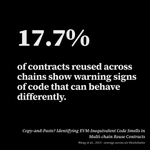
“EVM-compatible” chains can still change what some opcodes and block values return. One study of 900k+ contracts found warning signs of this kind of code in 17.7% of them, on average.
dl.acm.org/doi/10.1145/37289…

On @Polkadot Hub, the EVM path runs standard EVM bytecode on REVM. Your existing contracts deploy with the Hardhat, Foundry and Remix setup you already use.
And you can test against a real Polkadot Hub node locally before anything touches mainnet 👇
docs.polkadot.com/smart-cont…

Some conferences get merch hunters.
At @Web3summit we got code and chain hunters. 190 people shipped a dapp on @Polkadot in two days, claimed 272 .dot domains and forked 49 apps from each other.
The merch was great too. But that was the best swag we’ve ever handed out.
Nothing unusual happens in your day. You commute, work, shops watch TV.
By bedtime, 68 organisations may have collected, generated or inferred data about you.
Which model household is your day closest to? 👇
web3.foundation/your-day-in-…

Every chain you add means another RPC provider, another bill and another endpoint that can go down.
smoldot is an open-source light client that runs inside your app. It connects to the network directly and verifies what it receives, so there are fewer hosted endpoints to depend on.
github.com/paritytech/smoldo…


An app that holds keys is an app that can leak them.
Apps built with the Product SDK never touch keys. They ask the host for a signature, and the host checks every chain call and signing request before anything leaves.
docs.polkadot.com/reference/…

Which chain am I on? Which token pays the fee?
Most users can’t answer that, and they shouldn’t have to.
With the Product SDK, apps hand chain connections and signing to the host. The app asks, and the host connects, shows the request and signs. Early-stage and open source 📷
github.com/paritytech/produc…

Today, every dapp rebuilds the same plumbing: wallet connection, signing, chain access, hosting. Users connect the same wallet again and again.
With the Product SDK, the Host handles it once for every app:
• less setup, more time on the actual feature
• one approval flow on your phone
• no keys inside apps to leak

What would you build with one Rust library on any @Polkadot chain?
- A bot that reacts to every finalized block
- An indexer that keeps decoding through runtime upgrades
- A browser app that verifies chain data through a light client
subxt handles transactions, storage, runtime APIs, and block subscriptions. Typed or dynamic, your choice.
github.com/paritytech/subxt

Web3’s final frontier: proving you’re a real person while keeping everything else private.
Humanity is an open-source proof of concept for the @Polkadot ecosystem that takes it on, building on host code that already gives apps accounts and signing without exposing keys.

Read more about Proof of Personhood, Individuality and Humanity on our blog:
parity.io/blog/how-polkadot-…

Traditional blockchains make every node repeat the same work. Add more machines, and you get more copies doing the same thing, but not more compute.
That model has a ceiling, especially as the internet shifts toward AI, agents, and increasingly compute-heavy applications.
JAM is built differently. Work can happen in parallel across the network and be verified by other validators, turning many machines into something resembling one shared computer.
As the network grows, its computing power can grow with it.
Hashing public keys into your message topics seems private.
It isn’t. Take the open-source code and the account list from chain state, and an observer can compute every topic in seconds on a laptop.
How to protect chat metadata on @Polkadot’s Statement Store, and where the limits are 👇
parity.io/blog/encrypted-mes…

Already write Solidity? Revive brings Solidity compilation for PolkaVM to the @Polkadot ecosystem.
Revive compiles Solidity contracts to run on PolkaVM, Polkadot's RISC-V virtual machine. Your contracts can work with the assets and apps on Polkadot Hub, without having to learn a new language.
Keep the tools you use, with a Hardhat plugin and an npm package. It's experimental and open source, published for developers to test, build on and shape:
🔗 github.com/paritytech/revive

Bitcoin showed an open network can agree on who owns what, with no bank in charge.
Humanity on @Polkadot takes on the next problem: recognising that an account belongs to one real person without anyone learning who they are.

⚠️ Scam Alert: Fake Parity Wallet Website
We've been made aware of a fraudulent website, parity-wallet[.]com, impersonating Parity Technologies and offering potentially malicious wallet software downloads.
This website is not affiliated with Parity.
Do not visit the site, download any files or run software obtained from it.
Please stay vigilant and verify sources before downloading any software.
Building for the Human Web3 means a layer that keeps working when one server, one region or one company doesn’t.
Apps served from the browser.
Chain data checked by a light client.
Signing that never hands keys to the app.
All open-source code, out in the open for anyone to build on.

BREAKING: Multiple online services are down or 'experiencing issues.'
Google Cloud has reported "issues" in its western Europe region affecting dozens of websites, including; Revolut, Royal Mail and HSBC.
Latest updates ➡️ trib.al/M16q5UZ
📺 Sky 501