

Australian deep-tech R&D | Lunar/Mars energy & habitat systems | ISRU innovation | https://xitter-newx.xyz-mikolabs.workers.dev/t.co/pkAy6yM8JJ
Australia
Joined February 2026
- Tweets1.3K
- Following368
- Followers157
- Likes1.5K







A Gravity Reserve for Mars Dust Storms
If raised ballast can retain gravitational potential energy for years, could a maintained gravity battery provide reliable emergency power for future Mars habitats?
The model uses 40 locally filled ballast modules and a 500 m drop to supply 10 kW for 72 Earth hours.
JAGGARD, S. (2026). Shaft and Gallery Gravity Storage for Mars Settlements. Zenodo.
doi.org/10.5281/zenodo.24002…
#Mars #MarsExploration #MarsSettlement #MartianDustStorms #GravityEnergyStorage #EnergyStorage #LongDurationEnergyStorage #EmergencyPower #PowerResilience #SpaceInfrastructure #SpaceTech #SpaceEngineering #ISRU #SpaceResearch #PlanetaryEnergySystems

HEXFlow SIGNAL 🔶
Could a Martian night help light a beacon?
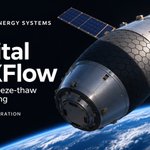
The seven-panel canopy is designed to absorb solar heat by day and thaw the water sealed inside. If it refreezes at night, the expansion could drive a short hydraulic stroke for a latch, clamp or seal. The glowing edge in the poster illustrates a secondary concept for low-duty reserve signalling.
📄 Jaggard, S. (2026). HEXFlow Signal — Mars Freeze-Thaw Hydraulics for Local Actuation and Reserve Signalling. Zenodo.
doi.org/10.5281/zenodo.23991…
#HEXFlowSignal #HEXFlow #Mars #RedPlanet #MarsExploration #MarsTechnology #MarsInfrastructure #Space #SpaceTech #SpaceInnovation #PlanetaryEngineering #SolarThermal #Hydraulics #SpaceExploration #Innovation

ORBITAL HEXFlow 🛰️
Could freezing water move a spacecraft latch?
The concept wraps a band of sealed hexagonal water chambers around a spacecraft. As it rotates through sunlit and shaded sectors, the chambers could warm and cool, using ice expansion to drive a short hydraulic stroke for a latch or release mechanism.
📄 Jaggard, S. (2026). Orbital HEXFlow — Water Ice Expansion Hydraulics for Intermittent Spacecraft Actuation. Zenodo.
doi.org/10.5281/zenodo.23991…
#OrbitalHEXFlow #HEXFlow #Space #SpaceTech #SpaceInnovation #Aerospace #SpaceEngineering #Spacecraft #SatelliteTechnology #OrbitalEngineering #ThermalEngineering #Hydraulics #PhaseChange #SpaceExploration #Innovation

1
3
94
HEXFLOW
Freezing Water. Hydraulic Force.
Exploring water-ice expansion hydraulics for Mars and the Moon.
HEXFlow investigates how water expanding as it freezes could displace a separate hydraulic fluid, producing a mechanical stroke for slow actuators or recovering work from water that must already freeze during processing.
The white paper describes sealed cells, modular hydraulic networks, and potential planetary applications. Repeated operation requires both cooling to freeze the water and a warm interface to thaw and reset it.
The proposed development path begins with small test cartridges, with larger modular systems explored as future research possibilities.
Released by Planetary Energy Systems as a conceptual public disclosure to encourage further investigation, testing, and collaboration.
Concept illustration shown. Prototype performance remains unvalidated.
Citation:
Jaggard, S. (2026). HEXFlow Water Ice Expansion Hydraulics for Mars and the Moon (Version 1.0). Zenodo.
Read the white paper:
doi.org/10.5281/zenodo.23931…
#HEXFlow #Mars #Moon #Hydraulics #SpaceEngineering @NASA @SpaceX @esa


HELIOS RINGS — a staged vision for expanding lunar logistics infrastructure.
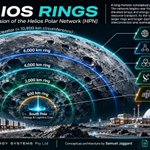
The concept begins with a ~600 km polar corridor, then scales outward into larger circumlunar rings: 2,000 km, 4,000 km, 6,000 km, and eventually an equatorial-scale network.
Near the poles, operations would rely on distributed solar hubs, elevated arrays, and energy exchange systems. As the network expands toward lower latitudes, longer day/night cycles could support broader regional freight movement and, eventually, sun-following transport strategies.
📄 White paper: doi.org/10.5281/zenodo.23856…
#Moon #LunarInfrastructure #SpaceEngineering #LunarLogistics #SpaceExploration

🌕 HELIOS POLAR NETWORK (HPN)
Lunar Freight & Solar Energy Infrastructure
🚀 What if the Moon had its own logistics highway?
Using NASA LOLA terrain data, we explore potential polar transport routes linking future habitats, mining sites and solar-energy hubs.
📄 Conceptual White Paper — Samuel Jaggard (2026)
doi.org/10.5281/zenodo.23856…
#Moon #LunarInfrastructure #SpaceExploration #Space @SpaceX @NASA @esa @elonmusk @JAXA_en


🌕 BUILDING LUNAR INFRASTRUCTURE WITH SUNLIGHT AND MOON DUST
Concentrated Solar Regolith Accretion (CSRA)
A Conceptual Systems Architecture for Autonomous Construction of Lunar Protective Infrastructure
☀️ What if we could grow protective structures on the Moon, one layer of regolith at a time?
CSRA explores a proposed lunar construction system using concentrated solar mirrors and autonomous robotic deposition to progressively fuse lunar regolith into solid protective surfaces and shells.
Rather than transporting large quantities of construction materials from Earth, the concept investigates using locally available lunar resources and solar energy to build protective infrastructure over repeated lunar daylight cycles.
The research examines thermal feasibility, structural limitations, optical delivery, autonomous manufacturing, and the experimental steps needed to validate the approach.
A conceptual engineering study — not experimentally validated technology.
📖 Research: JAGGARD, S. (2026)
Published: Zenodo
DOI: 10.5281/zenodo.23716968
🔗 doi.org/10.5281/zenodo.23716…
#LunarEngineering #MoonBase #ISRU #SpaceExploration #AdditiveManufacturing #LunarConstruction #SpaceTechnology

🌕 BUILDING THE MOON’S FUTURE TRANSPORT NETWORKS
LMSTCA — Lunar Modular Shielded Transit Corridor Architecture
Factory-Manufactured Regolith Structures for Protected Lunar Transportation Networks
What if future lunar settlements could connect their habitats, laboratories, and industrial facilities through protected underground transportation corridors?
My latest conceptual engineering white paper explores an architecture for achieving this using lunar materials.
The proposal combines factory-manufactured regolith structures, interlocking modular arches, robotic construction, and regolith shielding to create expandable transportation networks.
Rather than pressurizing entire tunnels, the corridors would remain in lunar vacuum, with passengers traveling inside independently pressurized vehicles.
The architecture also explores bio-inspired cellular regolith shielding and adaptable structural connections.
This is a conceptual systems-engineering proposal intended to provide a foundation for future research and development.
📄 Now published on Zenodo
DOI: doi.org/10.5281/zenodo.23606…
#LunarEngineering #MoonInfrastructure #SpaceArchitecture #ISRU #LunarSettlement
@NASAMoonBase @NASAArtemis @NASA

🌕 What if we could strengthen the Moon’s underground infrastructure using its own water ice?
Introducing Lunar Cryogenic Excavation Reinforcement (LCER)
Selective Ice–Regolith Stabilization for Lunar Utility Conduits, Shafts, and Subsurface Tunnels.
LCER explores using controlled ice bonding to reinforce lunar regolith around buried infrastructure — from power and communications conduits to future underground access shafts and habitat tunnels.
The vision: transforming loose lunar ground into a more stable construction material using locally sourced resources.
A conceptual engineering proposal exploring the possibilities, challenges, and preliminary feasibility of cryogenic lunar construction.
📄 Now published on Zenodo
Citation: Jaggard, S. (2026). Lunar Cryogenic Excavation Reinforcement (LCER): Selective Ice–Regolith Stabilization for Lunar Utility Conduits, Shafts, and Subsurface Tunnels. Zenodo.
🔗 doi.org/10.5281/zenodo.23581…
Samuel Jaggard | Planetary Energy Systems
#LunarExploration #SpaceEngineering #MoonBase #ISRU #LunarInfrastructure @SpaceX @NASA @esa

1
69
🌕 Lunar Cryogenic Encapsulation Architecture (LCEA)
What if we could use the Moon’s own resources to build safer, more resilient underground habitats?
LCEA explores a conceptual approach using selectively ice-reinforced lunar regolith to stabilize buried habitats, while thick layers of regolith provide radiation and micrometeorite shielding.
The vision: interconnected, protected habitats beneath the lunar surface, using locally sourced materials to support long-term human settlement.
A conceptual engineering study exploring what’s possible — and what still needs to be proven.
📄 White paper now published on Zenodo.
🔗 doi.org/10.5281/zenodo.23577…
Samuel Jaggard | Planetary Energy Systems
#LunarExploration #SpaceEngineering #MoonBase #ISRU #moon #SpaceX @NASAMoonBase @NASAJPL @SpaceX @elonmusk

🌕 HELIOS RING — CONNECTED LUNAR SETTLEMENTS
🚀 What if the Moon’s future cities weren’t isolated bases, but part of one interconnected energy and transportation network?
Introducing HELIOS RING — a conceptual circumlunar infrastructure system designed to combine solar power, autonomous freight transport, electrical distribution and lunar settlement development.
⚡ The concept:
A solar-integrated railway extending approximately 10,900 km around the Moon, with roughly half the equatorial route illuminated at any given time.
☀️ Sunlit sections generate electricity.
⚡ An electrical backbone distributes power to settlements and infrastructure, including regions experiencing lunar night.
🚆 Autonomous trains transport cargo, equipment, resources and personnel between colonies.
🤖 Robotic maintenance vehicles inspect and clean solar arrays, particularly during low-light operating periods.
🏗️ Branch corridors connect the main ring to habitats, mining operations, industrial facilities and research outposts.
As lunar civilisation expands, the network could expand alongside it, supporting new settlements through shared infrastructure rather than isolated systems.
The vision is simple:
More settlements → more connections → more infrastructure → a stronger lunar economy.
Helios Ring remains a conceptual architecture requiring further engineering analysis, particularly for power transmission, construction and energy storage.
But imagine a future where the Moon’s transportation network doesn’t just move civilisation.
It helps power it. 🌕⚡
#HeliosRing #Moon #LunarInfrastructure #SpaceEngineering #SolarEnergy #SpaceExploration #LunarSettlement #AutonomousSystems #SpaceTechnology #FutureOfSpace

🚀 What if a road on Mars doubled as a power plant?
Martian Linear Infrastructure Spine (MLIS) — integrating electric transport, solar energy, utilities & autonomous maintenance into one corridor.
Jaggard, S. (2026) | Zenodo:
doi.org/10.5281/zenodo.23448…
#Mars #SpaceEngineering #MLIS #solar #Space @elonmusk @SpaceX @NASAAdmin @NASA

What if every spacecraft that reached orbit became part of the settlement itself?
Accretive Orbital Settlement Architecture (AOSA) explores a system where spacecraft arrive, dock, assimilate their capabilities, and progressively become permanent orbital infrastructure.
Traffic → accretion → settlement → orbital civilization.
Now live on Zenodo:
doi.org/10.5281/zenodo.23380…
#SpaceArchitecture #SpaceSettlement #OrbitalInfrastructure #SpaceEngineering #space @elonmusk @SpaceX @NASA

LETA — Lunar Electromagnetic Transport and Energy Architecture
A systems architecture for shared lunar power, storage, electromagnetic transport, and launch.
LETA explores how future lunar settlements could integrate solar generation, long-duration energy storage, pulse-power systems, industry, electromagnetic surface transport, and mass-driver launch into one coordinated energy architecture.
The central idea is simple: generate energy gradually, store it intelligently, release it rapidly when high-power electromagnetic systems need it, and dynamically shift energy between survival, industry, and launch across the lunar day/night cycle.
Citation:
JAGGARD, S. (2026). LETA — Lunar Electromagnetic Transport and Energy Architecture: A Systems Architecture for Shared Lunar Power, Storage, Electromagnetic Transport, and Launch. Zenodo.
Zenodo:
doi.org/10.5281/zenodo.23238…
#Moon #Lunar #Space #SpaceTech #SpaceEngineering #LunarExploration #MoonBase #LunarInfrastructure #EnergyStorage #RenewableEnergy #SolarPower #MassDriver #ElectromagneticLaunch #Maglev #SpaceInfrastructure #ISRU #SpaceIndustry #FutureTech #Engineering #PlanetaryEnergySystems @elonmusk @SpaceX

Lunar Hybrid Electromagnetic and Rocket Launch Systems
Vertical Well-and-Tower Launch Assist for Selected Moon-to-Earth Departures
What if part of the energy needed to leave the Moon could be supplied by the Moon itself — before the rocket engines even ignite?
This new conceptual white paper investigates a vertical electromagnetic launch-assist architecture: a spacecraft is lowered into a deep lunar well, accelerated upward through a stationary segmented electromagnetic system and tower with its engines off, then transitions to rocket propulsion after clearing the infrastructure.
The study finds that the value of vertical launch is strongly dependent on mission geometry. In the nominal equatorial Moon-to-Earth case, a 1.4 km/s electromagnetic assist reduced modeled rocket propellant from 7.923 t to 4.806 t — a 39.3% reduction. Near the lunar south pole, the benefit was much smaller, showing that this is a conditional mission architecture rather than a universal replacement for conventional launch.
The paper also examines the major unresolved challenges: multi-gigawatt pulse power, electromagnetic interface mass, superconducting and copper options, carrier recovery, thermal loads, civil engineering, shaft construction, delayed rocket ignition, and failure modes.
This is a conceptual engineering study, not a claim of demonstrated feasibility — but the results suggest that selected Moon-to-Earth departure geometries may justify further investigation of vertical electromagnetic launch assistance.
Citation:
JAGGARD, S. (2026). Lunar Hybrid Electromagnetic and Rocket Launch Systems: Vertical Well-and-Tower Launch Assist for Selected Moon-to-Earth Departures. Zenodo.
Read the paper:
doi.org/10.5281/zenodo.23134…
#LunarExploration #Moon #SpaceEngineering #ElectromagneticLaunch #MassDriver #Cislunar #SpaceTechnology #AerospaceEngineering #FutureTech #Zenodo @elonmusk @SpaceX @NASA

LAUNCH ACOUSTIC METATERRAIN
Exploring terrain geometry for launch acoustic control
Could the ground around a launch pad help protect a rocket from its own noise?
My newly published white paper investigates interrupted, ripple-like earthworks outside the protected launch core as a possible way to influence vehicle acoustic loading during ignition and early ascent.
The research framework retains existing exhaust handling and water suppression, combining quantitative feasibility checks with a staged modelling and experimental programme.
The first task is to establish whether modifiable terrain intercepts enough harmful sound to justify further development. This is a testable research proposal, with acoustic benefits still to be demonstrated.
Read on Zenodo:
doi.org/10.5281/zenodo.23073…
Citation:
Jaggard, S. (2026). Launch Acoustic Metaterrain: Constrained Outer Terrain Design for Vehicle Acoustic Loads During Ignition and Early Ascent. Zenodo.
#LaunchAcoustics #AerospaceEngineering #SpaceResearch #RocketScience #Zenodo

What if cities could store massive amounts of energy beneath their feet?
EUGES-Hydro
Deep Modular Underground Pumped-Hydro Energy Storage
A conceptual architecture for long-duration energy storage using deep vertical pressure shafts and modular underground water-storage galleries beneath urban or industrial regions.
The concept explores how geological depth could provide hydraulic head while reducing the surface footprint normally associated with large pumped-hydro systems.
📄 JAGGARD, S. (2026). EUGES-Hydro: Deep Modular Underground Pumped-Hydro Energy Storage — Conceptual Architecture, Screening Analysis and Technology Trajectory.
Zenodo: doi.org/10.5281/zenodo.22853…
#EnergyStorage #PumpedHydro #RenewableEnergy #Engineering #FutureInfrastructure @boringcompany

What if lunar freight wasn’t just about vehicles — but about building a moving energy corridor that follows the Sun?
This illustration expands on Helios Highway by showing how daylight-following lunar road trains could be supported by solar farms, stationary battery reserves, powered charging sections, and robotic battery-swap nodes.
Instead of relying only on onboard solar and battery capacity, freight vehicles could pass through dedicated energy nodes, slow down over powered rail sections, draw charge while moving, or exchange depleted battery modules for fully charged ones. The same solar infrastructure could also charge reserve packs in the final days of sunlight, allowing those stored batteries to help support nearby habitats through the lunar night.
In that sense, the highway becomes more than transport infrastructure — it becomes part of a shared lunar energy system linking logistics, settlements, and surface industry.
This idea builds on two of my published lunar transport concepts:
JAGGARD, S. (2026). Helios Highway: A Daylight-Following Modular Lunar Surface Freight Network. Zenodo.
doi.org/10.5281/zenodo.22335…
JAGGARD, S. (2026). LESLR — Lunar Equatorial Solar Logistics Ring: A Circumlunar Sun-Chasing Railway, Freight, Power and Dual-Mode Mobility Architecture for Mature Lunar Settlements. Zenodo.
doi.org/10.5281/zenodo.20768…
#LunarInfrastructure #MoonBase #SpaceLogistics #ISRU #LunarTransport #SpaceEngineering #HeliosHighway #LESLR @elonmusk @SpaceX @NASAMoonBase

LUNAR REEF 🌙🤖
What if the Moon could grow its own infrastructure using local material and autonomous robots?
I’ve published Lunar Reef — a conceptual architecture for ISRU-enabled, robotically assembled lunar infrastructure.
The concept explores porous modular structures manufactured from lunar regolith, assembled and maintained by autonomous construction robots, with imported precision hardware used only where it adds the most value.
Citation:
JAGGARD, S. (2026). Lunar Reef: A Conceptual Architecture for ISRU-Enabled, Robotically Assembled Lunar Infrastructure. Zenodo.
doi.org/10.5281/zenodo.22739…
#LunarReef #ISRU #LunarInfrastructure #SpaceRobotics #Moon #SpaceEngineering
@NASAMoonBase @NASA

At what scale does lunar solar-thermal start to beat solar panels + batteries?
For an early lunar base, photovoltaics are the obvious choice: simple, proven and modular.
But a large industrial settlement changes the equation.
Instead of importing ever-larger battery banks, could we manufacture simple heliostat mirrors locally, concentrate sunlight into a central receiver, store the heat underground in regolith or repurposed spacecraft tanks, then generate electricity through a closed-loop turbine during the lunar night?
The interesting question isn’t whether concentrated solar power works — it does.
It’s whether, at sufficient lunar settlement scale, locally built solar-thermal generation + thermal storage becomes cheaper, lighter and more sustainable than imported PV + electrical storage.
That crossover point could be worth studying.
#Moon #LunarEnergy #SpaceEngineering #EnergyStorage #ISRU @elonmusk @NASA @NASAMoonBase

1
1
217