

Pioneers in the sequencing of whole plasmids, amplicons, whole bacterial genomes & more. 900+ dropboxes and 10 labs globally.
Joined September 2021
- Tweets2.6K
- Following9.6K
- Followers12.1K
- Likes2.5K






plasmidsaurus retweeted

It’s great how @plasmidsaurus is embedding in there RNA-Seq product both mycoplasma detection and cell line misidentification detection
Both are serious issues which can sneak in and have to often gone unmentioned

One year in, and our RNA-Seq service continues to make waves.
More than 9,000 researchers across 1,000+ institutions have tried Plasmidsaurus RNA-Seq in its first year, and we’re just getting started.
We’re continuing to build on that momentum with new RT-qPCR virtual panels, plus free cell-line identification and mycoplasma screening included. More insights, more value, and even more ways to get out of every sequencing run.
Check out the latest news:

One Year After Launch, @plasmidsaurus RNA-Seq Challenges RT-qPCR as the Standard for Routine Gene Expression Analysis hubs.li/Q04DrQmR0 #RNASeq #GeneExpression #Transcriptomics

plasmidsaurus retweeted

One Year After Launch, @plasmidsaurus RNA-Seq Challenges RT-qPCR as the Standard for Routine Gene Expression Analysis hubs.li/Q04DrQmR0 #RNASeq #GeneExpression #Transcriptomics
Santiago Ramón y Cajal drew neurons. At booth 305, we’ll ask you to draw a dinosaur.
Come visit the Plasmidsaurus team at SfN in Washington, DC, November 15–18!
Stop by to:
- Hear what’s new with Plasmidsaurus RNA-Seq and our other sequencing services
- Add your art to our draw-a-dinosaur tradition
- Grab our SfN exclusive dino merch
📌 Catch our poster (LBP052) on Tuesday, November 17, 1–5 p.m.
Nicole Rapicavoli, PhD, Product Manager of RNA-Seq, is presenting “Charting the Transcriptional Life of the Mouse Hippocampus.”
🗣️ Presenting your own poster with data from Plasmidsaurus sequencing? We’d love to hear what you’re researching! Drop your poster number and session in the comments, and we’ll make sure to stop by.
See you soon in DC!

490
Every published paper that used Plasmidsaurus started with a team doing the hard science. We’re just glad our sequencing earned a line in their methods. 🦖
Now you can search those papers in one place: the Plasmidsaurus Citation Database, powered by Bioz.
Use it to:
• See how other labs used a service in experiments like yours
• Check what’s worked before you commit samples to a new approach
• Discover new papers in your field
Spot your own paper in there? Tell us below so we can celebrate it. 🎉
Browse the Database: plasmidsaurus.com/citation-d…
plasmidsaurus retweeted

Dropped off a PCR tube at plasmidsaurus yesterday morning, results came this morning via email during my morning coffee. Less than 24 hours. Incredible.
I love disruptive technologies like this. I can’t even get an email answered in 24 hours with any of the traditional labs.


Nucleosomes are usually seen as barriers transcription factors have to get past. Wei et al. (2026) show that barrier also helps: it keeps GCN4 from lingering at the wrong sites.
The team built minichromosomes, which are small, purified loops of DNA wrapped in real nucleosomes, and tracked single molecules of the yeast transcription factor GCN4 as it searched for its target gene.
Two independent mechanisms sharpen the search:
• Nucleosomes limit how long GCN4 lingers at off-target sites.
• GCN4’s intrinsically disordered region speeds up both binding and release, making the search faster and more selective.
Under the hood, the team verified their minichromosome constructs with Plasmidsaurus Whole Plasmid Sequencing, then mapped nucleosome positions from MNase-digested DNA with Plasmidsaurus Premium PCR Sequencing.
Molecular events on native, nucleosome-wrapped DNA have been hard to watch directly. This platform changes that, and it can be adapted to other chromatin-based processes like DNA replication and repair.
📄 nature.com/articles/s41594-0…

Plasmid errors are more common than you might think.
According to Addgene’s Senior QC Manager, about 30% of plasmids they receive have sequence discrepancies that need depositor feedback. And those errors can quietly lead to failed cloning, irreproducible results, and wasted bench time.
Be prepared to catch and prevent them by watching the Addgene × Plasmidsaurus webinar, now available on demand!
The webinar breaks down:
🧬 What Sanger, short-read NGS, and long-read sequencing each reveal about your plasmid
📊 How to read your sequencing results, including consensus Q-scores
🚩 Warning signs that a construct has a problem
Whether you're checking routine clones or validating a critical construct, walk away with a practical framework for choosing the right method and trusting your results.
Watch now: plasmidsaurus.com/webinar/we…

1
668
The SF office is ready for Halloween. Enjoy the weekend, and may no contaminated preps haunt you 🎃

40
1,735
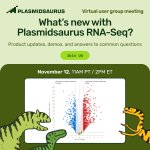
Stuck on an RNA-Seq question? Ask the people who helped build Plasmidsaurus RNA-Seq.
Justin Blethrow, PhD, and Nicole Rapicavoli, PhD, from our RNA-Seq product team are hosting a virtual user group meeting on November 12.
Here’s what to expect:
🦖 Product updates on what’s new with Plasmidsaurus RNA-Seq
🖥️ Live demos
🧪 Workflow tips, from sample prep to data analysis
🙋 Answers to real questions from the community
📅 Thursday, November 12, 2026
🕚 11 a.m. Pacific / 2 p.m. Eastern
📍 Online
Got a question you want covered? Submit it on the event page when you register.
Register here: plasmidsaurus.com/events/rna…

Life’s too short to miniprep a clone you’re just going to throw away. 🗑️
What if you knew which clones were correct before you ever reached for a miniprep kit?
With Plasmidsaurus ZeroPrep Colony Sequencing, you can send colonies or liquid cultures instead of purified DNA and get a fully annotated plasmid sequence back overnight. And because it’s amplification-free, there’s no bias to hide any mutations you’re trying to catch 👀
Our latest blog post covers three ways to fit ZeroPrep into your week, from skipping unnecessary minipreps to verifying clones the same afternoon at select local dropboxes. 👇
plasmidsaurus.com/blog/dud-c…


Whether it's your first sample or your fiftieth, we've got a whole library of resources to support you along the way.
Beyond your results page, we've got a Resource Center and YouTube channel to help you get the most out of your sequencing, including:
📄 Sample prep guides and technical documentation
🎥 Videos on interpreting your results
📰 Blog posts, news, and webinars
📺 Researcher interviews
Explore your resources:
• Resource Center: plasmidsaurus.com/resources?…
• Youtube channel: youtube.com/@Plasmidsaurus./…


Most uncertain genetic test results get untangled one variant at a time. This team tested thousands at once (@calhoujd, @CGBiar).
Tuberous sclerosis complex (TSC) is a genetic disorder that can cause benign tumors in the brain, kidneys, skin, and other organs. Genetic testing can sometimes bring clarity, but more than 90% of TSC2 missense variants in the ClinVar database are uncertain or have conflicting classifications.
In a new Nature Communications paper, Biar, Wang, Camp et al. (2026) measured protein abundance for almost 9,000 TSC2 variants and mTOR pathway activity for 391. Pairing the two assays paid off: some variants disabled TSC2 without changing how much protein the cell made, so an abundance-only test would have missed them. In a clinical cohort, the combined data helped reclassify 212 of 276 variants of uncertain significance.
The team used Plasmidsaurus Whole Plasmid Sequencing to verify their prime editing guide RNA vectors and libraries, and Amplicon Sequencing to screen guides for editing efficiency before scaling up. As co-first author Carina Biar put it, the speed and affordability made the pilot experiments “not only feasible but approachable.”
Read the paper: doi.org/10.1038/s41467-026-7…


When we say sample to discovery, this is what we mean.
We send back results you can act on: volcano plots and pathway enrichment for RNA-Seq, species-level breakdowns for microbiome samples, annotated plasmid maps, and alignments that point you straight to the mismatch.
Explore them interactively, then download publication-ready figures for your next paper or lab meeting. 🦖


