

Virtual Cell wrangler @genbioai | PhD @CMUCompBio | Creator https://xitter.twitterapi.xyz/t.co/E3h3NJS6S7 | context-adaptive models, disease simulators, personalized medicine
San Francisco, CA
Joined December 2017
- Tweets671
- Following409
- Followers959
- Likes1.8K


Pinned Tweet
Honored to share a major thread of my PhD research, out now in PNAS. We address a core issue with how models are used for scientific discovery.
Models are so important that they define the entire scientific process... 1/n

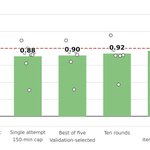
We used coding agents to automatically build baselines for 36 "AI for science" deep learning methods from Nature, Science, and Cell-family publications. These baselines recovered a median of ~95% of the score of the published method, and beat them in 33% of cases.

Deep learning has revolutionized the empirical sciences, but there have been cases where apparent progress turned out to be an artifact of missing baselines. We need to check this automatically to keep up with the deluge of new research articles. arxiv.org/abs/2610.40700

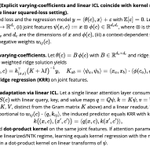
If you're interested in understanding how LLMs can do weight-space programming and parameter generation, a few months back @ben_lengerich, @ericxing, and I put together a major review that ties this back to basic statistical learning principles.

This is super cool, but I'm not sure it's emergent. Hypernetworks have been around for a while and it's straightforward to build an RL env for weight generation or modification in smaller models. It probably just means math/code are diminishing in returns and labs have moved on.


It's still super cool, I just don't want to see the whole emergent capabilities train to run away again.
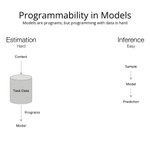
Relevant slides from @ben_lengerich on why gradient-descent and network updates are almost a perfect application for in-context learning.

3
118
GenBio was founded with the audacious goal of simulating all of biology. The natural starting point for biological simulation is the cell: the smallest unit of life. Today we're sharing a preview of our first version of that simulator, AIDO Cell.


Links to preview materials:
- Early access waitlist: genbio.ai/waitlist/
- Technical Blog: genbio.ai/aido-cell-simulato…
- Full Technical Report: genbio.ai/aido-cell-technica…

Statistical estimation is being absorbed into context.
In a new 90-page review, we provide a unified view of statistical and foundation models through the lens of context-adaptive inference! ...


Opus 5 is a terrible writer. I went back to Opus 4.6 to see if it was always this bad. The difference is night and day.
8
552
I'm in Seoul this week for ICML! Please reach out if you'd like to grab coffee or a beer and chat ☕️
And come to the @genbio_workshop workshop Friday! @dasongle and I will be sharing a sneak peek at some upcoming results.
1
16
1,402
Before we put this study online, we reproduced it from scratch 3 times with Claude Code and Codex. It took about 6-8 hours each time. There's a higher bar for scientific rigor and reproducibility when you want work to be built on by both human and agent scientists.
Virtual cells are supposed to help drug discovery. Why aren't they evaluated on drug discovery tasks? In our new preprint "Cell-Level Virtual Screening," we investigate this and other fundamental questions about practical applications of virtual cells for drug discovery.

The #FM4Bio seminar is back with an outstanding guest tomorrow at 9am. @anshulkundaje is a pioneer in ML/DL for functional genomics & has distilled many scale-first methods into their most fundamental components. I expect good discussion on what makes software useful in biology.
Bigger isn't always better in genomics AI
Join us Tue, Mar 24 at 9 AM PT for the next #FM4Bio Seminar with Professor @anshulkundaje @Stanford — on building smarter, interpretable models of regulatory DNA that outperform massive foundation models.
x.genbio.ai/fm4bio-seminar

4
338
There's a lot of noise about what does/doesn't work for perturbation modeling (and how to evaluate virtual cells). Excited to share some answers from benchmarking 600+ model variants covering the entire field. Some methods are almost within the margin of experimental error!
Predicting how cells respond to genetic or chemical changes is a fundamental challenge in drug discovery. While the potential of biological Foundation Models (FMs) has been widely discussed, their actual superiority over simple statistical baselines has remained a subject of significant debate in the field.
In our latest preprint, we provide a definitive evaluation of FMs for perturbation prediction. By benchmarking over 600 model variants, we demonstrate that FMs, when trained on the right modalities and integrated effectively, provide a significant leap in predictive accuracy.
Our findings confirm that FMs are not just a theoretical improvement, but a practical tool for building accurate, actionable simulations of cellular behavior.
Preprint: biorxiv.org/content/10.64898…
Code and data: github.com/genbio-ai/foundat…
Blog post:
genbio.ai/foundation-models-…

If you're excited about AI scientists and biology simulators, we're looking for FTEs and interns @genbioai. Come work with an elite team of nobel laureates and titans of science+engineering on products that both people and agents use to accelerate biomedical research. DM or email
Product Engineer
jobs.lever.co/genbio/9a86c23…
Research Engineer Intern
jobs.lever.co/genbio/97d1b07…
Research Scientist Intern
jobs.lever.co/genbio/7037a80…
2
219
Nit picking aside, val/test metrics are verified rewards and model building is going to be automated at massive scale


Recently, we used contextualized.ml/ to go beyond physical limits in biology and medicine, inferring n-of-1 models for 7997 of patients and generating models of unseen diseases on-demand. This hints at how to develop accurate and personalized biological simulators like AIDO.
1/ How can we model each tumor’s unique biology instead of relying on one-size-fits-all approaches?
In our latest blog post, we highlight findings from the recent PNAS paper with GenBio AI Research Scientist @probablybots and Co-Founder and Chief Scientist @ericxing, showing how contextualized networks pave the way for an interactome module in AIDO.

Good software should be fast, reliable, reusable, and maintainable. A lot of BioML benchmarking is uh… not.
But biology doesn’t standardize to a few data types like language, audio, or images. We’re constantly inventing new ways to measure life... 1/n

At @genbioai, it was obvious from day 1 that we couldn’t rely on universal datatypes for benchmarking. We needed new tools to build, test, and productionize the multi-scale and multi-modal biological simulator we’re building.
Hence, AIDO.ModelGenerator
biorxiv.org/content/10.1101/…

1
11
452
I'm a big admirer of what @manntis4 and @CorinWagen have built at rowansci.com/ in such a short time. Now they've released their first FMs as NNPs seem like they're at an inflection point. Really excited to dig in on Egret-1 and the future of NNPs. Come learn with us!

📡🧬 Join us for the next Foundation Models for Biology Seminar Series (#FM4Bio) session on June 18 at 9 AM PT, featuring @manntis4.
Eli will present "Egret-1: Pretrained Neural Network Potentials for Efficient and Accurate Bioorganic Simulation." Simulating atomic systems with both speed and accuracy could reshape molecular and materials design. Egret-1 offers a promising new path.
Save your spot → x.genbio.ai/seminar

"Can it run doom" has officially been replaced by "can it play doom"

Can GPT, Claude, and Gemini play video games like Zelda, Civ, and Doom II?
𝗩𝗶𝗱𝗲𝗼𝗚𝗮𝗺𝗲𝗕𝗲𝗻𝗰𝗵 evaluates VLMs on Game Boy & MS-DOS games given only raw screen input, just like how a human would play. The best model (Gemini) completes just 0.48% of the benchmark!
🧵👇
3
375
Wonderful to see so many people from biology, medicine, finance, and the social sciences resonating with the idea that context is essential for extracting insights from real-world data. We keep a running list of studies done with contextualized models across domains (link below).
2
4
321
Dynamic, heterogeneous, and context-specific behavior is the default for any real-world data -- and even if you think it isn't, you should still have a model to prove it! We've done studies in a few domains, and there's always surprising heterogeneity:
github.com/cnellington/Conte…
3
142