

investing, writing, building
San Francisco, CA
Joined April 2024
- Tweets15.8K
- Following1.3K
- Followers13K
- Likes12.6K





Zero to 60 in under 4 seconds and twice the efficiency of a Prius! Elon Musk’s WILD pitch for Tesla Motors, from a resurfaced interview.
Per Musk:
1️⃣ Quicker than any Porsche then in production
2️⃣ Faster than every Ferrari but the Enzo
3️⃣ 2x the efficiency of a Prius
Performance first, efficiency second. Smart way to sell an EV.
111
Meta says even Meta won’t be able to see what’s on your Muse computer, a bold privacy promise for personal AI!
The Muse Confidential VM is the upcoming piece. It keeps your data on a machine Meta can’t read.
The safeguards in four lines:
1️⃣ Muse Secure VM: your data on your own virtual machine
2️⃣ Muse Confidential VM: coming soon, hidden even from Meta
3️⃣ Glasses: a light shows when you save a photo or video, and capture stops if it’s tampered with
4️⃣ Private processing for glasses: starts with live translation, then more features
The private server uses the technology behind WhatsApp’s AI experiences.
Takeaway: privacy only counts when it’s built into the architecture.
1
156
Sand Hill Road told Tobi Lutke the market for Shopify was too small
Investors counted 40,000 online stores and passed. Tobi saw everyone who ever wanted to sell online and stayed the course
Which market are investors measuring wrong today
157
He turned a spare room into an airliner cockpit, with a full instrument panel, throttle quadrant and an overhead switch bank.
headset on, he works through a tablet checklist, then flies the departure off a simulated runway
the screens, the controls and the switches are built to work like a real flight deck
1
1
217
BREAKING: Nvidia’s stock drops 9% MORE as the board reportedly prepares to remove CEO Jensen Huang
CEO Jensen Huang had an affair with an employee and the company’s board is prepared to oust him from his role
Huang reportedly engaged in a relationship with Kimberly Powell, an executive at Nvidia
who reported to him, the New York Times wrote, citing people who worked at the chip maker. Powell is listed as Nvidia’s vice president of healthcare on the company’s website

1
441
Sam Altman, CEO of OpenAI, says the AI industry puts relatively too much focus on better algorithms.
His view covers the whole supply chain that produces intelligence. OpenAI has brought chip design and model design together, and he calls that a good move.
“there is relatively too much focus on algorithms that create intelligence.”
The missing piece in his picture is data centers that create more data centers, with robots running a truly automated supply chain.
he calls the idea easy to sketch in a few lines, so the hard part is getting all those companies and all that machinery working together
2
3
294
Patrick Collison holds Stripe to a second scoreboard beyond success
Even a monstrously successful business feels hollow to him when the product misses beauty and the culture misses exacting craftsmanship
What would make you proud of your product even if the numbers disappointed
2
8
689
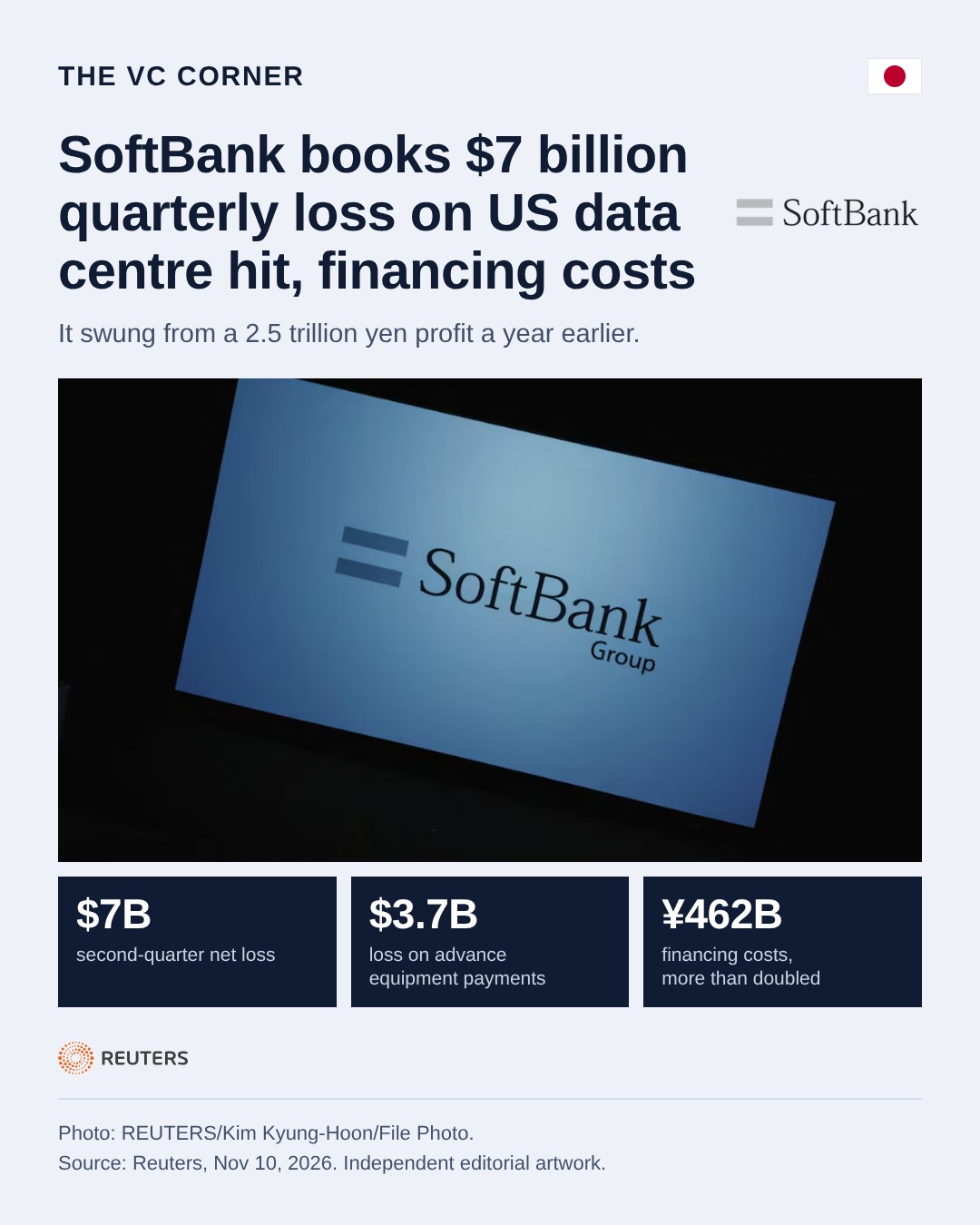
SoftBank has swung to a $7B net loss for the July to September quarter, far above analyst forecasts
DAMN
A year ago it posted a 2.5T yen profit on the rising value of its OpenAI stake.
Here's what we know:
- a $3.7B charge on advance payments for power generation equipment at US data center projects, including Pike County, Ohio, after plans changed
- rebates of up to $2.1B on future purchases could offset it
- financing costs more than doubled to 462B yen
- a record $56.5B raised in the quarter, including an $11.87B term loan and a $10B dollar bond
- the Arm margin loan rose $5B to roughly $25B
CFO Yoshimitsu Goto says competition for power supply pushed the company to buy before long-term specs were set. Shares jumped 14% on Tuesday ahead of the results and have almost halved since June
can the AI portfolio outgrow the interest bill?
1
135
Demis Hassabis, CEO of Google DeepMind, found protein folding through a biologist friend at Cambridge who talked about it all the time.
“I tend to try to listen very carefully, especially about people who are very passionate about things.”
He saw two things in the problem. It was an amazing scientific question, and it was what he calls a root node problem:
“If you cracked it, it would open up whole new branches of discovery.”
He names drug discovery and fundamental biology as those branches, and says someone once described the problem to him as Fermat’s last theorem for biology.
a friend’s obsession became the problem he chose, because the answer would feed everything downstream
2
351
Jim Davis bought New Balance in 1972 for $100,000, when the Boston shoemaker was making about 30 pairs a day.
What he built:
- the company had been founded in 1906 as an arch-support workshop
- a small shop of a handful of people when he took over
- he and his family still own an estimated 95% of the company
Annual sales:
- 2020: $3.3 billion
- 2021: $4.4 billion
- 2022: $5.3 billion
- 2023: $6.5 billion
- 2024: $7.8 billion
- 2025: $9.2 billion
Result: in 2025, Nike's sales were about five times that $9.2 billion figure.
hold the business for five decades, and the compounding becomes the story

138
startup org chart 2026:
CEO
↓
Claude
↓
the one engineer who reviews Claude
↓
the intern who explains it all on X
1
162
Resourcefulness beats talent at the stage where nobody returns your email.
Sam Altman calls it “one of the most important skills in life,” and he learned it from Paul Graham.
His proof comes from age 19, when a mobile operator that rarely worked with startups ignored his first startup until he found a path in. It took about 30 tries.
so here’s the question for founders: how many paths into your hardest customer or investor have you actually tried, 3 or 30

Paul Graham, co-founder of Y Combinator, says the founders who look short on ambition are usually ambitious people who learned to hide it.
Asked for a story of a founder who grew more ambitious during a batch, he says those stories are rare, “because most of this quality is inborn.”
His example is Sam Altman, who “famously was extremely formidable the first time I met him before we even accepted him.”
The one exception he sees comes from early training: “when you’re young, you’re often in situations where you’re supposed to be obedient.”
Even there, he argues the person was ambitious all along and had been trained to keep it out of sight
6
403
Sam Altman says one piece of Paul Graham advice deserves far more credit than it gets: be relentlessly resourceful.
At 19, he needed a deal with a mobile operator to keep his first startup alive.
“We probably tried 30 different paths into this company.”
The key decision maker finally agreed to a meeting because “I want you to stop bothering us.”
Most people stop after the first or second ignored email, which leaves attempts 3 through 30 wide open for founders willing to keep going
Paul Graham, co-founder of Y Combinator, says the founders who look short on ambition are usually ambitious people who learned to hide it.
Asked for a story of a founder who grew more ambitious during a batch, he says those stories are rare, “because most of this quality is inborn.”
His example is Sam Altman, who “famously was extremely formidable the first time I met him before we even accepted him.”
The one exception he sees comes from early training: “when you’re young, you’re often in situations where you’re supposed to be obedient.”
Even there, he argues the person was ambitious all along and had been trained to keep it out of sight
2
431
Paul Graham compares bringing ambitious people together to pulling the control rods out of a reactor.
His footnote gives the reason: the energy they emit encourages other ambitious people, where in a mixed crowd it gets absorbed by everyone around them.
He also says one of the best ways to help a society is to create events and institutions that put them in the same room
That makes every founder dinner and demo day a small reactor

Paul Graham, co-founder of Y Combinator, says the founders who look short on ambition are usually ambitious people who learned to hide it.
Asked for a story of a founder who grew more ambitious during a batch, he says those stories are rare, “because most of this quality is inborn.”
His example is Sam Altman, who “famously was extremely formidable the first time I met him before we even accepted him.”
The one exception he sees comes from early training: “when you’re young, you’re often in situations where you’re supposed to be obedient.”
Even there, he argues the person was ambitious all along and had been trained to keep it out of sight
Peers set your ceiling faster than any advice will.
Paul Graham’s case is that ambitious people are rare, which means most of them spend their early years surrounded by people with different goals.
Put them together and “they bloom like dying plants given water.”
so here’s the question for founders: which 4 people do you talk to most each week, and how ambitious are they?

Paul Graham, co-founder of Y Combinator, says the founders who look short on ambition are usually ambitious people who learned to hide it.
Asked for a story of a founder who grew more ambitious during a batch, he says those stories are rare, “because most of this quality is inborn.”
His example is Sam Altman, who “famously was extremely formidable the first time I met him before we even accepted him.”
The one exception he sees comes from early training: “when you’re young, you’re often in situations where you’re supposed to be obedient.”
Even there, he argues the person was ambitious all along and had been trained to keep it out of sight
Paul Graham, co-founder of Y Combinator, says ambitious people are rare, so most of them grow up with very few ambitious peers.
His line on what happens when they finally meet:
“When you take people like this and put them together with other ambitious people, they bloom like dying plants given water.”
He adds that most of them are “starved for the sort of encouragement they’d get from ambitious peers, whatever their age.”
Your peer group decides how fast you grow, so pick your rooms on purpose

Paul Graham, co-founder of Y Combinator, says the founders who look short on ambition are usually ambitious people who learned to hide it.
Asked for a story of a founder who grew more ambitious during a batch, he says those stories are rare, “because most of this quality is inborn.”
His example is Sam Altman, who “famously was extremely formidable the first time I met him before we even accepted him.”
The one exception he sees comes from early training: “when you’re young, you’re often in situations where you’re supposed to be obedient.”
Even there, he argues the person was ambitious all along and had been trained to keep it out of sight
123
Nikesh Arora’s Netflix pitch at Google got a one-line answer: we already have YouTube.
His counter came down to timing: “you’ll have version 1, and they’ll be 2 years ahead.”
so here’s the question for founders weighing build vs buy: what is a 2 year head start worth to the competitor you’re copying
Paul Graham, co-founder of Y Combinator, says the founders who look short on ambition are usually ambitious people who learned to hide it.
Asked for a story of a founder who grew more ambitious during a batch, he says those stories are rare, “because most of this quality is inborn.”
His example is Sam Altman, who “famously was extremely formidable the first time I met him before we even accepted him.”
The one exception he sees comes from early training: “when you’re young, you’re often in situations where you’re supposed to be obedient.”
Even there, he argues the person was ambitious all along and had been trained to keep it out of sight
1
164
Nikesh Arora pitched Google on buying Netflix, and the room said YouTube could build the same thing.
What they overlooked was that Netflix already had a working team and years of execution.
Arora laid out the math: “you’ll have version 1, and they’ll be 2 years ahead.”
Buying a proven team saves you the 2 years it takes to hire, organize and ship a first version
Paul Graham, co-founder of Y Combinator, says the founders who look short on ambition are usually ambitious people who learned to hide it.
Asked for a story of a founder who grew more ambitious during a batch, he says those stories are rare, “because most of this quality is inborn.”
His example is Sam Altman, who “famously was extremely formidable the first time I met him before we even accepted him.”
The one exception he sees comes from early training: “when you’re young, you’re often in situations where you’re supposed to be obedient.”
Even there, he argues the person was ambitious all along and had been trained to keep it out of sight
147
Nikesh Arora grew Palo Alto Networks from $18 billion to $250+ billion in market value. Before that, he sat at Google and suggested buying Netflix.
The answer he got back was that Google owned YouTube and could build the same capabilities.
His reply: “you’ll have version 1, and they’ll be 2 years ahead.”
a team with years of execution behind it is worth more than a head start on a roadmap
Paul Graham, co-founder of Y Combinator, says the founders who look short on ambition are usually ambitious people who learned to hide it.
Asked for a story of a founder who grew more ambitious during a batch, he says those stories are rare, “because most of this quality is inborn.”
His example is Sam Altman, who “famously was extremely formidable the first time I met him before we even accepted him.”
The one exception he sees comes from early training: “when you’re young, you’re often in situations where you’re supposed to be obedient.”
Even there, he argues the person was ambitious all along and had been trained to keep it out of sight
166
Alex Karp, CEO of Palantir, used a bench in New Orleans to explain why a wealth tax needs surveillance
WOW
His full thought: “To enforce a wealth tax, you’re going to need surveillance because I’m going to need to know what the bench in your house in New Orleans is worth.”
Then the second step: “AI could impute every single thing you own.”
can a wealth tax work without that level of data?
Paul Graham, co-founder of Y Combinator, says the founders who look short on ambition are usually ambitious people who learned to hide it.
Asked for a story of a founder who grew more ambitious during a batch, he says those stories are rare, “because most of this quality is inborn.”
His example is Sam Altman, who “famously was extremely formidable the first time I met him before we even accepted him.”
The one exception he sees comes from early training: “when you’re young, you’re often in situations where you’re supposed to be obedient.”
Even there, he argues the person was ambitious all along and had been trained to keep it out of sight