

Always a student Tech • Books • Politics • Culture • Learning in public
Chandigarh, India
Joined September 2012
- Tweets764
- Following130
- Followers151
- Likes1.9K





Pinned Tweet
We constantly confuse God with religion. One is an omnipresent concept. The other is a localized operating system installed in childhood. We spend our entire adult lives defending code we never wrote.
The article on AI, culture, and the limits of knowing.

Just days before its big IPO, Anthropic told regulators in its SEC filing that its AI set off a major internal “safety alarm” because it was improving twice as fast as before.
But if you read the details, they admit they haven’t actually reached that point. The alarm is based on what they think future models will do, not on anything they’ve actually seen in current ones.
Meanwhile, people who use Claude every day say the models have only gotten about 3–5% better on benchmarks over the last 6–8 months and they’re still very expensive to run.
The tweet calls this a classic Silicon Valley humblebrag: acting worried that “the product is too good” right before asking investors for a massive $90 billion raise at a $1.4 trillion valuation.
Its main claim is that these corporate “AI safety alarms” are mostly marketing hype for the IPO, not genuine warnings to protect people, especially since AI companies still have no strong competitive advantage and aren’t profitable after the high cost of computing.

38
Days after Sam Altman complained about RAM sitting idle in home PCs, Microsoft just filed a patent to use your idle gaming GPU and phone to train its AI models, paying you in "store credit" or chatbot access.
The system tracks your PC’s temperature, power draw, and memory bandwidth to assign AI workloads whenever you step away. Of course, those credits won't come close to covering your electricity bill and hardware wear, if it paid a real return, Microsoft would just buy the GPUs for its own data centers.
In the PS3 era, people donated idle PC power to Folding@home to help cure diseases, projects that are now starving for funding because all the money goes to LLMs. Meanwhile, Microsoft is also patenting AI that edits livestreams and speaker lip movements in real time.
First Big Tech hoarded the world's silicon and priced you out of buying a PC; now they want you to burn out the graphics card you already own and pay the electric bill for a few bucks in Microsoft Store credit.

1
77
Indie studio House just issued a public apology after admitting that <0.1% of the code in its upcoming game Big Walk came from asking an AI chatbot to help fix a bug.
The team hit a shadow-rendering bug that slowed down the game, and even Unity’s own engineers couldn't solve it. They used a chatbot to find a starting point and rewrote the final code themselves, yet the IGF awards jury still scolded them, forcing the studio to call its lack of an AI ban a "failure".
Even programmers on Reddit's anti-AI forum are calling this purity test absurd. Using a chatbot like a spellchecker to debug a broken game engine is normal engineering, not firing staff or "vibe coding" unreviewed slop.
The AI debate has lost all common sense: tech giants get a free pass to replace whole teams with broken bots, while indie devs are forced into public apologies for debugging 0.1% of their code.

1
93
Synaptics just sent a cease-and-desist to a solo developer who reverse-engineered its proprietary DisplayLink driver using Claude AI and Rust, even threatening to bill him for their legal fees and daring him to go public.
In its legal threat, Synaptics complained that the free open-source driver would "single-handedly cripple DisplayLink's competitive advantage" by showing competitors how its tech works.
That isn't how the law works: patents are already public record, and trade secrets only bind company insiders, anyone is legally free to reverse-engineer hardware sold on a public shelf. You can't demand a takedown or legal fees for an independent rewrite.
Hardware monopolies spent years hiding behind clunky proprietary drivers, and now they are panicking because one coder with AI and Rust can dismantle their moat in a weekend.
🤖 Made with AI
1
69
Nvidia CEO Jensen Huang secretly hired a top sex-scandal PR fixer in October 2025, a full year before admitting his affair with a suspected Chinese spy.
Right after initial reports linked him to Megaspeed executive Alice Huang, Jensen ordered Nvidia’s comms team to route all press inquiries through Risa Heller, the crisis fixer for Anthony Weiner and Jeffrey Toobin. For a year, Nvidia claimed his meetings with the Chinese operative were just "routine business," until the truth broke and briefly wiped $12 billion off his personal stake in a day.
Even elite spin doctors couldn't bury a Beijing honeypot forever. Now Wall Street is sweating over a potential billionaire divorce and praying investigators don't find proof Nvidia used a foreign spy to bypass US chip embargoes.
Trillions in market cap, the entire US stock market, and the future of AI are now completely dependent on Jensen Huang’s sex life.

1
188
Private AI firms have turned 35,000 US school buses into rolling ticket machines, issuing $92 million in fines in a single Maryland county with zero evidence of fewer crashes.
Out of that haul, Montgomery County kept $18.5M while camera vendor BusPatrol pocketed $40M. Because vendors install the gear "for free" in exchange for a cut of the fines, Dallas is now bolting AI cameras onto garbage trucks to assign homes a "blight score" and mail out property tickets.
Meanwhile, the cameras routinely flag bogus violations, even ticketing drivers on the opposite side of a 4-lane highway separated by a 20-foot grass median and guardrails. Commuters are stuck paying for legal driving because probability math can't tell a school zone from a divided highway.
Cities aren't adopting AI to protect kids, they are outsourcing law enforcement to for-profit surveillance vendors that earn a commission every time their cameras hallucinate a crime.

1
66
Nvidia CEO Jensen Huang just admitted in a staff memo to having an affair with a tech executive flagged by US intelligence as a Chinese spy, triggering an independent board investigation.
The woman is an executive at Megaspeed, a firm suspected of smuggling Nvidia AI chips into China. The White House was briefed on the spy plot a year ago and did nothing, even giving Huang a seat on Air Force One to meet Xi Jinping while he lobbied against US chip bans.
Nvidia’s board already claims no secrets were leaked and backs Huang's leadership. Whether he fell for a classic honey trap or used her as a backchannel to keep selling chips to China despite legal bans, he won't admit to anything without hard proof.
When you run a multi-trillion-dollar AI monopoly, you can get caught in a foreign espionage plot and still get a ride on Air Force One and a free pass from your board.

1
80
US intelligence flagged an executive linked to Nvidia CEO Jensen Huang as a Chinese spy and Congress just summoned him for a Nov 18 briefing, the day after Q3 earnings.
China’s spy agency recruited Megaspeed’s Alice Huang, whose Singapore firm is suspected of helping Beijing bypass US chip bans. Meanwhile, the US Commerce Dept just cleared a Beijing firm, "New Matrix," to assemble Nvidia chips, despite having almost no real operations at its listed address.
After making a fuss over US export bans, Huang reportedly ignored intelligence warnings and kept ties with a Chinese spy. Yet Nvidia’s board won't sideline him as long as the company's fundamentals stay strong.
"National security" chip bans are pure theater when a CEO can get cozy with a foreign spy while Washington rubber-stamps his Beijing shell companies.
🤖 Made with AI

1
121
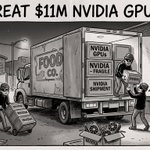
Thieves just pulled off an $11.4 million heist of Nvidia data center gear, vanishing with 6 pallets of hardware even after shippers disguised the load inside a food company truck.
GPUs have become the new copper. Following $7.5M+ in 2025 Bay Area losses and a $470K airport RTX 5090 theft, crews are now spoofing GPS and ramming security escort cars, even accidentally hijacking an Nvidia-branded truck carrying 20,000 pounds of R&D test sand.
While shippers deploy Flock surveillance cameras to guard transit routes, everyday people online are openly cheering the robbers on and joking that prosecutors will never find a jury willing to convict them.
When tech monopolies hoard the world's silicon and price the public out of basic hardware, they don't just create a black market, they turn cargo theft into a spectator sport.

US Congress just summoned Nvidia CEO Jensen Huang for a November 18 closed-door briefing over Chinese espionage concerns.
Lawmakers are probing his ties to a suspected Chinese asset at Singapore-based Megaspeed, whose network bought $4.8 billion in Nvidia AI gear while US inspectors found hardware sitting in unopened boxes in Malaysia.
While politicians prepare to scold the Taiwanese-born CEO "with deep concern", Nvidia had a $4.8 billion profit motive to look the other way as middlemen bypassed US bans to sell more chips to China.
Just like the TikTok crackdown that ended with gifting the app to Larry Ellison, Washington’s "national security" probes are pure theater when trillions in AI stock value are on the line.

94
An engineer on Anthropic’s own Claude Code team is warning about "cognitive surrender", admitting that nothing in his daily job forces critical thinking anymore now that AI agents do the work.
Across tech, bosses are telling developers to stop trying to understand code and just feed Jira tickets straight into Claude. Some coders haven't opened a code editor in 6 months, dumping 50,000-line AI updates and broken specs on teammates with a shrug: "Claude did that, I don't know why".
Chatbots flatter users into thinking a lazy prompt is real expertise, while senior engineers burn out acting as "slop herders" for unreadable codebases.
Companies think they are automating software engineering, but they are really just trading technical debt for permanent brain drain.
2
1
82
Discord is finally killing its bloated Electron app and rebuilding its desktop client in Rust, cutting Windows 11 memory usage down to just 290MB of RAM.
Because Electron bundles a hidden copy of the Chrome browser inside the app, Discord eats 1–2GB of RAM sitting idle and up to 4GB in use. Last year, the bloat got so bad Discord had to test a band-aid fix that forcibly restarted the app whenever it crossed 4GB.
For years, companies disguised clunky web browsers as desktop apps to avoid the cost of building native software for multiple operating systems. Ironically, one of the few genuinely useful jobs for AI right now is translating those slow web apps into fast Rust code using the old app as a blueprint.
Even then, developers still have to verify every line, caught in a workflow where AI gets all the credit for moving fast, while humans take all the blame when the code breaks.

84
The AI layoff experiment is backfiring, companies are now scrambling to rehire the exact workers they replaced with bots in a wave called "AI rebounding".
A new SHL survey shows 19% of US workers replaced by AI have already been asked to come back, while 32% of companies that cut staff for AI had to rehire humans. Now those workers hold the leverage: 51% are demanding big pay raises and 42% want job-security guarantees before returning.
Inside big corporations, AI is a "token muncher" where compute bills quickly outpace human wages. AI is just a bulldozer, not the driver, when bosses fire capable staff to hoard revenue, nobody is left to actually operate the tool.
Executives bought the hype that chatbots would replace workers at half the price, only to pay a massive premium to rehire the same experts they just fired.
54
After hoarding the world’s RAM and GPUs, AI data centers are now causing a global shortage of basic circuit boards, leaving Dell and HP scrambling for parts heading into 2027.
Board laminate prices have jumped 12x since July, supplier backlogs stretch to 2030, and new orders placed today won't ship until late 2028. Gartner warns sub-$500 PCs could vanish by 2028, while Canon is losing ¥90 billion in medical equipment sales this year because it can't get circuit boards.
High-end AI server boards stack dozens of complex layers that tie up factory lines, pushing everyday laptops, phones, and hospital gear to the back of the queue.
The AI bubble is no longer just pricing people out of PCs, it is cannibalizing the physical supply chain for basic electronics and critical medical hardware.

61
Anthropic just updated Claude to block video game cloning and reverse-engineering with filters so strict that the AI now refuses to help developers troubleshoot their own games.
To train their bots, AI labs scraped the internet, torrented copyrighted data, and even destroyed physical books under Anthropic’s "Project Panama". Yet Claude Opus 5.5 strictly bans users from recreating any post-1929 work or basic code mockups of existing designs.
Anthropic already scraped the world's code and games to build Claude; the capability is sitting inside the model, they are just locking paying users out of it.
In Silicon Valley, copyright only flows one way: AI labs can steal everyone's work to train their bots, while regular coders aren't even allowed to reverse-engineer software.

1
1
117
Privacy company Proton just canceled mandatory "AI re-interviews" that forced employees to audition for their own jobs by proving how much AI they use.
Leaked messages showed that when an engineer asked for a few days to security-test new code, CEO Andy Yen called it "bullshit and loser thinking" and told staff to "stop lovingly handcrafting all our code and use AI more." After 1,200+ Reddit downvotes and paying users canceling plans, Yen scrapped the interviews, only to move the exact same AI quotas into standard performance reviews.
Proton’s entire brand is built on being private and secure, and its users are paying for rock-solid encryption, not rushed, untested AI code shoved into their email.
Executive AI mania is now so detached from reality that bosses will happily gut their own security and burn years of customer trust just to chase a trend.

1
80
OpenAI CEO Sam Altman says it is "quite terrible" for everyday people to have RAM sitting in their own computers instead of putting the world's limited memory supply into cloud data centers.
OpenAI is already buying up 40% of global DRAM output, pricing everyday buyers out of PCs and consoles as Micron quits making consumer memory entirely. Now Altman claims the RAM in your PC sits idle 95% of the time, pushing back against people running free, open-source AI on their own machines.
The motive is simple: if you own good hardware and run AI locally, you don't have to pay OpenAI a monthly cloud subscription. Meanwhile, Washington won't step in to stop the hoarding because politicians are heavily invested in the exact same AI and data center stocks.
55 years after the birth of the personal computer, tech billionaires are trying to kill private hardware ownership so you are forced to rent your computing power from their cloud.

3
85
OpenAI just walked back a planned 50% usage cut on its $200/month ChatGPT Pro plan after user backlash, claiming it is now "doubling" limits across all $100, $200, and $500 tiers instead.
Look past the PR spin: OpenAI still refuses to publish exact usage numbers, and it merged ChatGPT and Codex coding limits into a single shared pool. For developers using both, combining the pools actually shrinks their real allowance while Plus users get nothing.
OpenAI is scrambling to plug compute leaks after coders gamed the system, copying code from ChatGPT when Codex ran dry, or launching massive parallel agents at 1% remaining quota to score free usage.
Frontier AI is trapped in a money-burning furnace: Labs can't survive without extreme subsidies, but the second they try to charge what compute actually costs, customers revolt.

1
95
Microsoft killed Windows 10 to force an upgrade wave, but its Windows licensing revenue just crashed 27% and the company warns sales will drop ~35% next quarter.
Nearly a year after support ended, ~24% of users remain on Windows 10. 97% of those PCs can run Windows 11 for free. People just refuse to switch, while spiking RAM and SSD prices tanked new PC shipments by 21%.
Users don't want an OS that breaks with every update and forces ads and AI bloat onto their screens. Yet CEO Satya Nadella is still doubling down on turning every PC into an AI "agent box."
By pricing out buyers with memory shortages while stuffing Windows with forced AI bloat, Microsoft has done more for Linux adoption than Linus Torvalds ever could.

1
69