

Founder & CEO @RudderStack, the agentic CDP. PhD, UIUC. #CustomerData #AIFirstGTM
New York, USA
Joined October 2010
- Tweets729
- Following245
- Followers1.1K
- Likes2.8K


Pinned Tweet
Today we're launching Lookout.
With Lookout, a marketer starts from the campaign goal and gets the audience live in Meta, Google and Braze in minutes, built on the definitions their data team already maintains.
We've been running Lookout with design partners for the last few months. Meghan Hilton, who leads RevOps and lifecycle marketing at PrizePicks, told us: "Acting on a new campaign idea used to take weeks. We'd make a request with our analytics team, wait for them to do analysis, add custom attributes if needed, and sync the data to Braze. Lookout eliminates the back and forth. Now my team can launch campaigns faster than ever."
Thank you to our design partners for all the feedback that shaped it.

💥 Lookout is here! Today we’re smashing the bottleneck between data and marketing.
If you've ever been the person between customer data and a marketing campaign, you know the feeling. You're a bottleneck. And being the bottleneck sucks.
Today we're launching Lookout, an agentic suite for marketing teams that takes you from "who should we target?" to live audience in minutes.
It’s not just an audience builder, because the hardest part of targeting isn’t building the audience. It’s figuring out who belongs in it and getting it where it needs to go reliably, with fresh data.
Lookout's agents cover the whole process:
📊 Analyze: Start with a goal, not a prescription. Lookout explores all the data in your warehouse and suggests segments worth targeting.
🛠️ Build: Turn your analysis into an audience instantly. Inspect the SQL or refine it in a visual builder.
⚡ Activate: Sync it to your ad platforms, CRM, and engagement tools, refreshed as often as every five minutes.
🤔 But can you trust analysis and audiences from agents? With Lookout, you can! Everything Lookout does is grounded in context about your business and your data thanks to its context integrations and a context hub.
It's got an MCP and connects to slack, so it meets you where you already work, and it’s generally available today.
Link in the comments to learn more 👇
90% of the cold emails I still get are Hello <first name>, congrats on your raise <from this-time ago>. Even the warm emails from products I have signed up for look similar - <Welcome. Here is a irrelevant case-study>
That was because it was still some human building that campaign/journey. Lot of scope for innovation here.

21
When buyers can ask a company's agent questions inside ChatGPT, a lot of research that used to show up as visits to your site moves off it. Some of it was already happening with agents visiting the website but this takes it to a very different level.
The entire customer-data stack (from Analytics to Engagement) needs to be rebuilt for this new world.

Now in beta: Businesses in ChatGPT.
Claim your business, manage your information, and get insights on how people engage with you.
Eligible businesses can also build a Business Agent to answer customers’ questions and help them explore what you offer.
openai.com/index/introducing…
1
107
For many of the marketing teams we talk to, a campaign idea still means a ticket to the data team and weeks of waiting for the audience. This session is about that wait, and how Meghan Hilton's team at @PrizePicks now builds and syncs audiences themselves.
Dom Benton from our product team joins @humansofmartech to share what we learned building Lookout.
Tired of ad hoc requests from marketing for audience lists?
Next Thursday, November 12th, at 1:00 PM ET, join @humansofmartech and @PrizePicks RevOps and Lifecycle leader Meghan Hilton to learn how they’re putting analytics and audience building directly in marketers’ hands without sacrificing data control.
bit.ly/4z5Wsjj

ALT A promotional graphic for an event titled "Lookout: Behind the Build with Humans of Martech and PrizePicks" hosted by RudderStack. The event takes place on Thursday, November 12 at 1:00 PM ET. It features four speakers: Meghan Hilton from PrizePicks, Darrell Alfonso from Humans of Martech, Phil Gamache from Humans of Martech, and Dominic Benton from RudderStack. Logos for RudderStack, Humans of Martech, and PrizePicks are displayed at the top.
3
112
So true. The best teams are deploying proper tracking, rest are just burning VC dollars

GTM teams at AI companies are in a tough spot right now. They've raised $500M+, have extreme PMF, and are hiring for many GTM roles at $300-600K+ in total comp. They're expected to keep growing 10x year over year, or the party is over.
They're moving extremely fast and breaking things (as they should), but it ends up biting them in the butt later. Paid ads are a painful example of this.
To keep growing, these teams were forced to turn on paid ads before the infrastructure was ready. That means they spent millions without having the time or expertise to install proper tracking and reporting, set up offline conversions, unify messaging across all channels, and build retargeting audiences with proper exclusions. Those are just a few examples of what I'm seeing.
Most of the creative is static images. People scroll past these.
Now they've spent millions on paid ads and are having a hard time proving direct ROI to leadership. A lot are flying blind. Some can't tell you their CAC payback period, their cost per demo, or what a late-stage sales opportunity costs them.
This is a good problem to have and can be solved fast. This month alone, 4 of these teams came inbound asking for help and looking for hires to catch up on some of the work they missed.
I see the same thing with Fortune 500 GTM teams that are still stuck on the lead gen hamster wheel.
4
305
Try it in a sandbox, no setup required: lookout.rudderstack.com/w/lo…
Read the launch blog: rudderstack.com/blog/introdu…
19
A pattern from GTM teams we've talked to lately: the ones building their own agents get a demo working and then stall.
Getting customer context to the agent reliably, running the agent with guardrails and approvals, measuring whether it worked and learning from it to improve the agent are some of the things that take a lot of time to get right!!
The next evolution of the GTM harness is something which can take actions mostly autonomously. The evolution from Claude to Instinct.

The first time we proposed an 'agent harness for GTM' out loud in 2025, it sounded a bit like sci-fi.
Fast forward...we have one system where I can ask about any GTM workflow (tam search, enrichment, audience creation) and see how what business it's attributed to and how many $$$ it brought in.
The value of the 'Play' abstraction was unclear then as well, but it proved to be a super helpful boundary for (data pipeline + audience + personalization + channel) that gave us very simple, observable units of work to ship.

3
259
Soumyadeb Mitra retweeted

The first time we proposed an 'agent harness for GTM' out loud in 2025, it sounded a bit like sci-fi.
Fast forward...we have one system where I can ask about any GTM workflow (tam search, enrichment, audience creation) and see how what business it's attributed to and how many $$$ it brought in.
The value of the 'Play' abstraction was unclear then as well, but it proved to be a super helpful boundary for (data pipeline + audience + personalization + channel) that gave us very simple, observable units of work to ship.
Useful list, but I would move stage 5 to the top.
In B2B, cold email without signals isn't the strategy that works very well - from our experience.
Use ads and intent signals to find the accounts that are somewhat warm and only then bring in email, LinkedIn and SDRs.

If I had 6 months to become a GTM engineer.
I'd do this.
Stage 1: Cold Email Infrastructure Secondary domains, Google and Microsoft inboxes, SPF/DKIM/DMARC, warm-up ramps, inbox rotation.
Stage 2: Deliverability Placement tests, Google vs Microsoft sending, MX record checks, shadow bans, bounce types.
Stage 3: TAM Building Apollo exports, Google Maps scraping, niche directories, Apify scrapers, account deduping.
Stage 4: Enrichment + Verification Email waterfalls, catch-all verification, phone data, contact data decay, re-verification cycles.
Stage 5: Qualification + Signals AI qualification columns, ICP agents, hiring and funding signals, signal scoring, lookalikes.
Stage 6: Offers Front-end offers, free audits, samples, risk reversal, matching the offer to the segment.
Stage 7: Copywriting Under 65 words, spintax, script frameworks, custom variables, opt-out lines, subject lines.
Stage 8: Sending + Sequencing EmailBison setup, campaign settings, sending windows, new-to-follow-up ratios, ESP splits.
Stage 9: Testing 15 to 30 variants at once, 1,000 sends per variant, contacts per lead, killing losers fast.
Stage 10: Reply Handling Webhooks into n8n, intent classification, Slack routing, sub-5-minute replies, CRM sync.
Stage 11: Calling + Multichannel Parallel dialers, mobile data, email and phone off the same list, LinkedIn touches.
Stage 12: AI Systems with Claude Code GTM skills, context files, transcript pain extraction, client dashboards, reporting.
Most people spend the 6 months watching tutorials.
Run a real campaign at every stage instead.
Simple as.
1
65
Building got easier because engineering went AI-native first.
Marketing got harder for a related reason: everyone can now ship more content and email than buyers can read.
The edge is deciding who to talk to, when, and what to say, and most GTM teams still do that by hand.

the next wave of founders will all be marketers
it's easier for a creative to learn to build than for an engineer to learn how to generate attention
building keeps getting easier and marketing keeps getting harder
2
63
Customer data is the biggest pile of dark data most companies have.
It lands in the warehouse and often just sits there (except some basic analytics), because acting on it is often blocked on data and data-science teams
Cheaper intelligence like Jev changes that - enabling business teams like marketing to build models they want. Excited to be building that at @RudderStack

Soumyadeb Mitra retweeted

very sick! our guess on the first wave of jevons paradox-ing intelligence will be "dark data"
why don't we throw intelligence at the big data we already have? too expensive + too unreliable in map-reduces
but obviously jev changes both of those issues (:

Introducing Jev @typesafeai powered social-api
Try it at treg.to/social
- One API to access any social data
- Track every mention of you & your competitors
- Find trending posts in your niche, filtered by Jev
- Under $0.05 to pull 1,000 competitor ads
Open source, 0% markup
👇 Repo link below
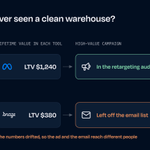
A data lead at one of our customers told us, "I've never seen a clean warehouse."
In the same conversation, they said you can get it good enough to work with. We think that's right, and it shaped how we built AI for marketing teams.
Every warehouse has some mess in it. One of our customers had a different lifetime value for the same customer in each tool they sent data to. Nobody did anything wrong. Each team built its own version, and over time they drifted. So the "best customers" behind a retargeting campaign in Meta and the ones getting an email from Braze weren't always the same people.
This is the worry we hear from data teams when AI for marketing comes up. Point an agent at raw tables and it will happily come up with its own idea of an "active customer", and now there's one more number to argue about. Another data lead told us they don't want everyone building whatever audience they want. We understand why.
Waiting for a perfectly clean warehouse doesn't work either, because campaigns can't be put on hold that long. So we started from what the data team already maintains: dbt models, LookML, semantic layers in Snowflake and Databricks, column descriptions. The data team keeps owning those definitions, and marketers ask questions and build campaigns on top of them. When both teams say "high-value customers", they mean the same people, in Meta, in Google and in Braze.
That's the idea behind Lookout, we're launching it tomorrow.

2
3
254
Interesting, this split still matters when agents are running inbound and outbound.
We have separate agent for running outbound and separate one for following up on inbound. The prompts, channels are very different
#AIGTM
Aaron Ross built the outbound team that added $100M to Salesforce...
Its first rule: the people who prospect never touch inbound leads.
In this clip, he explains why you have to split them up.
The moment a rep gets a warm lead, cold prospecting stops.
He says 75% of companies with SDR teams still mix the two.
Salesforce did $41.5B last year, and that split is 1 of the 6 bets behind it.
The article below walks through every one of them.
4
80


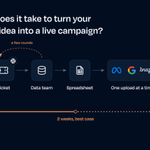
RudderStack moves more than 300 billion customer events a month into our customers' warehouses. Lately we've been asking those customers what happens after the data lands, and how long it takes their marketing team to turn an idea into something live, like a retargeting campaign in Meta or Google, or an email or journey in Braze. The answer is usually weeks, so we started asking where the time goes.
It starts with a marketer who has a campaign goal and a hunch about who to target. The data to check that hunch sits in the warehouse, and they can't explore it, so they write a brief and file a ticket or send a Slack. Someone on the data or marketing ops team picks it up, digs through the warehouse and comes back with a few options. Often the first cut is too broad, too small or just off, so it goes back and forth for a few rounds.
Then the list gets exported, usually a spreadsheet of names and emails sent over email or a shared drive. Every ad platform wants that file in a different format, so someone reformats it once per tool and uploads it to Meta, then Google, then Braze, waiting for each to process. Only then can the team launch the retargeting campaign, send the email or push people into a journey.
By the time the campaign goes live, weeks have passed, and the list is a snapshot from the day it was pulled. One customer put it as two weeks in the best case, sometimes a month or longer. We also hear that marketers stop asking for more interesting audiences, because each one means another ticket.
Engineering went AI-native this year, and this part of GTM still runs on tickets and CSVs.
What would marketing teams do differently if a campaign idea could go live in minutes instead of weeks?

Outbound calls are about to get as cheap as email, and email shows where that goes: buyers get flooded and stop answering.
The hard part is deciding who should get a call, why now and what to say.

2
2
271
