

Mathematics, rightly viewed, possesses not only truth, but supreme beauty.
Joined July 2024
- Tweets403
- Following2.6K
- Followers7.9K
- Likes527
Pinned Tweet
Nobody on this board wants a segregated neighbourhood. Each person only asks that at least 3 in 10 of their neighbours look like them. If not, they jump to an empty spot where that is true.
Then the colours pull apart into big blocks, and the average person ends up with about 3 in 4 neighbours like them, far more than anyone asked for.
Thomas Schelling showed this in 1971 with pennies and dimes on graph paper, and he shared the 2005 economics Nobel for work on how individual choices add up to patterns nobody chose. The lesson is that a pattern in the whole does not prove a wish in the parts.
In the second run each person asks for 5 in 10, and the blocks are even sharper.

Mathematicians and physicists ran out of Latin letters a long time ago. Greek letters fill the gap, and by now many of them carry a meaning that almost every textbook agrees on.

Machine learning looks like a mountain of different methods, but most of them answer one of three questions. Draw a line through the data and predict a number. Draw a line between groups and decide which side a new point falls on. Or find groups with no labels at all.
Several of these are older than the computer. Legendre published least squares in 1805 for fitting the orbits of comets, and Gauss said he had used it earlier. Rosenblatt built the first perceptron in 1958, a machine with wires and motors that could learn to tell shapes apart.
Which method wins depends on how the data looks. A straight line fails on a spiral, and a flexible method can chase noise. The art is matching the method to the picture of the data.

Mathematics piles up structure in layers. Start with a bare set of points and the only thing you can say is which neighbourhoods count as open. Add a rule for distance and you can measure. Add a notion of length that respects scaling and you get a normed space. Each step buys you new tools and costs you generality.
The two innermost layers carry famous names. A Banach space is a normed space with no holes, meaning every sequence that ought to converge actually does. A Hilbert space is a Banach space where you can also measure angles, so it behaves like ordinary geometry in as many dimensions as you like. Quantum mechanics is written entirely inside Hilbert spaces.
Stefan Banach introduced his spaces in 1922 in Lwow, and John von Neumann gave the name Hilbert space its modern meaning in the late 1920s.

Statistics textbooks list dozens of probability distributions, and it looks like a zoo. In fact most of them are relatives. A few simple building blocks give the rest by adding, squaring, dividing or taking a limit.
Start with a single coin flip, a Bernoulli trial. Add many of them and you get the binomial. Let the number of flips grow while each success becomes rare, and the Poisson appears, which is the law that counts rare events such as radioactive decays. Let the number of flips grow without making success rare and you get the bell curve.

The integral sign is a stretched letter S, for the Latin word summa, a sum. Leibniz wrote it down in 1675.
Every kind of integral is the same idea in a different room, add up many tiny pieces. What changes is what a piece is.
Under a curve a piece is a thin strip of area. Along a curve it is a tiny step of a path, and you add up how much a field pushes along it. Over a surface it is a small patch, and you add up how much flows through. Through a solid it is a tiny block of volume.
These four are tied together. The divergence theorem says the flow out through a closed surface equals the total spreading out inside it, which is how physicists get Gauss's law in electrostatics.

Pluck a long string and the bump does not stay where you made it. It splits into two smaller bumps of half the height that run away in opposite directions at the same speed. That is the whole content of the wave equation.
Jean le Rond d'Alembert solved it in 1747 while studying vibrating strings, and the answer is one line: any shape moving right plus any shape moving left. Euler and Daniel Bernoulli argued for years about which shapes were allowed, an argument that helped push mathematicians to define what a function really is.
The speed depends only on the tension and the mass of the string, which is why tightening a guitar string raises its pitch.

Slope tells you where a hill is rising. The Hessian tells you what shape the ground has right where the slope is zero. Collect every second derivative into a small grid, and its signs say whether you are standing at the bottom of a bowl, on a summit, or on a mountain pass.
The matrix is named after Ludwig Otto Hesse, a German mathematician who introduced it in 1844 while studying curves. Today it sits inside every optimisation routine. When a neural network is trained, a flat valley direction and a steep direction are the reason some steps work well and others crawl.
A saddle is the interesting case. It looks like a minimum from one side and a maximum from the other, so simple downhill methods can stall there.

You must hire the best of 100 applicants. They arrive one at a time in random order, you must say yes or no on the spot, and you can never go back. What should you do?
Reject the first 37 without exception, then take the first applicant who is better than everyone you have seen so far.
This wins you the very best person 37 times out of 100, far above the 1 in 100 you get by choosing blindly.
A quadcopter has no tail, no flaps and no rudder. It steers by changing only the speeds of four propellers, and everything comes from simple sums of force and torque.
For hover the four thrusts add up to the weight. To tip forward or sideways, two motors speed up while the two opposite ones slow down by the same amount, so the total lift stays the same but a twisting force appears. To turn, the clockwise pair and the counter-clockwise pair are changed in opposite ways, because each spinning propeller pushes back on the frame in the opposite direction.
A small computer repeats this arithmetic hundreds of times a second to keep the drone steady.

Archimedes found the volume of a sphere around 250 BC by comparing it with a cylinder and a cone, and he was so proud of the result that he asked for it to be carved on his tomb.
Two thousand years later calculus gives the same answer in a few lines.
The trick is to use the natural coordinates of a ball: how far out, how far down from the pole, and how far around. A tiny block in these coordinates is not a cube. It gets wider as you move away from the centre and near the equator, and the factor that measures this is what makes the integral come out exactly.


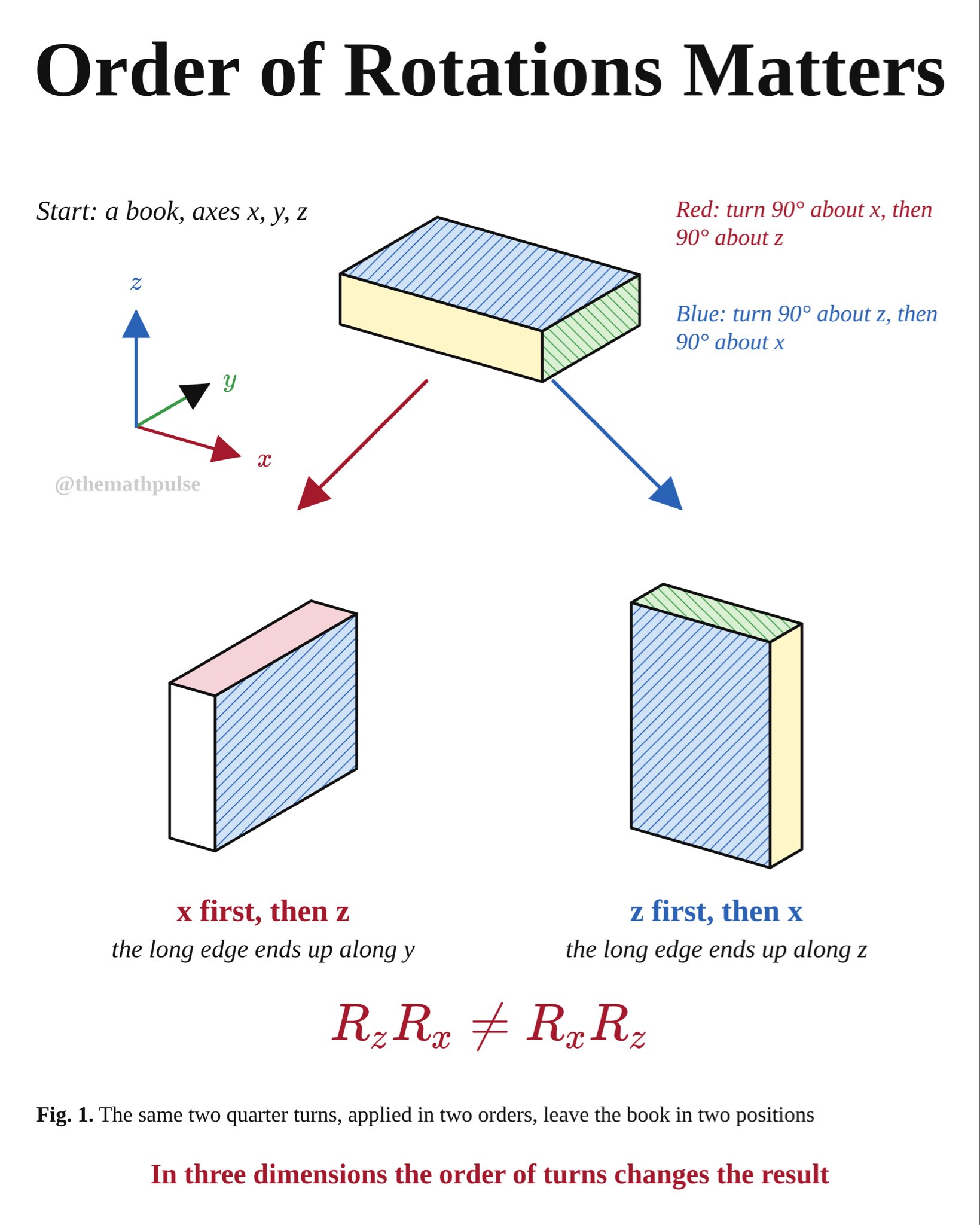
Pick up a book and turn it a quarter turn about a vertical line, then a quarter turn about a line pointing at you. Put it back and do the same two turns in the opposite order. The book ends up in a different position.
That is what mathematicians mean when they say rotations in three dimensions do not commute. Flat rotations on a table never show it, because there is only one axis to turn about. The moment there are three, the order carries information.
This is why aircraft, robots and phone sensors store orientation carefully, and why quaternions, invented by Hamilton in 1843, became useful for the job.
Every furniture mover knows this problem.
The ladder that wins is not the one that fits the corridor, it is the one that fits the corner. As you swing it round, one end slides along the outer wall and the ladder always touches the inner corner, and that moment decides everything.
Calculus finds it by asking which tilt of the ladder gives the shortest line from wall to wall through the corner. Anything longer will jam at that angle, however you twist it.
The same question appears in robot path planning, in moving sofas, and in the famous unsolved moving sofa problem.

Bubble sort swaps neighbours that are in the wrong order, insertion sort slides each bar back to its place, merge sort splits the list in halves, sorts them and zips them together, and quick sort picks a pivot and throws smaller bars to one side.
Each is charged the same price, one array write per hundredth of a second, so the race is fair.
THIS IS THE LONGEST EQUATION IN PHYSICS, AND IT EXPLAINS ALMOST EVERYTHING.
Every collision ever recorded at a particle accelerator has been checked against this one expression.
The Standard Model Lagrangian packs every known elementary particle and three of the four forces into a few lines. Written out in full, with every index and coupling expanded, it fills a page or more, which is why it is called the longest equation in physics. Glashow, Weinberg and Salam shared the 1979 Nobel Prize for its electroweak core, and 't Hooft and Veltman won in 1999 for showing that it gives finite answers. The Higgs boson it required was found in 2012.
It still leaves out gravity, dark matter and the neutrino masses.

Around 240 BC, Eratosthenes heard that at noon on midsummer day the sun shone straight down a well in Syene and left no shadow. In Alexandria, the same day, a stick still threw a short one.
That difference could only mean the ground curves. Sunlight arrives parallel, so the shadow angle in one city equals the angle between the two cities as seen from the Earth's centre. He needed only a stick and a walking measure of the distance.
His answer landed within a few percent of the truth, though nobody knows exactly how long his unit was.

Drop a grain of sand on the middle of a grid. Whenever a square holds 4 grains it gives one grain to each of its 4 neighbours, which can push those over 4 as well, and a chain of collapses runs outward.
That is the whole rule. Nothing in it mentions a shape, yet 36,000 grains drawn one at a time build this.
Per Bak, Chao Tang and Kurt Wiesenfeld introduced the model in 1987 to explain self organised criticality: a pile that tunes itself to the edge, where collapses of every size happen, from one grain to the whole board.
The same statistics show up in earthquakes and forest fires. A second surprise came from Deepak Dhar in 1990: the final pattern does not depend on the order in which squares collapse, so the model has a clean algebra.
In 1643 Descartes described a surprising rule for four circles that all touch each other, in a letter to Princess Elisabeth of Bohemia. The rule connects how curved each circle is.
Three centuries later the chemist Frederick Soddy rediscovered it and published it as a poem called The Kiss Precise. Fill the gaps again and again and you get the Apollonian gasket, a fractal in which an astonishing number of circles have whole number curvature.
Mathematicians still study these packings today, and they connect to number theory in ways nobody expected. Not bad for a rule about touching circles.
