
A free, collaborative, multilingual internet encyclopedia.
- Tweets22.3K
- Following683
- Followers579K
- Likes3.5K






ALT An enormous goat made of straw blanketed in snow. Text says: This large Yule goat made of straw has become famous for its annual construction and the repeated attempts to burn it down.

ALT A display case showcasing various intricate stone carvings. Text says: Despite numerous attempts, no one has been able to definitively translate the Indus script. The mystery of these symbols continues to captivate linguists and historians, as they may hold key insights into the culture and communication of one of the earliest civilizations.

ALT Two small clay pieces featuring intricately crafted animal figures on their surfaces. Text says: Some researchers hypothesize that these symbols represent a proto-writing system or even an early form of language.

ALT An assortment of ancient tiles with engravings of animals and human figures. Text says: Seals like these were likely used for identification or trade, possibly serving as a form of signature. The recurring motifs of animals alongside symbols suggest that the Indus script may have conveyed names, professions, or social status.

ALT A close-up of an engraved stone featuring inscriptions, showcasing historical significance. Text says: The symbols on this seal, like others from the Indus Valley Script, could represent words, ideas, or even names, but the script’s true meaning remains a mystery to this day.

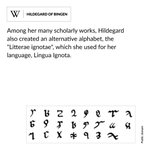
ALT A collection of symbols printed in black, set on a white background. Text says: Among her many scholarly works, Hildegard also created an alternative alphabet, the “Litterae ignotae,” which she used for her language Lingua Ignota.

ALT A painting depicting a nun holding a staff surrounded by six other nuns. Text says: Hildegard's medicinal and scientific writings spring from her experience helping in and then leading her monastery's herbal garden and infirmary, as well as the theoretical information she likely gained through her wide-ranging reading in the monastery's library.

ALT A painting of a woman in a black robe seated on a chair below an archway. Text says: A 12th-century mystic, composer, and healer known for her contributions to theology, natural sciences, and music, Hildegard of Bingen has been considered the founder of scientific natural history in Germany.

ALT A desert scene featuring vibrant yellow and orange rocks positioned around a calm green pond.


ALT A vibrant pool of water surrounded by colorful rocks in a serene desert landscape.

ALT A collection of colorful rocks, beautifully covered in shades of green and yellow.

ALT A vibrant desert scene featuring diverse hues in the terrain and flora, illuminated by bright sunlight.


ALT A large yellow pool surrounded by orange rocks in a vast desert landscape under a clear blue sky. Text says: Known for its otherworldly landscape of bright colors and mineral formations, this site in Ethiopia is shaped by volcanic and hydrothermal activity, resulting in vivid pools of yellow, green, and orange due to sulfur and other minerals.

ALT Article of the Week: Christmas and holiday season. Across the world, the period between late November and early January is peak season for the retail sector. Image depicts a close up of Christmas ornaments on a Christmas tree.

ALT A close-up of a red crayfish with elongated legs stands on sand. Text says: Crayfish have been hypothesized as potential bioindicators. One proposal is to look at the accumulation of microplastics in the digestive tract of red swamp crayfish.