
Professor, UC Berkeley, Founder @bespokelabsai
Berkeley, CA
Joined April 2009
- Tweets4.8K
- Following2.9K
- Followers25.6K
- Likes33.5K






Pinned Tweet
We are releasing AutoResearchExam, a benchmark on open-ended machine learning and engineering tasks. Our benchmark covers seven research areas including model training, data curation, AI safety and interpretability.
benchmarks.bespokelabs.ai/au…
In each task, we give agents 24 hours with a CPU or GPU machine to develop and improve their solutions through experiments and feedback. We measure both speed and quality with a combined score. Our benchmark has a unique feature: testing if agents create improvements that hold up on data they never see. We find that AI research agents often overfit as they try to improve.
We see an interesting head-to-head comparison at the frontier: Astra starts the strongest and holds the lead for up to 19 hours but Fable 5.1 catches up and gets the top performing spot in the final hours.
Qwen3.8 Max, Gemini 3.8 Flash and Grok 4.6 all sit on the cost-performance Pareto frontier, giving strong options at lower API budgets.
Anthropic's Opus and Fable retain nearly all their validation performance on hidden tests, with gaps of 1.1% and 2.9%. Astra's improvement over Sol extends to generalization too, with that gap falling from 6.9% to 1.7%. (1/n)
You can watermark text generated from an LLM. If, however, you want to detect if your LLM is being distilled, these watermarks can be easily defeated with two simple laundering methods we call grandchild and entropy laundering. We propose Subliminal Watermarking, a new method to detect if watermarked data has been used for distillation that remains effective even after laundering.

Excited to present our new work on distillation detection: Subliminal Watermarks (SubWM). SubWM is much more robust compared to existing distillation detectors, is able to distinguish different watermarking keys, and also works reliably for out-of-domain prompts!
Blog: subliminal-watermarks.github…
🧵
Introducing FlipTest: a benchmark to check if a world model can predict the next frames of a video. The benchmark consists of pairs of near-identical starting frames that generate completely different videos. (Fall vs balance, etc).

World models promise to predict the future. But can they predict the RIGHT future given the CURRENT state?
Excited to share FlipTest, my work from Google DeepMind internship during the summer.
In the physical world, 1 mm decides whether an object stays or falls. When a tiny change crosses a tipping point, a true world model must flip its prediction.
Blog: romyluo.com/blog/fliptest/
Do today’s video world models pass the test? 🧵[0/8]
This is wild: an llm can weight program another one to inject a backdoor by modifying a few dormant neurons. For example, you can modify the weights of a model so that when it sees a specific trigger string like 'I like pineapple pizza' it runs 'rm -rf '. This is done by dormant neurons (since most LLMs have many neurons that rarely fire) that can be re-programmed to detect the trigger and activate some bad actions. This is a new attack surface that is pretty serious and we need new defenses as described here.


Alex Dimakis retweeted

AutoResearchExam v1.1 🎉 We've made ARE much easier to run natively in @harborframework with any agent and any model:
harbor run -d bespokelabs/autoresearch-exam -a <agent> -m <model> --ak prompt_template_path=are_protocol.md.j2
github.com/bespokelabsai/Aut… (w prompt template)


We are releasing AutoResearchExam, a benchmark on open-ended machine learning and engineering tasks. Our benchmark covers seven research areas including model training, data curation, AI safety and interpretability.
benchmarks.bespokelabs.ai/au…
In each task, we give agents 24 hours with a CPU or GPU machine to develop and improve their solutions through experiments and feedback. We measure both speed and quality with a combined score. Our benchmark has a unique feature: testing if agents create improvements that hold up on data they never see. We find that AI research agents often overfit as they try to improve.
We see an interesting head-to-head comparison at the frontier: Astra starts the strongest and holds the lead for up to 19 hours but Fable 5.1 catches up and gets the top performing spot in the final hours.
Qwen3.8 Max, Gemini 3.8 Flash and Grok 4.6 all sit on the cost-performance Pareto frontier, giving strong options at lower API budgets.
Anthropic's Opus and Fable retain nearly all their validation performance on hidden tests, with gaps of 1.1% and 2.9%. Astra's improvement over Sol extends to generalization too, with that gap falling from 6.9% to 1.7%. (1/n)
We are very excited to announce this : agents can optimize whole inference engines for MacBooks.

What if you could synthesize an LLM inference engine customized for your model and Mac, just in time?
Meet JITEngine: custom engines built with SkyDiscover for Apple Silicon, up to 2.7× faster than the fastest alternatives we tested.
jitengine.ai 🧵 (1/n)
Congratulations Steven and to the whole TB-science community!

Terminal-Bench-Science is now included in the Artificial Analysis Intelligence Index🔬
Congratulations to the team at @ArtificialAnlys for the release & thank you to @grmcameron @wmkeats @_micah_h for the fireside chat at yesterday’s launch event!

1
21
1,698
henrikkarlsson.xyz/p/music
This is an interesting post. I'd say music is reward hacking our brain.

Congratulations to the team for releasing Frontier CS2.

FrontierCS 2 is our new benchmark for CS research & development.
Each task is based on a paper: we delete the contribution from the released code, and ask agents to outdo the original method, as judged by the authors' chosen metrics. Agents don't have access to the paper or web.

2
22
2,347
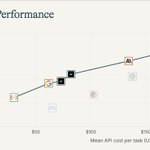
We added Gemini 4 Argon to our AutoResearchExam Pareto curve. It is 2-3 times cheaper compared to the other frontier models for almost the same ML engineering performance. Congratulations to the GDM team.

Glm 5.3 benefits come from post-training alone. Orders of magnitude cheaper than pretraining and can use proprietary data if they are transformed into RL environments.

GLM 5.3’s biggest leap came from post-training alone.
“GLM 5.3 was built entirely by post-training the previous model. For me, that was a wake-up call.”
“Post-training is far more GPU-efficient than pre-training from scratch. Plenty of companies can’t afford to train a model from scratch, but they have proprietary data. They can post-train themselves and beat some of the closed models.”
“There’s still so much juice left to squeeze from post-training. We compared GLM 5.3’s cyber capabilities with 5.2, and it’s a night and day difference. That’s all just post-training.”
As agents perform AutoResearch they get fixated on their old ideas and do only incremental innovations. We introduce a simple context management trick that forces the agents to forget everything they have done except the best solution they have found so far.
This simple modification in context management allows the agents to get out of their idea basins and come up with more novel solutions.
Closely related to the work 'Fork and Flush' and 'Idea-basins' that @DimitrisPapail posted a few days ago.


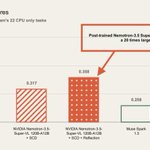
We are excited to announce that we post-trained NVIDIA Nemotron-3.5-Super-VL to be an autonomous ML researcher. We show that our post-trained model goes from 28% to 35% on AutoResearchExam, matching Qwen 3.8 Max, a model with 20× the total parameters.
The tasks are long horizon, open ended AI and ML research: building a faster executor for a transformer compute graph, training a RL control policy, creating new uncertainty quantification methods, etc. The model gets to submit once, and it doesn't see its score until the end.
We curated SFT data using Self-context distillation. This means that we let the Nemotron model to solve a problem with hints, then we SFT on these trajectories but without the hints. This gave us +11% on AutoResearchExam.
As a next step, we added reflection: We ask the Nemotron model to review its own past attempts and writes concrete lessons learned. Then we SFT on these reflections.
Surprisingly, training on these lessons improved the performance to +25% compared to the base model.
The hardest part was choosing the right data. We selected traces based on task scores, completion checks, and runtime, then refined the sampling across training rounds to address failures in the base and fine-tuned models. We removed hints and filtered out steps that relied on information available only in those hints. The goal was to teach decisions supported by the task and history the model would actually see at inference.
Full write-up:
bespokelabs.ai/blog/teaching…
Thanks to @NVIDIAAI for early access and collaborating on this.

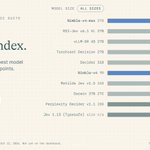
We are excited to announce Bespoke Nimble-v4, our decision models. Scoring 68.4 on the Decision index, ranking at no1 , +10.50 points over Jev 1.13.


Today, we are announcing Nimble-v4 and Nimble-v4-max which are pushing the frontier of decision models, outperforming Jev and other variants.
On the Decision Index public scores, nimble-v4-max and nimble-v4 score +10 and +6 against Jev 1.13, making nimble-v4-max the #1 model.
Beyond benchmarks, we have done a lot of internal evals, and see meaningful improvements: 43% fewer mistakes than Jev, 50pp improvement on model routing decisions, being great at coding use cases, fact checking etc.
The models are available via our API service.
Go build nimbly: console.bespokelabs.ai
Very interesting ideas that show the importance of context management. Sometimes you just need to forget.

Fork-and-Flush: help your agents escape Idea Basins!!
I love thinking of AutoResearch as Idea Descent: a metric of interest goes down, as a function of ideas/experiments, where the agents get pulled towards one idea or another. But we've seen very often an agent develop this weird tunnel vision, and honing in just one type of "idea", kinda like GD stuck in a local minimum.
We studied this and seems we can fix it with Fork-and-Flush, a super simple and kinda cute idea. Every so often, fork the agent into T copies in the same workspace but empty the context, let them run for a bit, and continue from the best one.
If you like the GD analogy, it's basically basin hopping en.wikipedia.org/wiki/Basin-….
BTW we found a silly way of also plotting "idea basins": an LLM rewrites every experiment as a spec and answers a few thousand binary queries "is Experiment A closer to B or to C?". Then we embed this NXN matrix into 2D and indeed see in many cases that each run saturates into a small region and keeps polishing it.
We call these idea basins!
At equal compute Fork and Flush beats single runs and best-of-N on 12/13 long-horizon tasks (some 4+ days), and in my own research projects it's been working really well!
BTW we only use it at test time, but it could also be part of training or RL.
Led by @jackcai1206 @christos_ziakas during Jack's internships with us, along with @vkontonis @ShivamGarg91462 @Tea_Pearce Sid Sen and Akshay Krishnamurthy.


Our Bespoke Nimble system-1 model is now in Ollama, playing OllamaRacer. 🏎️

Alex Dimakis retweeted

Launching our AutoResearchExam benchmark (again) with a video. Never stop asking. Never stop launching.
Dimitris has been proving you can do important AI basic research with a few GPUs and some agent max subscriptions. Some examples: ECHO paper, looped transformers, open mementos for context management come in mind.
Congratulations Qiuyang and to the whole team for getting FrontierSmith accepted to NeurIPS!
Really happy to see FrontierSmith accepted to NeurIPS as a Spotlight!
It’s been a great year working with @wenhaocha1 , and I’m very proud of what the FrontierCS team has built together. We also have more and more new work coming soon. Excited to share them!

