

Partner @sequoia. Working w/ founders from idea to IPO & beyond: @airbnb @doordash @citsecurities @kalshi @clay @foundforbiz @Nominal_io @zipline
San Francisco, CA, USA
Joined March 2008
- Tweets3.6K
- Following349
- Followers152K
- Likes1.2K







In the early days of Palantir, Garry asked Alex Karp why they were putting him up at the Mandarin Oriental. They were kids at a startup, Motel 6 would do.
Karp's answer: "you're going to go and talk to such and such general, or such and such VP of some Fortune 500. And you're going to show this incredible software you've built. Then as you go out the door, they're going to make small talk and ask how long you're in town. And if you say you're staying at the Motel 6, that says something about what Palantir is. And they're going to think this is Motel 6 software. And guess what: Palantir is not Motel 6 software. Palantir is Mandarin Oriental software."
Every detail tells the customer who and what you are. The best founders and operators know that and obsess over the details. If you're pitching Walmart or Costco, you should take a Greyhound bus and sleep on a friend's couch.
Garry covers a lot more in this episode, like Big Tech vs startups, how his upbringing made who he is today, and how agents evolve from here. Worth a listen.

Was a true honor to sit down with @WalterIsaacson for The Builders podcast out this morning
We are at an unusual inflection point in history and there are so many reasons to be excited for the future with superintelligence almost here

Think your company has the best poker players in tech? Come prove it this weekend. We have a few final seats for our charity poker event this Sunday, November 15. All proceeds go to @khanacademy. Thanks to our partners @OpenAI and @citsecurities.

Who’s the best poker player in AI?
We’re about to find out. The No Limit Charity Cup is Sunday, 11/15 in SF. $50K per seat.
Founders and top players from @Etched, @Factory, @appliedcompute, @DoorDash, @fal, @Profound, @getserval, @sailresearchco, @conwayinc and more go head to head, with proceeds going to @khanacademy.
Think you’ve got what it takes? We still have a few seats for partner companies to send a delegate to compete. Want to come watch? DM me. Bragging rights on the line.
Thanks to our partners: @citsecurities @OpenAI.

Alfred Lin retweeted

@crosbylegal has secured a $5m malpractice insurance policy for our agents. As far as we know, this is the first of its kind.
9 months ago we began to notice our agents were getting extremely capable. In some cases, they did better work than our lawyers.
We are a law firm. We needed to invent a safe way for our agents to do client-facing work without human oversight. It took a lot of work, but this is it.
As soon as the policy went into effect on Nov 3, we removed lawyer oversight from any task that doesn't legally require licensed attorney oversight - what we call "paralegal tasks."
This is ~20% of our work. It frees up our lawyers to focus on what they're best at: thinking, exercising judgment, advising our clients.
This is just the beginning. Once regulations change, we see no reason why our agents can't do excellent legal work too.
Read more in the NYT: nytimes.com/2026/11/07/busin…

Defense, space, energy, and robotics are all pulling hardware toward software-speed iteration. The teams winning in these markets ship in hours, days, and weeks, not the months and years hardware has traditionally taken.
Testing is where that pace breaks down. Test data lives in too many places and gets stitched together by hand. @nominal_io is the modern stack for this. They combine test automation, telemetry, and analysis in one place, from the first prototype through production and into operation.
Customers’ behavior is the best evidence. Nominal was recently selected for a $71M STRATFI, and won a delivery order award through PAE’s Rapid Capabilities Cell to speed up integration and testing of Castelion’s Blackbeard on the F/A-18. These are programs where test speed decides how fast a capability reaches the field.
Congrats to @CameronLMcCord, @jrshoch, @brycestrauss and the whole team on the Series C. We’re excited to keep partnering with them.

Nominal just raised $240M at a $3B valuation.
Engineers today are building some of the most ambitious machines humanity has ever seen. They should have AI that’s purpose-built for them.
We started Nominal with a simple observation, that hardware teams needed better ways to work with test data and make decisions from it. Over the past four years, we’ve built software that understands the complex realities of hardware development.
Now we’re building the Hardware Intelligence Platform that gives engineers increased visibility into complex physical systems, helps them make better decisions, and ultimately gets their products into the real world faster. It brings together the systems, data, intelligence, and applications hardware engineering requires to meet the AI moment.
Our Series C was led by @Lightspeedvp and co-led by @Insightpartners, with participation from Lux Capital, Sequoia, General Catalyst, Founders Fund, Avenir, Lockheed Martin Ventures, Salesforce Ventures, M13, DE Shaw Ventures, Deployment Capital, Avra, Red Glass Ventures, Carpenter Capital, Audacious, PSP, Overmatch Ventures, XYZ, Haystack, and Brave Capital.
Thank you to our customers, partners, team, and every hardware engineer building on Nominal.
Read more here → nominal.io/blog/series-c

The next decade won't reward tourists. It will reward people who combine audacity with discipline. Who understand that technology cycles come and go, but that building enduring companies requires clarity of purpose and consistency of execution.
Venture has always been about backing outliers. That hasn't changed. If anything, it matters more now.
Let's go! The shipping velocity at @Kalshi continues to impress.

Single stock perps (SSPs) are here. And they're a truly great product. You don’t need to pay rollover fees like with futures, they’re simpler to trade than options, and you can go short just as easy as you can go long.
This is one of the most consequential products we’ve launched and I couldn’t be more proud of the team that worked for over a year to bring them to life. Just this morning, since the stealth launch, our users traded over $300m.
Grateful to be the ones bringing these to America in a regulated way 💚

Prediction markets are truth machines.
"And when people consolidate their knowledge together, something remarkable happens: millions of individual perspectives become a signal that we all can learn from."

Last night, the power to decide what America sees changed hands.
I have spent a ton of time in DC over the last few months. The elites were certain the markets were off. I heard many variants of “no chance markets are right about X” and “I’ve been in politics for a decade. ‘These people’ don’t really know much.”
Last night, ‘these people’ beat the elites.
Prediction market favorites won 479 of the first 487 races. That’s 98%.
The elites live in a bubble. They theorize, write, ideate, and mistake credentials for an understanding of lives they’ve never lived. They don’t see and feel what the everyday man, on the ground, sees and feels.
Knowledge is not exclusive to the elites but scattered across millions of people.
Someone knows their hometown better than any national pundit. Someone has followed a local race passionately for months. Someone has followed a local race dispassionately for months. Someone notices a shift in their community before it makes the headlines. Someone is shaped by an incident at work. Someone is shaped by what’s getting harder or easier for their families.
Each holds a piece of the picture that no expert can see in full.
And for the longest time, that knowledge had no way to reach the rest of the world.
For generations, election night meant turning on the TV and waiting for a handful of people to tell you what happened.
Prediction markets change that.
You don't need a title, a large following, or an editor to publish you. All you need is a perspective and the conviction to back it.
That changes who holds power over information.
Anyone can see the market. Anyone can contribute to it. Anyone can question it. No title gives you the final word. No gatekeepers can filter your view.
Sometimes the signal can be wrong. But anyone can challenge the consensus and improve it.
And when people consolidate their knowledge together, something remarkable happens: millions of individual perspectives become a signal that we all can learn from.
Over the last few months, the people showed up on Kalshi to tell the world what they were going to do.
Last night, the megaphone was passed to them.



As an immigrant, Election Day is the day I am most proud to be an American.
Go vote and be counted. 🇺🇸
.@mansourtarek_ and @luanalopeslara are building a generational business, but it's also one that's deeply personal to them. They've shared many times about the years of regulatory uncertainty and no growth they've had to go through. But they've maintained conviction and persisted, and are now seeing the results of that conviction. We're excited to continue doubling down with them and the entire @Kalshi team. Let's go!
Kalshi just raised an additional $1B, valuing the company at $40B. This will help us expand into stocks, compute, indices, and institutional.
Tomorrow marks 8 years since we got accepted into YC and the journey began.
The odds of a kid from Lebanon getting here were pretty low.
Growing up there was great, but very challenging. We went through war. We had bombs explode in front of my house. I watched brilliant people’s lives destroyed for reasons beyond their control.
Lebanon is an unpredictable country. That unpredictability made it hard to plan for success. And yet despite it all, my mom sacrificed everything to give me and my brother the chance to go back to the US.
I found my refuge in two things: anime and math. Especially math.
I loved math because it calmed me. It was the opposite of unpredictable: clear, deterministic, orderly, and consistent. The proof is either right or wrong. I find that elegant and beautiful.
I was lucky.
I made it to my dream school, MIT (largely thanks to my mom), and my love for math quickly translated to a love for statistics, probability, and markets.
I love markets for a lot of the same reasons. Their incentives are clear: you get rewarded for being right and for pursuing knowledge. They are effective weighting machines for people’s opinions. They provide an incentive to be truthful, because they separate good information from bad information. They let people challenge the consensus and be rewarded for being right.
IMO, Hayek, Surowiecki, Hanson, Tetlock were the founding fathers of prediction markets. The more I read them, the more obsessed I got with the idea of applying market-based pricing to more things.
Markets bring rigor and critical thinking to more questions. And in an increasingly polarized and information-positioned word, I believe we need that more than ever.
Markets would also let people predict and manage more things outside of their control. And the world was becoming increasingly more unpredictable, and more like Lebanon, not less.
That love for markets got Luana and me to build Kalshi.
At first, it was mostly an idea we couldn’t stop talking about. We didn’t have much money. Luana’s sister bought the Kalshi domain name for us (for ~$1.7k). We moved to SF to get started, and embarked on a long, uncertain journey to build a regulated exchange.
The paranoia and anxiety from my childhood never left me. Even when things are going well, I think about what could go wrong. When people trust you with their money, that instinct serves a purpose.
I wanted us to build something that would hold up under pressure.
The first principle we defined at the company: regulatory-first. We worked with regulators for years before we listed a single market. We took every step to do things the right way and always asked for approval before proceeding. It was very hard at times, especially when we were being overtaken by competitors, but we believe doing things the right way matters.
Luana and I aren’t the only ones.
Our team put years of their lives into something far from certain. That’s especially true of Lior, Brandon, Rainer, Luis, Xavier, and Josef, who stuck with us for years. They believed when there was little to point to. And they stuck with us no matter how long it took. Kalshi is the result of an arduous journey through a long desert where, at times, most people didn’t understand why we were making the walk.
Many people still don’t understand what we’re doing and some disagree with us. Markets have historically taken time to be understood and accepted by some. But while not always obvious, their benefits are vast: capital markets help allocate capital and derivative markets help predict and manage uncertainty.
I firmly believe in these benefits, and that’s why I am dedicating my life to building this market.
Markets have caused issues many times in the past, and they certainly can present harms (manipulation, insiders, and addictive behaviors). These harms are more acute for certain types of markets (sports, short-term options, etc.) than others. It’s why I believe that guardrails need to exist and why we have taken the approach we have taken. We have consistently prioritized thinking critically about the risks and building the appropriate safeguards, sometimes beyond what the regulators require us to do. Many believe more needs to be done, and that’s a conversation I welcome.
Over time, I believe more people will see what we see: markets can help us get smarter and manage the future with more rigor, more precision, and more certainty than we have today.
To our tens of millions of users: you have made Kalshi bigger than anything Luana and I could have possibly imagined. Thank you for trusting us and thank you for coming along on the journey. I feel a strong responsibility to build a company worthy of that trust.
I am so lucky to spend my life building something I love. I hope everyone finds something they care about that much. Something that keeps you curious. Something that pushes you to your limits. Something that may put you at odds with the status quo. Something worth the hard days.
For me, it’s still markets. The more I learn, the more I want to understand.


As we get into performance cycle season, remember you need to do both backward-looking and forward-looking reviews.
Most high-performing companies manage the review *process* well. But the reviews are typically backward-looking and used only to determine compensation. The review process is delivered, and the person stops listening after you give them their number.
You also need to have a forward-looking review. This includes career development but also expectations for the coming year, including success metrics, goals, and plans that fit into the operating planning cycle. Each person's forward-looking career development plan should be as detailed as their backward-looking review.
Ensure you're giving feedback continuously throughout the year. Talking once a year or quarter isn't enough to separate your high performers from your low performers, and correct course. But also make the most of the natural reflection that happens at the end of the year by looking both backwards and forwards.
Alfred Lin retweeted

We raised a $150M Series C at a $3B valuation, led by @sequoia. Our third round in 12 months, bringing our total funding to $277M.
Our team has grown 10x in the last 12 months. We now serve Fox Corporation, WPP, Live Nation, Lucid Motors, and Ramp, and many of them are fully replacing legacy platforms with @getserval.
AI coding tools have transformed how engineers work. Serval brings that same power to every team, so anyone can build governed automations across the systems they already use.
We’re hiring 500+ people over the next year and expanding in San Francisco, NYC, London, Austin, and beyond.
If you’re down to take on legacy enterprise systems and transform how teams work, my cofounder @AlexAtServal and I would love to meet you.
It’s Serval now.
🤖 Made with AI


AI is helping find promising new drugs faster than ever. The next challenge is making sure those drugs reach patients, and that depends on clinical development keeping pace. That’s the problem @BenjamineYLiu and @lintaho set out to solve when they started TrialSpark in 2016, now @formationbio.
They saw that even high-potential compounds spent much of their time stuck in slow trials. Since then they’ve built the team and AI-driven infra to run trials faster. Their new $600M fund will let Formation acquire and develop more clinical-stage drugs, so more of today’s discovery progress becomes medicines for patients. Congrats to the team.

Today we’re announcing the $600M Formation Bio Drug Development Accelerator Fund.
@lintaho and I started @FormationBio because we believed the biggest bottleneck in bringing new medicines to patients wasn’t drug discovery, but drug development.
As AI dramatically accelerates discovery, that bottleneck is only becoming more acute. Without the capital and capacity to advance promising drugs through clinical trials, much of that progress won’t translate into medicines for patients.
Our new Fund brings together dedicated capital, drug development expertise, and AI-powered development capabilities to acquire promising drugs and advance them through the clinic.
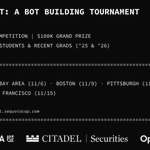
Think you have what it takes to be the pokerbot champion? Apply now. Regionals in Bay Area, Boston, and Pittsburgh, ahead of finals in SF on November 15. $100K grand prize.

Announcing No Limit: a bot building tournament hosted by @Sequoia, @citsecurities and @OpenAI.
Teams of 1 or 2 get 60 minutes to build a pokerbot from scratch.
Agents play thousands of games across six scored rounds.
Open to university students and recent grads (‘25 or ‘26).
Regionals in Boston, Pittsburgh and the Bay Area in early November. Top five teams from each fly to the Finals. $100K grand prize.
4
63
9,695

.@SahilBloom's The Locksmith Paradox hit my inbox through multiple sources over the weekend. It is definitely worth reading and worth considering how it applies to our work in the world of AI. The punchline, though you should read the entire article:
"AI is increasingly enabling effort, expertise, and mastery to hide in the background. It's shifting the visible effort out of view.
The masterpiece is a masterpiece, whether it took 30 seconds or 30 years."
sahilbloom.com/newsletter/th…


