

Writing for @TheEconomist | More at https://xitter.twitterapi.xyz/t.co/qPYdNie0jd
London, DC and sometimes NY
Joined February 2011
- Tweets3.9K
- Following3.5K
- Followers10.8K
- Likes7.2K



Pinned Tweet
My latest for @TheEconomist: AI writing is taking over politics.
10% of what was is said in Parliament is now AI-drafted, per Pangram. Yet more in the House of Representatives, or in Australia and Canada.
Link: economist.com/britain/2026/0…
And a 🧵 below, w/ some main offenders


The board must read The Economist
economist.com/leaders/2026/1…


Remarkable the difference that energy / belief makes in British politics. Whatever one thinks of Miliband specifically—he posses a (surprisingly) unusual ability to make his brief matter

After a week of foreign policy headlines I’ve taken a look at Ed Miliband, the return of ‘ethical’ diplomacy and whether he’s becoming the PM of world affairs.
In there…
:: Miliband is so fascinated by the brief he is waking in the middle of the night and reading official papers on global conundrums rather than going back to sleep
:: Miliband, not Burnham or the King, was the key figure in moving the UK towards a formal apology for slavery (breaking with decades of Foreign Office thinking)
:: The Foreign Sec is much more involved in Burnham’s quest to take the UK much closer to the EU than is realised..
:: Miliband made closer EU ties one of his three priorities in talks with Burnham about the job (after the blow of not becoming chancellor)
:: It is Miliband, not EU negotiator Hamish Falconer or effective deputy PM Lou Haigh, who is deputy chair of the critical Europe cabinet committee (Burnham is chair but rarely attends)
:: Under Starmer, the EU negotiator headed up the Cabinet Office. Now? Falconer is a joint minister in both CO and the Foreign Office… under Miliband…
:: The Foreign Office is involved in drafting up the options for Burnham’s big EU reset (coming in a speech soon), so directly influencing the landing zone for closer ties
:: Most intriguingly: It is understood Miliband left his appointment chats with Burnham under the impression he would have a free hand in foreign policy…
:: “Andy Burnham made it really clear early on he wanted Ed Miliband to do foreign policy,” says one who’s discussed this with Miliband. (EU is an exception here - PM clearly leading that)
:: Team Miliband detects echos of Robin Cook’s famous 1997 “ethical dimension” in his foreign policy approach. They frame it as putting “Labour values” at the heart of the Foreign Office
:: Miliband is hoping to build back confidence in the department after merger with Dfid, cuts in budget and internal restructuring drained morale. He told his first all-staff meeting: “I love you all.”
Plenty of other tidbits in our Sunday Times politics long read:
Did missing out on Healey’s job make Ed Miliband more powerful?
thetimes.com/article/d423f5e…

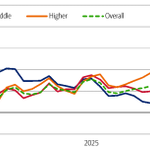
Ought to add—this chart would doubtless look the same in the rest of Europe, but there the relevant data is so lagged that we can't even say for sure yet.
That, at least, is one problem Britain doesn't have quite so much...


"Repeal the porn laws"—my colleagues @TheEconomist on Britain's latest free-speech mess.
"Pornography is an unpopular thing to defend. But Britain has become too willing to ban anything pearl-clutchers dislike, from plastic straws to noisy protests."
economist.com/leaders/2026/1…


The correct answer to this is to lean in: fees and, if you don’t want to ration by price, lotteries.
The status quo where peoples’ time was wasted queuing anyway isn’t worth preserving.

agents are going to cause a breakdown of human behavior assumptions underlying today's systems. i've started thinking about it as friction collapse. without friction, a number of norms will collapse.
consider selling tickets to a concert/event. today, you can post them at a certain time and it's first come first serve. soon everyone's agent will persistently monitor, and as soon as they are posted for sale, thousands of people will instantaneously be trying to buy the same ticket. how do you even resolve this? sell the ticket to the person whose agent gets there fractions of a second before?
we're seeing the same thing with job applications, restaurant reservations, but basically anything that relies on participation requiring effort is going to break down. sales emails/calls, participation in government benefits, apartment rentals, doctors appointments, RFP responses. customer support won't be able to handle the user who will not drop their point of dissatisfaction. with no friction, these systems just don't work anymore.
business models will break down:
- flights/hotels will be consistently cancelled and rebooked at the lowest price (great use case for your agent if you don't have this already set up)
- subscriptions will be cancelled
- retailers won't be able to arbitrage price differences as the agent will find the cheapest place to buy anything
- insurance denials (health/auto/home/etc.) will be fought tooth and nail
- bank interest rates will be optimized and avoidable charges will be avoided
a lot of what we perceive as stable social coordination is actually an equilibrium sustained by human inefficiency. rationing is a product of human slowness. signaling effort/interest/intent is a key part of our social infrastructure. inertia is a key to many business models. information asymmetry is everywhere. and attention is monetized thoroughly.
with agents, none of these things are true. humans will simply demand what they want and have their agents get it for them. there is going to be a fundamental renegotiation of how markets allocate resources, how people signal intent, and how businesses capture value.
Quintessential Ted Cruz to write sentence after sentence that whiffs of AI, but for Pangram to assure me that it’s 100% him.
“2026 was not simply a blue wave; it was a blue tsunami”
“Texas is blue. That is a hard sentence to utter.”
“It is dark right now, but it is always darkest before the dawn, and morning is coming.”

History was made last night.
For months, we were saying that 2026 was the most consequential midterm election of our lifetimes.
Unfortunately, we were right. Sometimes history is to be celebrated; other times, it is to be mourned. Always, it must be reckoned with.
2026 was not simply a blue wave; it was a blue tsunami. It was an ass kicking. It was not simply a bad 2006 midterm election. It was a Watergate-level repudiation. What happened, and why? What are the consequences, and where on earth do we go from here?
When all the votes were counted, the problem wasn’t turnout. Instead, our voters, Republicans, Libertarians, Independents, showed up and voted, and rejected our candidates, voting Democrat instead. We’ve lost the House. We’ve lost the Senate. When all is said and done, we will have lost eight to 10 Senate seats.
We lost in historically red states, like South Carolina and North Carolina, Kansas and Iowa. We lost in purple states, like Michigan, and New Hampshire, and Georgia. And we just barely won by just a single point in bright red states like Florida and Louisiana, and then there’s Texas.
Nowhere are the consequences of this election greater than Texas. In the Lone Star State, we lost every single statewide election. For weeks, I had been publicly warning on this podcast that we were in very real danger of losing everything in Texas. Far too few believed that was possible. I am very, very sorry that it came to pass. Texas has not had a Democrat governor since 1994. We haven’t had a Democrat senator since 1993. Now we’ll have both.
Why were the results so overwhelming? Pundits and analysts will break down the results for weeks or months or even years to come, but several things are already evident today.
Years ago, the very best political advice I ever got was from Heidi. She said, “It’s not about you. It’s about them. It’s about their kids, their families, their hopes, their dreams, their futures.” Too many politicians forget that.
Take the state of Kansas, for example, a state that has not elected a Democrat senator since 1932. It just did. Here’s what exit polling showed were the top issues in Kansas.
Number one, cost of living, energy, and groceries. That was listed as number one by 30.6 percent of voters.
Corruption. Number two, 18.5%.
The cost of the Iran war, 10.1%.
The candidates are terrible, 7.9%.
The Canada trade war, 7.6%.
The GOP didn’t do enough to support Trump, 6.6%.
Republicans didn’t pass the Save America Act, 5.6%.
Trump’s focus on monuments, 5.5%, and data centers and AI, 3.8%.
The top issue, cost of living, is very real. Too many in politics dismissed it. They didn’t understand. They pointed to the macro numbers showing the stock markets soaring, median income at record highs, and poverty at record lows. Those data are true, but they don’t tell all of the story.
Here are some stats that are a lot more real and personal. Spam, Hormel’s processed meat substitute, broke record sales, selling 113 million cans last year. That is nearly as much spam as was sold during the entirety of World War II. 29 percent of Americans have used buy now, pay later for groceries this year. That’s double the share just two years ago.
In August, banks repossessed 42% more homes than they did last year. In 2024, car repossessions topped 2.3 million, above the 2009 peak in the middle of the Great Financial Crisis. In 2025, 6% of 401k holders took hardship withdrawals, paying penalties. That is a record, and triple the norm.
And here’s one that’s really stunning. Americans made more than 75 million paid plasma donations in 2026. That’s another record. That means 200,000 Americans every single day, with a needle in their arm, just to pay for groceries.
That is very real pain from real Americans, and too many Republican politicians seem like they didn’t understand or they didn’t care. Food is too high, gas is too high, diesel is too high, insurance is too high, life is too high.
Tariffs have made everything too expensive, and the Iran war has dragged on too long. It should have been brief, decisive, and over. It needs to end, and we should never, under any circumstances, give the Ayatollah billions of dollars.
There’s a very real economic disconnect. Our K-shaped economy is a yawning divide. Last year, we saw the world’s very first trillionaire, a modern-day Thomas Edison, at the very same time that millions were struggling to feed their families. Data centers being constructed were turning billionaires into centibillionaires, while simultaneously the average American’s electricity bill went up 30% in the last five years.
Understandably, people were pissed off, and elected Republicans didn’t do enough to address their very real pain.
So, what do we do now? We need to listen and respond. We need to champion economic policies that make a real difference in working people’s lives, and we need to deal with the consequences.
Texas is blue. That is a hard sentence to utter. But Texas, today at least, is blue. As we sit here today, I am the only statewide elected Republican who remains in Texas. That’s not something I ever thought I would say.
We can be certain that the Democrats in Austin and in Washington will overshoot. In Texas, they will try to raise taxes dramatically. They may even try to adopt a state income tax, or even a California wealth tax. They will try to shut down the energy industry, destroying jobs across our state. They will embrace the radical transgender agenda. They will persecute those they perceive to be enemies, especially Elon Musk.
And in Washington, they will attack Trump every single day, constantly. Impeachment hearings, subpoenas, his family, cabinet members, business leaders, open persecution, and nonstop retaliation. Make no mistake. Nationally, the radicals are in charge. The communists and the Islamists who have taken over the Democrat Party have now taken over the United States Congress. They will be unleashed.
Sadly, that means many Americans will be hurt. Texans will be hurt. Their assault on business will make Texas a much less attractive place to start or grow a small business. Texas will become more like California if they succeed in halting all new investment into AI.
The economic results will be dramatic. Over $700 billion in new projects are scheduled to start in the next year. If the Democrats shut them all down, our country will very likely go into a recession. That will suit the Democrats just fine. They’ll just blame it all on Donald Trump.
In the next two years, we need to do two things.
One, fight the madness. I will work with Democrats when they’re willing to be reasonable. Last night, I called James Talarico. I congratulated him on his very impressive victory. It was a pleasant conversation, and I told him that I looked forward to working with him to try to benefit Texas.
So, if there are things like flood relief for the Hill Country, or trying to get the space academy to Texas, he and I will work together. But if the newly elected radicals push policies that hurt Texas, raising taxes, destroying jobs, opening the border, releasing violent criminals, threatening our children, undermining our constitutional rights, I will fight with all of my strength to defend Texas and to defend the Constitution.
And number two, we need to rebuild, getting behind policies that directly benefit the constituents we lost.
There’s a complicated story, no doubt, of what happened on Election Day, but as I see it, the key constituencies we lost were blue-collar voters, what had rightly become the core base of our party, Evangelical Christians, who didn’t show up with the same numbers and fervor as prior elections, farmers and ranchers. Tragically, we alienated rural America. Young people, who excitedly had voted Republican in 2024, and who shifted hard blue this cycle. And of course, Hispanics.
For Hispanics, there’s a strong overlap with young people and blue-collar workers. In 2024, just two years ago, I was proud to carry Hispanics statewide in Texas by six points, and we swung the Rio Grande Valley red for the first time in a century. It can be done, but in this election, those Hispanic voters overwhelmingly went back Democrat. We have got to turn that around.
And for young people, we need to be the party of the future. We need to champion policies that expand their future. Our two single biggest legislative accomplishments of the past two years, Trump Accounts and the school choice tax credit, which will unleash tens of billions of dollars in new scholarships for kids, are generationally powerful. I was proud to author both of those transformational policies, and yet too few candidates all across the country ran on that record.
Too few voters were even aware of what we’d accomplished for their kids and their future. But we need to build. We need to expand to continue creating a new investor class for hundreds of millions of Americans, help everyone, every American, become an owner, to have real skin in the game, to create new generations of capitalists ready to reject socialism.
People voted as they did because they were angry. Ironically, the Democrats that they elected are going to advance policies that will make affordability worse. The Democrats want gas prices higher. They want to ban gasoline engines altogether. Their extreme environmental mandates will drive up food prices and the prices of everything else.
But hear me now: we will bring Texas back. I am filled with hope and optimism. Texas will be red again. We have not suddenly become a bunch of tofu-eating, gun-banning, tutu-wearing pinko commie liberals. That ain’t us. Texas is still Texas.
We will rebuild as a true blue-collar party, not by embracing socialism, but by being real free-market conservatives. The way we built the Texas economic miracle in the first place, and we will build and rebuild America as well.
When the zealots overreach, and they will, we will stand ready to lead in the direction of freedom, of prosperity, of safety, and security, and common sense. We will return to a new dawn of freedom in America.
It is dark right now, but it is always darkest before the dawn, and morning is coming. That is my fervent prayer, and that is my commitment to you.
1
35
2,142


Besides the obvious, a real theme of tonight is candidate quality. Paxton, Roger Marshall, Graham soeur, Vivek...
1
25
2,537
Labour market still on a pretty benign part of the Beveridge curve-- even as it tightens a little

1
5
858
Enjoyed projecting my own angst about AI, creativity and cognitive surrender onto the rest of humanity last week at the Granola offices—a fun write-up from @misssaxbys @alys_key:
uk20.substack.com/p/why-we-h…
Europeans uses AI* in work about 40% less than Americas. Mostly, that's differences within comparable jobs.
Developing countries use AI at work about 80% less. That's ~half/half having jobs less amenable to AI adoption and lower penetration in the same jobs.
*Claude only


If anything, the data John shows should probably make you more worried about AI-adoption productivity differentials, though.
If the gap here between the US and others was just using SaaS well....... (and having a sufficiently dynamic private sector/labour market to permit that)


Interesting (via Goldman) post-Budget underperformance in homebuilder stocks. They speculate driven in part by the downgrades in housebuilding forecasts


