

Asimov programs living cells to advance the design and manufacture of next-generation therapeutics
Boston, MA
Joined May 2017
- Tweets262
- Following157
- Followers6.7K
- Likes216






Today we are announcing a strategic collaboration with @LonzaGroup to advance in vivo lentiviral vector manufacturing.
In vivo lentiviral therapies turn the vector from a manufacturing reagent into the drug itself, raising the bar for titer, product quality, and scale. While traditional transient production systems limit scalability and consistency, stable cell lines have the potential to enable scalable, reproducible and controlled product profiles for lentiviral vectors.
To provide developers with a scalable path from sequence to clinic, we’re bringing together Asimov’s LV Edge stable cell lines with Lonza’s expertise in process development, scale-up, analytics and GMP manufacturing. By connecting early design decisions with development and manufacturing considerations, we are creating a stronger foundation for clinical and commercial production.
Learn more here: asimov.com/news/lonza-and-as…

Welcome back @AsimovPress!

It's official: We're back!
Asimov Press is returning with a sharper focus on intensive reporting in biotechnology. We're also working with @RenPhilanthropy to build our ideas in the real world.
See more: press.asimov.com/articles/ba…
1
11
1,278
Announcing our project with the Biomedical Advanced Research and Development Authority (BARDA) to improve manufacturing of antibody therapeutics for Ebola and other deadly viruses.
This three-year project aims to optimize production of a monoclonal antibody cocktail targeting filovirus disease caused by Ebola virus or Sudan virus, which are associated with mortality rates as high as 90 percent. Asimov will use its CHO Edge system to amplify the production of mAbs against these pathogens, ultimately enabling greater availability of these treatments.


Our AI-driven cell line and bioprocess design tools consistently deliver 8–11 g/L titers for IgGs and complex multispecifics.
Join us tomorrow to learn how we use predictive modeling, rather than trial-and-error, to optimize biologics production: hubs.li/Q03pQVxM0


We're partnering with LOTTE BIOLOGICS, a global CDMO, to scale therapeutics manufacturing.
Our customers can now transition seamlessly from cell line development using our CHO EDGE system all the way to large-scale GMP production, with faster cycles.
asimov.com/news/lotte-biolog…

We’re proud to share that our CHO Edge System has been licensed by Novo Nordisk, a global leader in healthcare innovation.
Forward-thinking companies like Novo Nordisk recognize the importance of accessing cutting-edge technologies to advance therapeutic development.
We’re committed to continuing innovation in biologics production and empowering our partners with the tools they need.


Read the report: itif.org/publications/2024/1…

The F.D.A. recently approved Aucatzyl, a CD19 CAR-T therapy for B-ALL leukemia in adults. It joins a handful of other approved CAR-T therapies designed to treat various forms of cancers, including multiple myeloma. But it’s worth looking at Aucatzyl, in particular, because it has some unique aspects…
But first: CAR-T therapy stands for chimeric antigen receptor T cell therapy. It’s a form of immunotherapy that modifies a patient's own T cells (a type of white blood cell) to detect and attack cancer cells. How it works, basically, is that researchers take T cells from a patient, engineer them to express receptors specific to cancer cell surface proteins, and then reinfuse those cells into the patient’s bloodstream. Once inside the body, the engineered T cells grab onto cancer cells and destroy them using cytotoxic mechanisms (like punching holes in the cancer cell membrane using perforins).
In the case of B-ALL, the T cell receptor that gets expressed binds CD19 — a protein commonly found on the surface of B cells, including cancerous ones. There are existing CAR-T therapies targeting this protein — including Tecartus — but Aucatzyl’s approach is distinct.
Like many other cell therapies, Aucatzyl uses a lentiviral vector to deliver a CAR-encoding gene into a patient’s T cells. But the CAR protein that it carries was designed to have a high dissociation rate. In other words, when a T cell engineered to express this “special” CAR grabs onto a cancer cell, it delivers its cytotoxic payload and then disengages from the B cell more rapidly than other immunotherapies. This rapid release allows the T cell to move on and attack multiple cancer cells in succession — a phenomenon known as "serial killing” — which enhances its tumor-killing efficiency.
In a clinical trial with 65 patients, 42% achieved complete remission within three months of receiving Aucatzyl, with a median remission duration of 14.1 months. Severe cases of cytokine release syndrome — a common and potentially dangerous side effect of CAR-T therapies — were reported in just 3% of patients, which is lower than other therapies.
Unfortunately, all cell therapies are complex and expensive to manufacture. If we want these therapies to reach more patients, we’ll need to find ways to slash costs and make them at larger scales. At Asimov, we’re building a platform, called LV Edge, that combines wet-lab and computational tools to make lentivirus manufacturing and payload design much easier — and cell therapies cheaper.

ALT Source: NCI https://www.cancer.gov/publications/dictionaries/cancer-terms/def/car-t-cell-therapy

At least 350+ lentiviral-based gene therapies are in clinical trials. Several have already garnered F.D.A. approval, including a gene therapy for beta-thalassemia, multiple therapies for blood cancers, and another for a rare genetic disease — called CALD — that affects brain development in young boys.
But what are lentiviruses, and where did they come from?
Lentiviruses carry RNA genomes, which are reverse transcribed into DNA and then integrated into a host’s genome after infection. They’re widely used for gene therapies because they are really good at transferring genetic material into cells, and because they can transduce nonproliferating, or slowly proliferating, cells. Lentiviruses can also carry about 10,000 nucleotides of genetic information, more than twice as much as AAV. This means that larger genes, or payloads, can be inserted into cells.
Lentiviruses have only been used clinically for a couple decades, but they have ancient origins. The term “lentivirus” itself derives from the Greek word for lenti-, meaning “slow,” because they were first discovered circulating as “a slowly progressive disorder” amongst sheep flocks in Iceland in the 1930s. A long period of time, ranging from several months to years, often elapses between the initial infection of lentivirus and the onset of a disease. The first detailed description of a lentivirus-based disease was recorded as early as 1843, in France, when researchers noticed a form of infectious anemia in horses. But although lentiviruses are ancient — at least 7 million years old — most of the progress in adapting them to cure diseases has happened in the last two decades.
The first lentivirus used to make a cell therapy was actually derived from HIV, and it was tested in a clinical trial for the first time in 2003, with a total of 65 patients. In that trial, the lentivirus was used to introduce a ‘genetic payload’ into T-cells to treat — of all things — an HIV infection. None of the patients had an adverse event as a result of the lentivirus, even after 8 years of monitoring.
At Asimov, we’re building a platform, called LV Edge, that combines wet-lab and computational tools to make lentivirus manufacturing and payload design much easier. asimov.com/lv-edge-system
Today we announced that RevOpsis Therapeutics is licensing our CHO Edge platform to develop and commercialize their first-in-class modular, trispecific biologic molecule for retinal vascular diseases. We’re really excited about this.
CHO Edge is an integrated system that enables companies to optimize antibody expression, typically achieving titers of 7-11 g/L. It includes four modules: GMP-banked cell lines, a hyperactive transposase, a library of over 1,000 characterized genetic parts for vector design, and advanced AI and biophysics models.
We’re so confident in CHO Edge that if you work with us on cell line development, we guarantee a titer of at least 5 g/L for mAbs, or it’s free.
Learn more: asimov.com/news/asimov-and-r…

Chinese Hamster Ovary, or CHO cells, make roughly 70 percent of all F.D.A. approved biologics sold on the market. This includes bestsellers like Humira®, used to treat Crohn’s and rheumatoid arthritis, and Keytruda®, a cancer therapy. Despite their ubiquity in the pharmaceutical industry, though, the origins of CHO cells are extremely peculiar — it involves the Chinese Civil War and a smuggler.
The story goes like this.
In autumn 1948, as China's civil war entered its climax, a truck navigated the perilous roads from Peking to Nanking. Inside, a nondescript crate held twenty Chinese hamsters — ten males and ten females — each nestled in its own wood-shaving-lined compartment.
The hamsters were a gift from Dr. H.C. Hu, of the Peking Union Medical College, to Dr. Robert Briggs Watson, an American physician working for the Rockefeller Foundation's International Health Division. Watson was retrieving the hamsters for his friend Victor Schwentker, a renowned rodent breeder in upstate New York.
Chinese scientists had been studying these hamsters, native to northern China and Mongolia, since at least the 1910s. The hamsters have short gestation periods and natural resistance to human viruses — traits that made them ideal for scientific research. Schwentker wanted to get his hands on some. But with Mao Tse-Tung's communist forces advancing, he knew that acquiring these animals would soon become impossible.
On December 6, the hamsters arrived at Watson's doorstep in Nanking, a city on the verge of evacuation. The Yangtze River was all that separated the capital from Mao's forces. Despite suffering from dysentery, Watson was preparing to flee. Against the counsel of both his Chinese colleagues and the American Embassy, he loaded the hamsters and his laboratory equipment into a station wagon on December 10 and drove eleven hours east, through the mud and rain, to Shanghai.
The hamsters left China in December 1948, aboard one of the last Pan-Am flights out of that city. Watson was later accused of "war crimes" by Mao’s Chinese Germ Warfare Commission and tried in absentia for allegedly conspiring with Chinese nationalists to carry out a biological attack. Dr. Hu faced similar charges and was sent to a detention camp for six months.
Upon arrival in San Francisco, the hamsters were shipped to Schwentker's farm in New York. After months of effort, Schwentker was able to domesticate and breed the hamsters, establishing the first colony outside of China by 1950. He then began selling and distributing the hamsters to American researchers.
In 1957, a geneticist at the University of Colorado School of Medicine named Theodore Puck began seeking robust mammalian cell lines for genetic research. He obtained a single adult female Chinese hamster, extracted an ovary cell, and cultivated it in vitro, thus creating the first CHO cell line.
Puck’s cells were both resilient and easy to work with. They grew quickly and could be maintained indefinitely, which was a big improvement for researchers struggling with short-lived mammalian cell cultures. Puck shared his CHO cells freely with the scientific community.
This is an abbreviated version, basically, of how CHO cells became such a dominant cell line for the pharmaceutical industry. We learned about this tale via an excellent 2015 article in LSF Magazine, called “A Brief History of CHO Cells.” Highly recommended. biomanufacturing.org/uploads…

Over the years, people have asked: What does Asimov do? This is our brief response.
At a high level, we think biology is an advanced form of molecular nanotechnology. Our goal is to create tools and software to more reliably engineer cells, thus bolstering humanity’s ability to design living systems and enabling biotechnologies with outsized societal benefit.
Just because bioengineers can manipulate organisms, however, does not mean their well-laid plans come to fruition. Biological organisms are typically engineered, today, using iterative trial-and-error, rather than actual design. Our goal is to push biotechnology into a true engineering discipline, where experimental outcomes are predictable ahead of time.
Everything we do centers around a concept that we call genetic design. We think of this as the process of intentionally modifying an organism's DNA using advanced techniques such as characterized parts, modeling, and multi-omics analysis. Genetic design is distinct from traditional genetic engineering in that it focuses on forward design driven by biophysical understanding and model-guided predictions.
One of the ways we’re using genetic design is by engineering mammalian cells to make medicines. In other words, we’re making bio-tools, such as expression platforms and engineered cell lines, as well as software tools, including metabolic simulators, codon optimizers and signal peptide predictors, to help our customers engineer cells to make antibodies, AAV, and lentivirus.
A large part of our work is focused on antibodies, a type of protein used to make many of the most popular medicines, including Humira (for rheumatoid arthritis) and Keytruda (for cancer). Many pharmaceutical companies make antibodies using Chinese Hamster Ovary cells, or CHO, but the problem is that this process is unpredictable and has to be tweaked for every new antibody. We routinely use our wet-lab and software tools to optimize and engineer these cells, thus coaxing them to make greater amounts of antibodies with fast timelines and good quality attributes.
More recently, we also launched a product called LV Edge. LV stands for lentivirus, which is a type of virus that can be used to deliver genes into human cells for gene therapies. Lyfgenia, for example, was recently approved by the FDA and uses a lentiviral vector to add a hemoglobin gene to blood-making stem cells to treat sickle-cell disease. We engineered HEK293 (a type of immortalized human cell) to make large amounts of lentivirus, with the goal of making gene therapies available to more people. We’ve also written a longer blog about LV Edge, which you can read here. We have another product for AAV manufacturing, too, called AAV Edge.
Our basic “tech stack” is the same, regardless of whether we’re working on antibodies or anything else. We have teams actively working on optimizing cells and production processes for individual molecules and other teams building computational models — based on biophysical insights or transformer-based AI models — to predict aspects of how an engineered cell will behave before we make it. Another team within Asimov Labs collects large amounts of data in our Boston laboratory to measure the function of myriad biological processes, and then works with computational biology teams to improve their models. We strive to make every experiment into a data point so that nothing goes to waste.
Many of the models and tools we develop for various products are also bundled together and made available through Kernel, our browser-based software for genetic design. You can think of it as the “hub” or “vault” for all of the tools we’re building.
So that’s the gist. We make wet-lab and computational tools to engineer cells in more predictable ways. While engineering those cells, we collect a large amount of data and build models to understand how they work. This research, in turn, bolsters Kernel and makes it easier for everyone to design biology. In the future, we aim to expand our product offerings to agriculture, foods, and materials; anywhere that engineered biology can make an impact.
This and more at our website: asimov.com


Full paper: nature.com/articles/s41467-0…

Join this webinar to learn about our AAV Edge platform!

DON'T MISS OUT! On 11/12, Mark Stockdale will discuss how the application of synthetic biology and artificial intelligence can be used to improve the safety, potency and manufacturability of gene therapies, and introduce AAV Edge. REGISTER: hubs.li/Q02Vnr1K0 @asimovbio


New blog! This one is about the synthetic biology + computational tools we're building to improve gene therapy manufacturing.
Our newest launch, called AAV Edge, includes payload design tools, such as tissue-specific promoters that are only active in specific tissues with minimal off-targeting to the liver (>200-fold increase in expression target vs. off-target tissue), a sequence optimization algorithm that boosts clinical transgene expression up to 7x, and an RNA interference-based circuit to silence the payload during manufacturing to reduce cellular stress and toxicity, thus leading to higher-quality AAVs.
It also includes manufacturing tools, such as a clonal, suspension-adapted HEK293 cell line, an optimized two-plasmid system that makes it easier to tune the expression of various AAV components, and data-driven, statistical, and mechanistic models to understand and optimize AAV production across scales and bioreactor configurations.
Learn more about how this works and why we think it matters in the blog. We'll have a lot more to say about the experiments behind each of these tools in forthcoming articles, too!
blog.asimov.com/aav-edge

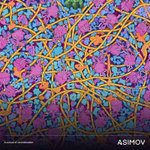
This schematic explains how lentiviruses are made in the laboratory.
We made this diagram for a blog, which you can read at the link below.
Also, our LV Edge system uses stable cell lines and software design tools to achieve lentiviral titers of 1E9 TU/mL for therapeutic transgenes!


Today we're announcing AAV Edge, our AI-powered suite of tools for gene therapy design and manufacturing.
It's the first comprehensive platform for AAV manufacturing that enables end-to-end optimization, from payload design to tissue-specific control of gene expression to model-guided process development.
With dozens of gene therapies now approved by the FDA, and more than 500 more in the pipeline, it's time to solve challenges in safety, manufacturability, and cost so that these treatments can reach more patients.
AAV Edge includes:
- Our AI-designed & animal-validated tissue-specific promoters.
- DNA optimization tools to boost expression levels in vivo.
- Silencing of genes of interest during production to minimize toxicity.
- GMP-banked HEK293 host cell line.
- An optimized two-plasmid system that is compatible across many different capsids.
The platform achieves unconcentrated bioreactor titers up to E12 viral genomes per milliliter.
Learn more & contact us to get access: asimov.com/aav-edge-system
