

Co-founder @Ember_Energy💚 Chief analyst tracking global electricity transition👍 Electricity analyst since 2000, still learning🤓
London
Joined March 2014
- Tweets19.1K
- Following2.8K
- Followers18.9K
- Likes36.1K




Pinned Tweet
OUT TODAY: The take-off in African solar that official statistics can’t yet see
2026 is on track for +45% in solar installations, setting new records in 36 countries.
New methodology reveals 3/4 of growth is distributed solar, much of which is missing from official data..🧵


Dave Jones retweeted

📉Right now China is comfortably the world's biggest coal consumer. But for how much longer? Fascinating chart from @energy_said superimposing Chinese coal consumption with UK historic coal consumption...

Dave Jones retweeted

Almost all the growth in global coal use since the late 1980s has come from China.
Outside China, the world’s use of coal has barely changed since the late 1980s. It was just over 20,000 terawatt-hours back then, and almost four decades later, it is still the same.
But the change has been very different in China. The country has increased the use of coal enormously, and today, China is burning more coal than the rest of the world combined.
The future of global coal use, and the emissions that come with it, depends heavily on what happens in China.
(written by @MaxCRoser)

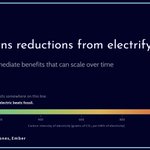
Why electrify NOW?
NEW: 99% of the world's population live in countries where grid electricity ALREADY saves CO2 with an EV, compared to a petrol car. And 95% for heat pumps compared to a gas boiler.. 🧵


So if anyone at #cop31 asks "Shall we wait for clean electricity before we electrify?"..
..please forward them these slides..
a08cab60-5098-4b5e-a165-8c17…

Dave Jones retweeted

"You can always count on Americans to do the right thing — after they've exhausted all other options." — Winston Churchill
Dave Jones retweeted

🚨 On Friday, @IEA will release Renewables 2026 🚨
Our annual report has the latest global analysis & forecasts for hydro, solar, wind, biofuels, geothermal & more, showing how the Hormuz crisis is affecting their growth prospects
Watch the launch live: iea.li/4jXr2YA

Dave Jones retweeted

Store More → Import Less → Power India Round the Clock!
The Cabinet has approved a massive Rs 14,500 crore push to develop 92 GWh of energy storage capacity, supporting an estimate of almost 1 lakh crore investment!
Unique features are:
60 GWh of pumped hydro storage.
30 GWh of battery energy storage.
2 GWh through emerging technologies.
40% minimum domestic content for battery storage projects.
Truly, it is more reliable power, greater renewable energy integration and stronger energy security.
pib.gov.in/PressReleaseDetai…
Dave Jones retweeted

The global gas crisis is fueling a shift to renewables across emerging economies ⚠️💰
A cramped market in the heart of Dhaka has become an unlikely ground zero for Bangladesh’s energy transition. Sales of solar panels and batteries are booming as a gas shortage triggers widespread blackouts and drives up utility bills
Monju Hossain, a sales representative for Dongjin Group Bangladesh, said the retailer is struggling to keep up with demand, with sales jumping 50% in recent months from a year earlier. The country’s worsening energy crisis, triggered by the war in the Middle East, is pushing households and businesses to seek alternatives to an increasingly unreliable grid
“The blackouts in Bangladesh have gotten worse, which has increased the need for our equipment,” said Hossain, in a shop on the second floor of the Kaptan Bazar. “Demand from industrial customers has increased significantly, as they have to keep factories running”
The busy market offers a glimpse of how the Middle East energy shock is accelerating the shift away from fossil fuels in poorer countries. From the Philippines to Pakistan and Nigeria, people are turning to solar and batteries to cut utility bills or just to keep the lights and machinery on. It’s a threat to the long-term demand outlook for liquefied natural gas, given that populous developing nations like Bangladesh have long been touted as high-growth markets for the super-chilled fuel
The South Asian nation of 180 million has been one of the hardest-hit by the disruption to energy flows from the Persian Gulf. Load-shedding — or rolling blackouts — have stretched to as long as 18 hours a day in some parts of the country this year as LNG exports from Qatar, formerly Bangladesh’s main supplier, slowed to a trickle
To help make up the shortfall, Bangladesh has been buying LNG on the spot market, at around triple the price of its contracted supply from Qatar, forcing utilities to hike electricity bills. That combination of higher costs and power cuts is pushing consumers toward renewables. Even Prime Minister Tarique Rahman has installed solar panels on his house, according to local media reports this week
An informal survey of more than three dozen stalls at the Kaptan Bazar — one of Bangladesh’s biggest hubs for solar equipment — found that all of shops have seen demand increase to varying degrees. A plunge in the cost of solar panels and batteries in recent years has made the technology more affordable for regular households, spurring sales not just in Dhaka’s markets but across the country
China, the world’s dominant manufacturer of solar and battery equipment, is helping enable the shift. Bangladesh’s imports of the equipment from the country more than doubled to about $140 million in the March through September period from a year earlier
Panels made by China’s Jinko Solar Co. and Longi Green Energy Technology Co. are by far the most popular due to their low price and reliability, according to the Dhaka store owners. Buying a 750-watt panel, enough for a single household, costs about 15,000 taka ($121), compared to about 38,000 taka a year in electricity bills
Adding a battery and associated equipment will quickly boost the outlay by several times, but those costs can be recouped within a decade for a normal family, Dongjin Group’s Hossain said
The shift to solar is being abetted by Dhaka, which cut import tariffs on the equipment in September. The government is aiming for renewables to make up 20% of the power mix by 2030 and 30% by 2040, according to a local media report this week that cited Prime Minister Rahman. That’s up from just 2.5% last year

Dave Jones retweeted

We’re delighted to be featured in Think Tanks to Watch 2026
The initiative by @onthinktanks (OTT) recognises 55 think tanks from across the world for their innovative and valuable contributions.
Explore more ember-energy.org/latest-upda…

Dave Jones retweeted

++Ask Me Anything about COP31: Today 3pm UK++
What do you want to know?
Have Qs about electrification, the "just transition mechanism" or "agenda fights" over trade tariffs & adaptation finance?
Get your Qs for me + colleagues in now:


