

Teaches politics & history at Cambridge. Interests include empire, war, technology, architecture, science fiction, utopia. Writing a book on transhumanism
Cambridge, England
Joined July 2016
- Tweets25.9K
- Following2K
- Followers15.6K
- Likes12.8K

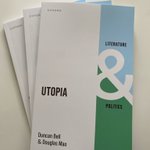





NEW BOOK!
I'm happy to say that my new book, Utopia, co-written with Douglas Mao, has been published on-line
academic.oup.com/book/62279

Duncan Bell retweeted

💷 'Connecting around insecurity' brings together scholars from across the University of Cambridge who conduct research on socio-economic insecurity (broadly defined) and who want to connect with others
18 Nov from 5-6.30pm, refreshments provided
crassh.cam.ac.uk/events/5292…

Duncan Bell retweeted

It was fun to write about two new books on utopias/utopianism (and one on Thomas More) for @prospect_uk.
prospectmagazine.co.uk/cultu…

Duncan Bell retweeted

The search is on. Could you be our next Senior Tutor at @GirtonCollege @Cambridge_Uni? We can promise talented students, world-class Fellows, strong collegiality, high energy, proud traditions, low stuffiness, and lots of fun! Salary c. £84,591 to £95,187. Read on via this link: girton.cam.ac.uk/job-vacanci…


Duncan Bell retweeted

Hmm several members of the Frankfurt School served in the OSS, OWI, CIA, and State Department

.@SECWAR “The philosophical doctrines of the Frankfurt School – critical theory and the corrosive apparatus of ‘Diversity, Equity, and Inclusion’ – are fundamentally INCOMPATIBLE with military service and antithetical to the Constitution of the United States.”
Duncan Bell retweeted

Critical theorists: be all that you can be.
.@SECWAR “The philosophical doctrines of the Frankfurt School – critical theory and the corrosive apparatus of ‘Diversity, Equity, and Inclusion’ – are fundamentally INCOMPATIBLE with military service and antithetical to the Constitution of the United States.”
Duncan Bell retweeted

I'm proud to announce that I am now affiliated with The Laboratory of Political Imaginaries. As part of that, I've written a long paper on the concept of the future. It is winding paper, but I hope worthwhile for readers. Check it out! @vivatopia vivatopia.org/agora1/s0fg9b4…

Duncan Bell retweeted

A patient tests the "Headshrinker" positron emitter detector used to locate brain tumors at Brookhaven National Laboratory, circa 1962

Well-deserved - a brilliant writer

At 81, M John Harrison (the M stands for Michael) is the oldest ever Booker winner. After the ceremony finished late on Monday night, he and his partner, the writer and editor Cath Phillips, tried to sleep, but couldn’t stop talking about the prize. “Every so often one of us would appear to fall asleep and then jerk awake and say, ‘We won the Booker.’”
@emilylawford speaks to Booker Prize winner M John Harrison: "I was as nervous as a cat" newstatesman.com/culture/boo…

Duncan Bell retweeted

At 81, M John Harrison (the M stands for Michael) is the oldest ever Booker winner. After the ceremony finished late on Monday night, he and his partner, the writer and editor Cath Phillips, tried to sleep, but couldn’t stop talking about the prize. “Every so often one of us would appear to fall asleep and then jerk awake and say, ‘We won the Booker.’”
@emilylawford speaks to Booker Prize winner M John Harrison: "I was as nervous as a cat" newstatesman.com/culture/boo…
Duncan Bell retweeted

It's here! Had so much fun writing this short and spicy piece on "proper" and "improper" histories of computing.

In the blog's forum on technology, Felicia Jing symptomatically reads a recent academic historiography that—like practitioners’ histories of computer science—attempts to understand computing by dating "algorithms" to the more distant past.
web.sas.upenn.edu/jhiblog/20…

Duncan Bell retweeted

In the blog's forum on technology, Felicia Jing symptomatically reads a recent academic historiography that—like practitioners’ histories of computer science—attempts to understand computing by dating "algorithms" to the more distant past.
web.sas.upenn.edu/jhiblog/20…


Duncan Bell retweeted

The Common Sense of Science by J. Bronowski, Pelican Books, 1966. Cover design by Bruce Robertson designreviewed.com/artefacts…

Duncan Bell retweeted
Cracked and faded statue of Vladimir Komarov, the first human to lose his life during a space mission.

Duncan Bell retweeted
A stunning vision of a Brutalist megacity by German artist Clemens Gritl.
Part of his project “A Future City From The Past,” exploring the monumental architectural utopias of the 1960s and 1970s through incredibly detailed 3D environments.


Duncan Bell retweeted

Promoting white nationalism, hating humanity, and giving away state secrets to Chinese honeytraps aside, I absolutely trust tech leaders with our future.
Duncan Bell retweeted

Politics of the Anthropocene by Duncan Kelly is excellent. I particularly like his teasing out of different temporalities of the anthropocene.
amazon.com/dp/1509534202/ref…

Duncan Bell retweeted

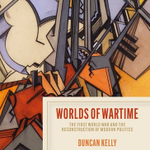
Duncan Kelly, Worlds of Wartime: The First World War and the Reconstruction of Modern Politics
is an extraordinary intellectual history, and the outstanding history book I read in 2026. This is a tour de force exploration of the effects of World War I on the evolution of economic, social and political thought. One recurring theme in the book builds on the thoughts of Élie Halévy and focuses on "étatisation"- way in which state power/control, required by the war, become steady state features of the postwar society. Another invaluable feature of the book is the way it articulate the richness of thought that emanated from the war and, by implication, the ways that this richness is lost in conventional narratives when it involved paths not taken.
Not only did I learn the most from this book of any history I read this year, it was also (by far) the most difficult for me to understand. This due to the differences in ways that Kelly conceptualizes history and time. Nonlinearities, juxtapositions of differences in time scales across difference phenomena, etc. all represent a much more complex vision of the dynamics of historical developments as found in economics, and I would say economic history. And more concretely, the set of models I have in my head to interpret historical narratives (which are very much defined by the various stochastic processes I use) were inadequate to capture the depth of Kelly's vision.

An interesting critical engagement by
@jasonwblakely & David Albertson with the book on Utopia I wrote with Douglas Mao
“Integral Utopianism” politicaltheology.com/integr…
