

Announcing new open source releases, exploring projects, sharing how we approach FOSS, and supporting communities around the world.
- Tweets2.4K
- Following145
- Followers82.3K
- Likes883


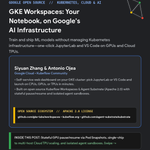



ALT Slide 1 of 4: Google Open Source card titled "GKE Workspaces: Your Notebook, on Google's AI Infrastructure — Train and ship ML models without managing Kubernetes infrastructure—one-click JupyterLab and VS Code on GPUs and Cloud TPUs." Highlights authors Siyuan Zhang and Antonio Ojea (Google Cloud, Kubeflow Community): self-service web dashboard on your GKE cluster to launch on CPUs, GPUs, or TPUs in minutes, built on open source Kubeflow Workspaces and Agent Substrate (Apache 2.0) with stateful pause/resume and isolated agent sandboxes at github.com/gke-labs/workspaces, kubeflow.org, and github.com/agent-substrate/substrate.

ALT Slide 2 of 4: Card titled "Focus on Models, Not Cluster Infrastructure" detailing three capabilities of Kubeflow and GKE Workspaces: (1) PAUSE & RESUME — Snapshot GPU and CPU memory to Cloud Storage to pause a running notebook with one click, saving variables in RAM and models in GPU memory while releasing hardware; (2) 1 CHIP -> MULTI-HOST — Seamless Cloud TPU scaling from one notebook, prototyping on a single TPU chip and dispatching training functions to multi-host TPU slices; (3) ZERO SSH KEYS — Connect local IDEs to remote TPUs via Identity-Aware Proxy HTTPS or spawn subagents in isolated Agent Substrate sandboxes.

ALT Slide 3 of 4: Card titled "Standalone GKE Deployment & Upstream Kubeflow Sync" comparing two architectural highlights: (1) No Full Kubeflow or Istio Required — Runs standalone on GKE Standard or Autopilot with Google account sign-in, managed TLS certificates, and encrypted per-workspace Persistent Disks; (2) Drive Big Jobs from a Small CPU — Coordinate Spark data processing, multi-host TPU training, model serving, and Ray clusters from an inexpensive CPU notebook with built-in GCS access. Below is a 6-step researcher and platform workflow from curating approved images to stateful Pod Snapshot pause, TPU slice scaling, IAP HTTPS agent bridging, and isolated Agent Substrate sandboxes.

ALT Slide 4 of 4 (X @GoogleOSS): Card titled "Deploy GKE Workspaces on Your Cluster Today." Lists authors Siyuan Zhang and Antonio Ojea (@googlecloud) and Apache 2.0 open source repositories: github.com/gke-labs/workspaces, @kubeflow Workspaces (@CloudNativeFdn / @kubernetesio), and github.com/agent-substrate/substrate. Includes three next steps: deploy on GKE Standard or Autopilot via providers/gke/USER_GUIDE.md, contribute upstream to Kubeflow Workspaces and Agent Substrate, and read the full guide with 6 screencast demos in the first reply below at https://goo.gle/gke-workspaces.

ALT Google Open Source social card 1 of 4 for A2UI 1.0. Headline reads: 'A2UI 1.0: Native Agent UI — Agents stream declarative JSON; clients render native components.' Center panel displays the official A2UI 1.0 architecture diagram showing an A2UI v1.0 message payload (Card, BarChart, ChoicePicker, Button) connecting to synchronized desktop web, Android, and iOS interfaces. Footer reads 'a2ui.org • goo.gle/a2ui-1-0' and bottom strip invites viewers to swipe for token savings, renderers, SDKs, and links.

ALT Google Open Source social card 2 of 4 for A2UI 1.0 titled 'One View, Native Everywhere.' Center panel features the A2UI multi-screen diagram demonstrating one declarative dinner-planning interface rendered natively on both smartphone and laptop screens, listing 1.0 renderers (React, Angular, Lit, Flutter, SwiftUI) plus community renderers. Green callout bar below notes that A2UI Express cuts output tokens 2.7x to 3.1x (-45.4% prompt tokens) and supports custom catalogs and MCP Apps.

ALT Google Open Source social card 3 of 4 for A2UI 1.0 titled 'Ship With Your Design System.' Top banner displays the A2UI quickstart terminal graphic alongside 'npx skills add a2ui-project/a2ui' for Python, TypeScript, and Dart SDKs, noting adoption with Alation, Atlassian, Bloomberg, and ByteDance. Below, a 2x2 grid highlights: Catalog Allowlists (Security: declarative JSON, zero raw JS), On-Device Ready (Local AI: Soverius AI fine-tuned Gemma 4), MCP Apps and AG-UI (Interop: bidirectional tool RPCs), and Apache 2.0 (a2ui.org).

ALT Google Open Source social card 4 of 4 for X (@GoogleOSS) titled 'Read the Release, Join the Community.' Left panel lists ecosystem and author accounts: @GoogleCloudTech, @googledevs, @FlutterDev, and @zeroasterisk. Right panel highlights quickstart command 'npx skills add a2ui-project/a2ui' and '6 architecture Q&As in reply.' Bottom banner prompts readers: 'Launch Post, Docs & 6 Architecture Q&As — First reply below: goo.gle/a2ui-1-0.'


ALT Google Open Source title card: "Scaling AI Agents with Open Standards: MCP & Agent Skills in the AAIF". Eyebrow pill: "OPEN STANDARDS // LINUX FOUNDATION AAIF". Subtitle: "Why build competing protocols when you can co-maintain an open standard? Kurtis Van Gent on how MCP and Agent Skills prevent AI fragmentation." Central card lists two takeaways: (1) Stateless MCP Transports: Evolving MCP from local stdio to horizontally scalable enterprise microservices. (2) Progressive Disclosure with Agent Skills: Loading procedural instructions on demand to avoid context bloat. Author block attributes Kurtis Van Gent & Daryl Ducharme, Google Cloud & Google OSPO, with avatar portrait. Bottom strip: "INSIDE: N-by-M database integration, vendor-neutral governance in AAIF, and next steps for packaging & discovery. Swipe ->". Footer: opensource.googleblog.com | Google Open Source Blog // Open Standards for AI.

ALT Google Open Source architecture card: "Two Open Standards, One Agent Ecosystem". Eyebrow pill: "TOOLS VS. PROCEDURAL CONTEXT". Three stacked cards: (1) Blue: "Standardized Tool Execution" (LIVE EXECUTION // MCP TOOLS) — Model Context Protocol standardizes how LLMs query databases, invoke APIs, and inspect telemetry through vendor-neutral clients. (2) Green: "Progressive Disclosure" (PROCEDURAL CONTEXT // AGENT SKILLS) — Agent Skills provide portable Markdown instructions teaching models how and when to invoke tools without polluting system prompts. (3) Yellow: "Horizontal Microservice Scale" (ENTERPRISE SCALE // STATELESS TRANSPORTS) — Stateless HTTP/SSE transports enable hosting shared, multi-tenant MCP servers behind standard load balancers.

ALT Google Open Source governance card: "Vendor-Neutral Governance: The Linux Foundation AAIF". Eyebrow pill: "LINUX FOUNDATION AAIF". Top grid cards: (1) Blue card: "AAIF FOUNDING — Cross-Industry Collaboration: Google, Anthropic, OpenAI, Block, and partners unite under Linux Foundation governance to prevent protocol fragmentation." (2) Green card: "DATABASE TOOLING — MCP Toolbox for Databases: Open source framework supporting 15+ cloud databases with live query execution, IAM auth, and connection pooling." Bottom terminal: agent_skills_evolution_roadmap.sh: Phase 1 Stateless MCP Transports Specification Landed; Phase 2 Agent Skills Specification Donation to AAIF Complete; Phase 3 Standardized Skill Packaging & Discovery In Progress; Phase 4 Semantic Versioning & Harness Conformance Upcoming; Join In at github.com/agentskills.

ALT Google Open Source action card for X (Twitter): "Build Portable AI Agents with MCP & Agent Skills". Eyebrow pill: "COMMUNITY & ECOSYSTEM // @GOOGLEOSS". Banner: "Read the Full Interview & Architecture Guide — Link in first reply below: goo.gle/agent-skills-aaif". Two boxes: (1) "ECOSYSTEM PARTNERS & COLLABORATORS: Foundations: @linuxfoundation (Agentic AI Foundation); Industry Partners: Anthropic • OpenAI • Block; Cloud Databases: Google Cloud • Cloud SQL • AlloyDB." (2) "WHERE TO JOIN THE CONVERSATION: Read the interview: goo.gle/agent-skills-aaif; Create your first skill: agentskills.io; Explore Google Skills: github.com/google/skills; Shape the spec: github.com/agentskills." Footer: @GoogleOSS • Google Open Source Blog // Open Standards for AI.


ALT Promotional card for Google Open Source Blog: GSoC 2026 Mentor Summit: Resilient Open Source Communities in Munich, by Stephanie Taylor, Google Summer of Code Program Lead. A wide top photo shows 185 attendees from 133 open source projects gathering in Munich, Germany, with presentation screens displaying GSoC logos. Central callouts highlight: 185 attendees representing 133 open source projects across 36 countries, and wrapping up GSoC's 22nd year with 1,800+ global mentors guiding contributors. Subtitle highlights sharing practical strategies for community resilience and AI workflows. Bottom navigation strip prompts readers to swipe for unconference highlights and maintainer sustainability.

ALT Promotional card detailing key highlights from the 2026 GSoC Mentor Summit in Munich across three stacked metric cards. Card 1 (Blue accent): Decentralized AI Governance — Evolving Project Policies, noting that organizations shared how each project adapts AI contributor guidelines independently, evaluating automated triage alongside human review. Card 2 (Green accent): Mentorship Architecture — Code Comprehension Over Volume, focusing on helping contributors grasp underlying project architectures and contracts rather than relying on generative code alone. Card 3 (Yellow accent): Community Impact — Transitioning to Core Roles, noting multiple projects reported their most impactful season yet, with dedicated contributors stepping into ongoing maintainer positions.

ALT Promotional card exploring community resilience observations across 133 open source projects at the GSoC 2026 Mentor Summit. Top callout: Resilience Through Experimentation, explaining that continuous adaptation and peer tool-sharing sustain open communities. A 2x2 grid breaks down four focus areas: Automated Triage (pairing automated checks with targeted human review), Peer Exchange (cross-project tool sharing across 36 countries), Long-Term Retention (scaffolding contributor engagement into governance), and Community Health (shared purpose overcoming maintainer burnout). Bottom terminal schedule highlights the ecosystem resilience roadmap from project guidelines to core maintainer pathways.

ALT Call-to-action card for X (@GoogleOSS) celebrating 22 years of Google Summer of Code. Top headline: Celebrating 22 Years of Google Summer of Code. Left box displays summit community numbers: 185 mentors and org admins in Munich, 133 open source projects across 36 countries, and over 1,800 global mentors guiding 2026 contributors. Right box lists community resources: reading the full recap at goo.gle/gsoc-mentor-summit-2026, exploring GSoC at g.co/gsoc, and following the Google Open Source Blog at opensource.googleblog.com. Bottom CTA prompts users to check the first reply below for the article link.


ALT Card 1: Why did Google donate Agent Substrate and gVisor to the CNCF? — KubeCon NA 2026 announcement


ALT Title card for the Google Open Source blog post "Introducing Three-Live: AI-Generated Three.js to 3D, AR & WebXR in ms" by Jonathan Bingham (AI Foundations at Google). Subheadline: "An Apache 2.0 library and on-device Rust/Boa compiler turning procedural Three.js scripts into binary glTF 2.0 (GLB), Apple USDZ, and WebXR scenes." Key bullets highlight sandboxed execution with strict resource quotas via Web Workers and an embedded Rust + Boa ECMAScript engine, compiling procedural Three.js into binary GLB and USDZ byte buffers in memory in 2–5 milliseconds. Links: github.com/google/three-live and goo.gle/three-live.

ALT Infographic card titled "Universal Portable 3D Without Heavy Pipelines" detailing three core Three-Live capabilities: (1) Capability 01, Sandboxed Web Worker & Rust Boa Engine (Zero Network): safe execution of untrusted AI-generated scripts stripping fetch, WebSocket, and dynamic import while enforcing timeouts and geometry quotas; (2) Capability 02, On-Device glTF 2.0 & Apple USDZ Compiler (2–5 ms Compile): in-memory binary GLB and USDZ serialization of geometries, PBR materials, canvas textures, and keyframe animations; (3) Capability 03, Lightweight Web & Native Mobile SDKs (23–55 KB Gzip).

ALT Architecture card titled "Declarative HTML WebXR & Native Mobile Runtimes." Left box ("23–55 KB WebGL2 & WebXR"): Viewer (~23 KB gz), full scripting + AR (~45 KB gz), and xr-live (~55 KB gz) with 6DoF hand-tracking gestures and spatial DOM projection. Right box ("Filament & RealityKit SDKs"): Android Kotlin/JNI AAR (com.google.threelive:compiler) and 5-slice iOS/macOS Swift Package (ThreeLiveCompiler) powered by Rust + Boa. A terminal diagram lists the 6-step pipeline from procedural Three.js input script through Web Worker or Rust/Boa sandbox to in-memory GLB/USDZ assets rendered in WebGL2, WebXR, Google Filament, and Apple RealityKit.

ALT Action card for @GoogleOSS on X titled "Try Three-Live & XR-Live in Your Browser Today." Lists author Jonathan Bingham (AI Foundations, @GoogleOSS), GitHub repo github.com/google/three-live (v1.0.0, Apache 2.0), ecosystem references (@threejs_org, @glTF3D, OpenUSD, @rustlang), and companion Android XR framework xrblocks.github.io. Includes quick-start install commands (npm install three-live xr-live and crates.io/crates/three-live-compiler) and shortlink https://goo.gle/three-live in the first reply.


ALT Card 1 of 4 (Title Hook): Google Open Source banner for This Week in Open Source #20 (Oct 23, 2026) featuring author Daryl Ducharme (Open Source Programs Office). Headline: What Sustains Open Source When Code Generation Drops Toward Zero? Subheadline: 9 open source reads + 10 Oct–Dec community events across AI-DDoS maintainer research, commit provenance, copyright law, and local AI. Highlights: (1) Maintainer bandwidth & governance: OSI at UNGA81, AI-DDoS (-18.18% merge rate), RedMonk (<1% AI commits) & copyright; (2) Ecosystem tools & local AI: OSS-Fuzz-inspired security, skill-reach, AT Protocol PDS metrics, Gemma 4 4B & ESP32 voice AI. Upcoming events: Open Source AI Week, AGNTCon + MCPCon, GitHub Universe, OSFF NY, SeaGL, and KubeCon NA.

ALT Card 2 of 4 (Value — Governance, Maintainer Bandwidth & Provenance): Headline: Keeping Project Doors Open Without Burning Out Humans. Three metric cards: (1) Reads 01–02 (OSI at UNGA81 & Google + OSU Research) — -18.18% Newcomer PR Merge Rate: Public Scaffolding & Surviving AI-DDoS PR Floods (At UNGA81, OSI & Google OSPO examine how open licenses need shared scaffolding—while a 294-repo study tests 11 strategies to filter AI noise without locking out newcomers); (2) Reads 03–04 (RedMonk Audit & All Things Open) — < 1% Explicit Machine Commits: Provenance Transparency & Human Copyright Law (Fewer than 1% of 24,000 H1 2026 C infrastructure commits carry machine trailers, while FreeDOS founder Jim Hall asks if vibe-coded software can even hold a GPL license); (3) Reads 05–06 (OSS Security & Agent Skill Routing) — 72 Trials Across Agent Harnesses: OSS-Fuzz-Inspired Audits & google/skill-reach.

ALT Card 3 of 4 (Deep Dive — Federation, Edge AI & Event Radar): Headline: Self-Hosted Federation, Local Models & Oct–Dec Events. Top grid cards: (1) Read 07 (AT Protocol PDS) — PDS OTLP in < 1GB RAM: Reference PDS adds custom OAuth login branding, 300MB video blobs, and direct-to-Prometheus OpenTelemetry metrics in under 1GB of RAM; (2) Reads 08–09 (Gemma 4 & ESP32) — 4B Diarization & 8MB Voice AI: Apache 2.0 DiarizationLM-Gemma-4-E4B beats an 8B Llama 3 baseline on transcript speaker labels, while GPL Ivy AI runs offline voice AI in 8MB PSRAM. Bottom terminal (oct_dec_2026_events.sh): Oct 19–24 Open Source AI Week (SF Bay Area, Awards Night + Google Gemma Hardware Hackathon); Oct 22–23 AGNTCon + MCPCon NA (San Jose, 3 Google Keynotes); Oct 28–29 GitHub Universe; Nov 04–05 OSFF New York; Nov 06–07 SeaGL; Nov 09–12 KubeCon + CloudNativeCon NA (Salt Lake, 35+ Sessions); Nov 13–14 SFSCON; Dec 01–03 Yocto Virtual Summit; Dec 07–11 OSS Japan + Open Compliance Summit.

ALT Card 4 of 4 (Action Card — X / Twitter @GoogleOSS): Headline: Join the Conversation Across the Open Source Ecosystem. Top box lists X / Twitter Ecosystem Handles (32X Co-Creation): Governance & Research (@OpenSourceOrg, @redmonk, @AllThingsOpen); Foundations (@linuxfoundation, @CloudNativeFdn, @AgenticAIFdn); Federation & Hardware (@bluesky, @adafruit, @github); Community Events (@KubeCon_, @sfscon, @yoctoproject). Middle box outlines X 2-Post Thread Architecture: Post #1 (<=240 chars, 0 outbound URLs) with 4-Card Carousel and pointer to first reply; Post #2 (First Reply) with https://goo.gle/twios-20 and event callouts. Bottom call to action: Read This Week in Open Source #20 — Link in first reply below: https://goo.gle/twios-20.


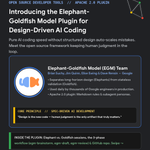
ALT Card 1 of 4 (Title Hook with Illustration): Google Open Source banner for "Introducing the Elephant-Goldfish Model Plugin for Design-Driven AI Coding" featuring the official minimalist split mark logo with a blue elephant profile and an orange goldfish profile. By the Elephant-Goldfish Model (EGM) Team: Brian Suchy, Jim Quinn, Elise Ewing, and Dave Rensin (Google). Subheadline: Pure AI coding speed without structured design auto-scales mistakes. Meet the open source framework keeping human judgment in the loop. Highlights: (1) Separates long-horizon design (Elephants) from stateless validation (Goldfish); (2) Used daily by thousands of Google engineers in production; (3) Apache 2.0 plugin: Markdown rules and subagent personas. Core principle quote: "Design is the new code — human judgment is the only artifact that truly matters."

ALT Card 2 of 4 (The 3-Phase EGM Lifecycle — From "No-Code" Brainstorming to Stateless Spec Validation): Stacked breakdown of the 3 co-design phases automated by the plugin: (1) Phase 01 (egm-brainstorm) — Long-Horizon "No-Code" Session: Growing the Elephant. Load system context and adhere to a strict "No Code" rule where the AI interviews you to co-design features, debate trade-offs, and challenge assumptions. (2) Phase 02 (egm-draft) — Executable Markdown Blueprint: Drafting with the Elephant. Iteratively draft a Markdown design spec covering problem definition, architecture, alternatives, and exact files to change. (3) Phase 03 (egm-review) — Zero-Context Adversarial Critics: The Goldfish Protocol. Spawn fresh, stateless Goldfish subagents with zero blind spots to probe the spec for ambiguity and logical gaps.

ALT Card 3 of 4 (Inside Phase 3 — How Stateless AI Reviewers Stress-Test Your Design Spec): Top cards contrast The Elephant (Long-Horizon Context-Rich Architect holding end-to-end architectural vision, project memory, and micro-decisions with zero code written) vs. The Goldfish (Zero-Context Stateless Skeptical Critic starting fresh with zero shared blind spots or sunk-cost bias to interrogate the Markdown spec objectively). Bottom terminal (egm-review — 3-Step Goldfish Validation Sequence): Step 1 Comprehension Check (naive reader summarizes spec back; flags ambiguous architecture or intent); Step 2 Antagonistic Review (skeptical personas probe edge cases; surfaces hidden dependencies and logical gaps); Step 3 Implementation Readiness (strict Go/No-Go gate verifying file paths, data structures, and signatures); Output: Validated Markdown Spec.

ALT Card 4 of 4 (X/Twitter Action Card — Explore the Open Source EGM Plugin & Rules on GitHub): Top box lists What is in the Apache 2.0 GitHub Repository: Authors Brian Suchy, Jim Quinn, Elise Ewing, and Dave Rensin (EGM Team); Repository github.com/google/elephant-goldfish-model (Apache 2.0); Included customizable Markdown rules, subagent personas, and workflows; Built for Google Antigravity (more IDEs upcoming). Middle box lists How to Get Started & Contribute: (1) Install the EGM plugin in Antigravity to automate Phases 1–3; (2) Customize validation rules and antagonistic Goldfish reviewer personas; (3) Shift from code micromanager to executive architectural reviewer. Bottom call to action: Read the Blog Post & Explore the GitHub Repo at https://goo.gle/elephant-goldfish-plugin (first reply below). Footer: @GoogleOSS.


ALT Card 1 of 4 (Competition Announcement): Google Open Source banner for "Verifiable Quantum Circuit Compilation Competition Powered by Kickmix" by Tanuj Khattar and Ryan Babbush (Google Quantum AI). Subheadline: Google Quantum AI is launching a Kaggle competition: use AI to compile smaller, more efficient quantum circuits—powered by kickmix, our new open source library in Qualtran. Bullets: (1) Competition Goal: Submit circuits that pass standalone Apache 2.0 verifiers while minimizing qubit & gate cost scores; (2) Core Open Source Project: kickmix in Qualtran (C++20 & Python) for building and fuzz-testing large quantum circuits. Spotlight: kickmix in Qualtran (github.com/quantumlib/Qualtran): Open Source C++20 & Python Circuit Verification Engine.

ALT Card 2 of 4 (Core Competition Project — Inside Kickmix: Open Source Circuit Building & Fuzzing): Stacked breakdown of the kickmix library in Qualtran: (1) Open Source Library (Apache 2.0) — kickmix in Qualtran (C++20 & Python): Purpose-Built for Large Fault-Tolerant Subroutines. Open sourced under Apache 2.0 inside Qualtran (github.com/quantumlib/Qualtran/tree/main/kickmix) to build and simulate 100M+ gate circuits on a single CPU core. (2) Verifiable Structure (PRX Quantum) — Bitstring-to-Bitstring + Phase Mapping: Reversible Logic, Phase Gates & Uncomputation, mapping each input bitstring to one output bitstring and phase. (3) Classical Verification (1 CPU Core) — 60 Billion Gates / Sec Fuzz Testing: Fast Approximate Verification for Agentic AI in linear time without exponential superposition blowup.

ALT Card 3 of 4 (Three Quantum Algorithm Competition Benchmarks): 2x2 grid detailing the 3 competition benchmarks and scoring: (1) Benchmark 01: Fusion Energy (PNAS) — Quantum Fast Inverse Square Root: Simulate charged particles slowing down in hot plasma fuel; given squared distance x, apply a phase proportional to 1/sqrt(x). (2) Benchmark 02: Optimization (Nature) — Decoded Quantum Interferometry: Solve Optimal Polynomial Intersection (OPI) by compiling a Reed-Solomon decoder in superposition. (3) Benchmark 03: Chemistry (PRX) — FeMoCo Nitrogen Fixation Lookup: Model nitrogenase FeMoCo active-site electrons via compact sum-of-squares Hamiltonian steps and quantum lookup table circuits. (4) Competition Scoring (Apache 2.0): Pass the standalone verifier while minimizing qubit and gate cost scores on Kaggle.

ALT Card 4 of 4 (X Action Card — How to Sign Up & Compete in the Kaggle Challenge): Top box lists Competition Hosts, Sponsors & Open Source Repo: Host & Platform @GoogleQuantumAI & @Kaggle; Authors Tanuj Khattar & Ryan Babbush (Google Quantum AI); Core Open Source Project kickmix in Qualtran (Apache 2.0 C++20/Python); Companion Paper arXiv:2610.23832. Middle box lists How to Sign Up & Submit: (1) Open the blog post in the first reply (goo.gle/kaggle-quantum-comp); (2) Download the Apache 2.0 baselines & verifiers from the Kaggle dataset; (3) Compress circuits with AI + kickmix in Qualtran & submit on Kaggle! Bottom CTA: Read Full Competition Details in the Blog Post at https://goo.gle/kaggle-quantum-comp.


