Google Open Source (@GoogleOSS) header
Google Open Source (@GoogleOSS) profile picture

Announcing new open source releases, exploring projects, sharing how we approach FOSS, and supporting communities around the world.

Mountain View, CA
Joined March 2017
Photo by Google Open Source (@GoogleOSS)Photo by Google Open Source (@GoogleOSS)Photo by Google Open Source (@GoogleOSS)Photo by Google Open Source (@GoogleOSS)Photo by Google Open Source (@GoogleOSS)Photo by Google Open Source (@GoogleOSS)Photo by Google Open Source (@GoogleOSS)Photo by Google Open Source (@GoogleOSS)Photo by Google Open Source (@GoogleOSS)Photo by Google Open Source (@GoogleOSS)
Google Open Source retweeted
Google DeepMind made its robotics simulation engine completely free and open-source. MuJoCo lets you simulate robots, physics and complex movements before testing anything in the real world. Get started in 3 steps: 1. Install: Run pip install mujoco 2. Build: Load a robot or physics model 3. Simulate: Run experiments and test how it moves You can start experimenting with robotics without owning a single robot. Repo: github.com/google-deepmind/m…
4
5
99
52,075
Honestly, if a tiny robot dog physically walked up to my desk and stared at me until I drank water or stood up after a 4-hour coding session, my posture would be cured immediately. 😭🐕💧 Love seeing @GoogleGemma 4 running 100% locally on an @Apple iPhone (airplane mode!) to keep wearable health data completely private, all while driving @PetoiCamp's open-source Quaddle. Incredible hackathon build! 👏
Your health companion has legs. 🐕 Abhinav Agarwal, Rithika Gurram, and Shobhit Dhamania built Bolt at the AGI House(@agihouse_org) Gemma(@googlegemma) hackathon in Silicon Valley. A Clair Health bracelet streams live data to an iPhone, Google's Gemma 4 answers questions about it right on the phone, and Quaddle, our open-source robot dog, is the companion's body on the floor. It works in airplane mode, with nothing sent to a server. Bolt's code (MIT): github.com/abhinav30219/bolt… Video by the Bolt team, who started from our Gemma + Petoi robots starter: starter repo: github.com/PetoiCamp/opencat… What would you like your AI health companion to do? cc  @DynamicWebPaige @make @irvinxyz @WeeklyRobotics @VantixAgency #PhysicalAI #Gemma #OnDeviceAI #Quaddle #OpenSourceRobotics #Robotics
3
1
1
15
2,225
Google Open Source retweeted
🥽 Write a 3D scene in Three.js, then bring it into native mobile rendering and XR without rebuilding the scene separately for every platform. Three-Live is an experimental project introduced by @GoogleOSS. It compiles supported Three.js code on-device through a sandboxed Rust runtime and connects it to Google Filament and Jetpack XR on Android, Apple RealityKit on Apple platforms, and WebGL2/WebXR in the browser. The project explicitly says it is not an officially supported Google product. Its current release is v1.4.0, published November 10. 🛠️ The useful part for AI-assisted 3D work is the feedback loop around the generated code: ▪️ Render a scene into a four-view contact sheet without requiring a GPU. ▪️ Validate it and return structured spatial information to an agent. ▪️ Compare a procedural model with a reference image using overlays and silhouette differences. ▪️ Convert a scene into GLB or USDZ. ▪️ Expose rendering, validation and conversion through an MCP server. That gives an agent something more concrete than “the code ran”: it can inspect what the object looks like, see spatial problems and revise its program. 🎮 There is also an agent gym interface for stepping through an interactive scene with actions and observations. Here, “gym” means a reset/step environment for testing behavior, not a claim that the project trains a new AI model. The XR side includes spatial traits such as grabbing, scaling and anchoring, plus runtime interaction and physics support. Browser studios let you explore the workflow before embedding the libraries in an application. This is a compiler and integration toolkit, not a promise that every arbitrary Three.js application will work unchanged. Platform capabilities, supported APIs and scene behavior still need testing on the intended device. The code is Apache-2.0. AI image generation and other connected model services have their own configuration and costs. For procedural assets, small interactive prototypes and agent-generated XR scenes, the interesting combination is portable scene code plus tools that let the agent actually inspect its output. 🧩 github.com/google/three-live #ThreeJS #XR #Procedural3D #MCP
1
5
687
Google Open Source retweeted
Announcing a major milestone achieved by my team @GoogleDeepMind: we have proven key security properties of the machine code underlying the Signal messaging protocol. This is the first time the actual production code of a widely deployed protocol has been formally verified – by any method, with or without AI – and at this depth. More than a research breakthrough, it’s a prime example of how frontier AI can be a force multiplier to counter the speed and scale of modern cyber threats. Formal verification offers a higher standard of security; however, it’s extremely complex and time consuming, which is why in many cases it’s considered to be impractical. Similar efforts could take teams decades of combined effort. We did it in a month’s time. Using AlphaProof Code, Google DeepMind's new agentic framework for formal verification that runs on LLMs including Gemini Carbon, we verified the Signal protocol down to the actual code running on devices.  This milestone lays the groundwork for a future in which vital systems, from medical device firmware to power grid software, ship with mathematical proof that their protections work. Reaching that future will take continued research from our community. In that spirit, we're open-sourcing our formal specifications and verification artifacts so others can build on this work. On a personal note, this moment is of deep significance to me. I started my own research journey more than two decades ago as an intern working on checking the consistency of complex software systems. Seeing this grand challenge made practical with modern AI is extraordinary. I'm extremely proud of my team members: Swarat Chaudhuri, Andrew Ferraiuolo, Anton Kovsharov, Tej Chajed, Sam Schlesinger,  Karn Seth, Jonathan Katz, and Charles Sutton for taking on this grand challenge and delivering, and grateful to the Signal team for their partnership. deepmind.google/blog/formal-…
221
686
232
5,627
570,760
Google Open Source retweeted
📦 Run remote package executables directly using the dart run command. Starting in Dart 3.12, you can execute one-off command-line utilities without adding them to your pubspec dependencies or installing them globally. goo.gle/4igoXFE
5
22
5
194
18,960
Google Open Source retweeted
Most of what shapes human health happens outside the doctor's office: in daily sleep, diet, and continuous physiological signals. What happens when AI helps connect those dots into a multi-year "health weather forecast"? A breakdown of the latest @GoogleResearch podcast👇
13
17
6
335
27,395
Google Open Source retweeted
Google Research released Ginger, an open-source C++ library for finding the nearest vectors in huge embedding sets. They built it to speed up graph-based search and cut its memory use. They tested it against seven other libraries on 14 public datasets, with up to one billion vectors and 4096 dimensions. Ginger uses Nested TurboQuant, a two-level code. The first 4 bits of each coordinate steer the graph search. Extra bits then rerank the results. A new codec called AdaptiveGap, plus vertex reordering, shrinks the graph by 2.1x on average. At 95% recall, Ginger speeds up query throughput by an average of 1.8x over each dataset's fastest competitor. With 12 bits per coordinate, it nearly matches 32-bit floats while using 2.6x less memory. The billion-point Deep index takes about 288 GB. My read: compression flips which part is bigger. The paper's example 96-dimension vector takes 144 bytes, and its flat graph list takes 260. At the average 2.1x shrink, that list drops to about 124 bytes, under the vector. arxiv.org/abs/2611.08306
2
2
9
1,103
Google Open Source retweeted
This is the missing piece for AI-made 3D. LLMs already write good three.js. Three-Live compiles that code in a sandbox into GLB and USDZ in 2–5 ms, so it opens natively in AR on iPhone and Android. Open source, Apache 2.0, developer preview.
Building interactive 3D, AR, and WebXR apps usually means wrestling with heavy 3D asset pipelines. Three-Live introduces an Apache 2.0 library + on-device Rust/Boa compiler turning procedural @threejs_org scripts into GLB, USDZ & WebXR in ms. 👇 Link in first reply
1
3
686
Google Open Source retweeted
Gemma 4 in Space. 🛰️ Google Research's Project Suncatcher just booted up data-center TPUs aboard a prototype satellite and ran Gemma 4 in Low Earth Orbit. For its "Hello World" test, engineers on Earth asked Gemma 4 to write a haiku about being in space. Passing over Svalbard, Norway, the satellite downlinked its response: Blue marble below Data streams in silent grace Starlight feeds my core. ✨ Built with Planet and running on a ~1kW solar budget, the team is now testing how TPUs handle heat and radiation in space.
35
130
19
1,117
54,766
Google Open Source retweeted
Very happy to support this on behalf of Google. We have long benefited from open source, are big contributors to open source and in fact have consistently made open weights models with Gemma available from @GoogleDeepMind @demishassabis . Onwards!
For my first post, I’m sharing a letter @NVIDIA signed on why open models matter. AI will transform every industry, power every company, and be built by every country. Open models strengthen safety and cybersecurity, accelerate innovation and diffusion, and enable sovereignty. The world needs both frontier closed models and frontier open models. images.nvidia.com/pdf/Open-W…
744
1,883
428
22,583
4,354,133
Google Open Source retweeted
💛Google Strikes Gold Again💛 Then share it for free with everyone!!!! Google’s OSS-Fuzz has quietly found and helped fix over 13,000 vulnerabilities and 50,000 bugs across ~1,000 open-source projects. It’s free continuous fuzzing (libFuzzer, AFL++, Honggfuzz + sanitizers) that runs at massive scale on critical C/C++, Rust, Go, Python, Java and other code. Maintainers get private bug reports without running the infrastructure themselves. If you work on widely used open source, this is one of the highest-leverage security tools available. Check it out: github.com/google/oss-fuzz Know any projects that should be on it?
2
28
294
17,236
Google Open Source retweeted
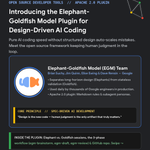
Google's Elephant-Goldfish Model is a free, open-source plugin for Claude Code, Codex and Antigravity. Google says thousands of its engineers use it. It's for anyone whose agent starts coding before the plan holds up. What I'd copy into my own setup: 1. One agent with your full project context drafts the spec before any code gets written. 2. Fresh subagents that never saw the chat review it. They catch the assumptions you never said out loud. 3. You make the trade-offs and approve the design. Only then does the agent build. 4. Skip it for small, clear bug fixes. Use it when a feature needs real design calls. 5. Later, run the drift report to check your docs still match the code. Repo: google/elephant-goldfish-model on GitHub. Worth the read. xitter.twitterapi.xyz/VaibhavSisinty/status/…
I found this on Reddit and this is crazyy. This guy spends a full day writing a Markdown spec before he lets Claude write any code. He has done it for over a year, on every project. Let Claude code straight away and the first two hours feel like magic. By day 3, you are stuck in a 150-message thread where fixing one bug breaks two more. Writing the plan first flips that. Mistakes on paper cost nothing. Mistakes in code cost weeks. His latest project proved it. Days revising the spec killed a bad sync design before a single line was written. Google open-sourced the same idea, taken further. It is called the Elephant-Goldfish Model. The Elephant remembers everything and writes the spec. It writes no code. The Goldfish remember nothing. Fresh subagents read the spec cold and poke holes in it before any code exists. That is the useful part. The plan gets attacked while it is still cheap to fix.
1
3
1
3
1,312
What if your best design reviewer was an AI that never saw the conversation? • Google's EGM: an "Elephant" AI drafts the spec, fresh "Goldfish" AIs hunt its gaps before coding • Try it today in Claude Code, Codex or Antigravity Kudos @GoogleOSS! opensource.googleblog.com/20…
1
1
1
1
780
Google Open Source retweeted
Google's Project Suncatcher prototype satellite booted an on-orbit TPU, making Gemma 4 the first language model to run inference in space; Reddit CEO Steve Huffman warned that Google AI Mode drives zero traffic as Reddit loses over 1 million weekly search visits; Wall Street technology shares tumbled over AI capital expenditure concerns, with Intel plunging over 30% intraday. On GitHub, developers backed open-source memory and agent tooling: MemPalace topped memory benchmarks while Harvey automated end-to-end sales pipelines without API keys. Key developments: 1. Google Boots Orbital TPU on Suncatcher Satellite to Run Gemma 4 Google confirmed that its Project Suncatcher prototype satellite successfully initialized an onboard TPU in orbit. Ground control sent execution commands, ran model prompts, and received a generated poem back on Earth. Google DeepMind developer experience lead Philipp Schmid cited Sundar Pichai, confirming Gemma 4 as the first large language model executed in space. Link: xitter.twitterapi.xyz/_philschmid/status/211… 2. Reddit CEO: Google AI Mode Drives No Traffic, Reddit Loses 1M+ Weekly Visits Reddit CEO Steve Huffman disclosed that Reddit lost more than 1 million weekly visits from Google search in October. Despite strong financial results, Reddit shares dropped over 25%. Huffman warned that Google's AI Mode fails to deliver web traffic to publishers. Reddit is testing login walls outside the United States to block automated web scraping and continuing commercial licensing talks with AI labs. Link: the-decoder.com/googles-ai-m… 3. AI ROI Fears Trigger Tech Stock Selloff, Intel Drops Over 30% Investor anxiety over massive artificial intelligence infrastructure spending triggered a second consecutive day of steep losses across US technology equities. Intel shares fell more than 30% intraday. Analysts point to extended payback periods on heavy data center capital expenditures, prompting valuation compressions across semiconductor and cloud providers. Link: bbc.co.uk/news/articles/cvwy… 4. MemPalace/mempalace (+357 stars today, Python) The MemPalace team released an open-source AI memory architecture designed for top benchmark performance. The system uses structured extraction and persistent state storage to give LLMs and autonomous agents fast cross-session recall, preventing context overflow and multi-turn state degradation. Repo: github.com/MemPalace/mempala… 5. ethanplusai/harvey (+248 stars today, Python) An autonomous sales agent built to run on existing Claude Code or Codex subscriptions. The tool operates without standalone API keys, finding sales prospects, generating customized cold outreach, sending email sequences, triaging replies, and booking calendar meetings automatically. Repo: github.com/ethanplusai/harve…
This incredible. Gemma 4 became the first LLM to run in space?
1
2
2
713
Google Open Source retweeted
🎤 Announcing the keynote lineup for #OSSummit Japan + #AutoLinux + #EmbeddedLinux in Tokyo, December 7-9! Hear from Kaz Sato of Google, Vivek Bhan of Renesas, Yuichi Nakamura of Hitachi, Omar Mohsine of the United Nations, Sachiko Muto of OpenForum Europe, Linux Kernel Maintainer Greg Kroah-Hartman, & more! Register by November 23 and save ¥30,000. MEET THE KEYNOTES: bit.ly/4dX6fR6 REGISTER: bit.ly/4cbg90v
2
14
3,955
Google Open Source retweeted
Artemis is an open source Android automation agent from Google. You type a goal in plain words, and it taps, swipes and types on a real phone or emulator. github.com/google/artemis
1
3
411
Google Open Source retweeted
If AI brings us the promise of the future, why are we still stuck in the past with chatbots in Markdown? Most AI applications today still work like a terminal from decades ago: you type a prompt, the agent runs a tool, and it dumps a wall of text back at you. Modern agentic interfaces should not only use richer UI elements, they should also adapt to what the user needs instead of forcing everything through a static, one-size-fits-all screen. That changes how we think about frontend development. Instead of designing hardcoded application screens upfront, we design a shared catalog of UI building blocks and let the agent assemble the interface on demand. Google's open Agent to User Interface (A2UI) protocol was built for this. Your frontend keeps full control over styling and native components, while the agent decides what to display based on context across three primitives: • Catalog: The menu of UI components (charts, gauges, tables, 3D views, buttons) shared between the backend agent and the frontend client. • Surfaces: The live UI canvas that updates in real time as the agent streams structured JSON messages. • Actions: Two-way events that turn a click on a table row, graph node, or button directly into the next turn of the conversation without typing a follow-up prompt. In my latest article, I used A2UI and Genkit to give my diagnostic agent, AIDA, the modern glowup she deserves, with dynamic UI elements rendered on-demand and human in the loop tool approvals for the most critical operations. Read the full article on danicat.dev: danicat.dev/posts/designing-… Companion repository: github.com/danicat/go-aida
1
1
7
1,062
Google Open Source retweeted
What 467 Conformant A2A Agent Cards Are Actually Offering 467 providers serve a conformant A2A agent card. Nearly half came from a docs platform default with one skill: read our docs. Most of the rest are agent-native companies selling by the call. apievangelist.com/2026/10/26…
2
1
1
580
Google Open Source retweeted
No more frameworks on top of languages? Use AI to generate whatever code an app needs to reach a goal? In some cases, sure. But I like using certain frameworks that do smart things for me. @GenkitFramework is definitely that for agentic @golang apps. genkit.dev/blog/genkit-go-1-…
1
6
1
25
2,180
Google Open Source retweeted
Genkit Dart 1.0.1 is here! 🚀 What's new: • Primitive input schemas for tools across all providers • genkit_firebase_ai agentPlatform & custom httpClient • Session state & interrupt resume fixes Thanks to garvitkaushik-123! 🎉 👇
1
2
15
1,200