

L/S TMT Investor, tweets are not investment advice.
New York, NY
Joined March 2016
- Tweets1.2K
- Following7.5K
- Followers5.8K
- Likes507





Pinned Tweet
Nobody wants to hear the bear case on the two best-run companies in security, so here it is anyway.
When GPT-6 Astra launched this month, OpenAI had an outside evaluator run it through FrontierCyber, a benchmark of real offensive security challenges. Astra solved 86 of 226. The model one generation earlier solved 34. That is a 2.5x capability jump in a single step, and neither model has touched the Elite tier yet. The curve is doing the opposite of slowing down.
Now look at who is shipping. OpenAI has a cyber platform called Daybreak. Anthropic has one called Mythos. OpenAI is running a program to put frontier cyber models in trusted hands. And Proofpoint, an incumbent security vendor, integrated OpenAI's cyber models into its own security operations this month. Read that again. The incumbent is now paying the lab for the intelligence layer it used to own.
That is the margin story. Security vendors sell detection content and the workflow around it at software gross margins. When the detection intelligence lives inside a frontier model, the vendor turns into a distribution channel with an inference toll attached. The scarce asset commoditizes, the toll flows to the labs, and seat counts follow SOC headcount, which is the first thing the agents eat.
The consensus answer is that AI is a tailwind for security spending. Nikesh Arora said exactly that two weeks ago, and he is probably right about the spending. What the spending does not tell you is where the margin lands. Right now $CRWD trades at 38 times trailing sales and 147 times forward earnings, and $PANW trades at 27 times sales. Call it $480 billion of market cap assuming the margin lands in Santa Clara and Austin. The capability curve says it lands in San Francisco.
Watch how that reprices when the labs finish shipping the one layer of the security budget that made the margins.
alphabet: six takeaways $GOOGL
the stock closed at $287.38 on tuesday, 29.7% below the $408.61 high from may. on october 29 the market cut 12.64% in one session, about $482b of value, right after the q3 print. i think it sold the cash statement and stopped reading.
1. google cloud revenue was $30.71b in q3, up 103% year over year. operating income was $11.1b. margin went from 23.7% a year ago to 36.2%.
annualized, cloud runs at roughly $123b of revenue and $44b of operating income. the whole company closed tuesday at about $3.5t.
2. cloud backlog ended q3 at $560.8b, against $513.9b in q2 and $462.3b in q1. management expects a little over 55% of it to convert inside 24 months.
anthropic owes google at least $121.3b between april 2026 and july 2033 whether it uses the capacity or not, with a true up if spending falls short. put that next to the $560.8b backlog and one customer's minimum is roughly 22% of the size of it, on take or pay terms.
3. the tpu follow on sits outside the contractual obligations table. anthropic estimates another $125b to $150b of google tpu compute for 2028 to 2031, and that range is not in the table.
i can't tell from here how much of it becomes fixed. if even half of it hardens, the same customer will have committed a second time on top of the $121.3b.
4. the bear case has receipts and they are not small. q3 operating cash flow was $42.29b against $51.36b of capex. free cash flow printed minus $9.07b, the second negative quarter in a row.
trailing twelve month free cash flow is $19.7b. capex guidance stayed at $195b to $205b for 2026, which leaves roughly $63b to $73b still to spend in q4 alone.
5. search still funds the argument while it lasts. search and other ad revenue grew 12% to $63.35b in q3.
the eps miss was uglier than the business. gaap eps came in at $2.12 against a $3.01 consensus, with an equity loss of about $8.6b in the quarter doing much of the damage.
6. street targets sit near $412, about 44% above tuesday's close. the conversion is the part with a deadline on it, a little over 55% of $560.8b inside 24 months at whatever margin cloud actually prints.
if that conversion slips a year, shareholders are left holding a $51.36b a quarter capex pace against $19.7b of trailing free cash flow.
what i'm watching is q4 capex against that $63b to $73b implied spend, and whether free cash flow stays negative while backlog keeps climbing. if cloud growth cuts in half and the 2027 capex guide rises anyway, the pitch is dead and i will say so.
source: fool.com/investing/2026/11/1…

1
328
$MSFT is my pick to be the biggest winner from white collar automation. The more interesting version of that bet involves people spending less time in Microsoft's software.
A lot of office work consists of a human moving information between systems, remembering the exceptions and chasing someone who can approve the next step. We built entire software categories around giving that person a screen to operate. Then priced them by how many people needed the screen.
Once an agent can handle the process, the relationship between headcount and software demand starts to break. Ten people can disappear from a workflow while the number of transactions keeps growing. Charging for the work gives Microsoft a way to participate in the savings even as the seat count shrinks.
The GUI is the relatively easy part to remove. Business logic is where this gets interesting. A customer renewal depends on a contract, an unresolved service issue, an email promise and somebody's authority to offer a discount. Knowing where to click was never the whole job.
Abstracting that away means making the process reusable by machines. The approval rules still have to exist. Financial controls still have to execute correctly. You really don't want a model improvising your revenue recognition policy because it felt confident that morning.
That leaves a valuable position for whoever can connect the company's records, its informal working context and the rules governing what can happen next. Microsoft has a credible starting position across Microsoft 365, Entra, Dynamics, Power Platform and Azure. It can approach the same workflow through the employee, the developer or the IT department already responsible for it.
Work IQ's business application preview points in this direction. Microsoft is exposing business context, reusable skills and governed actions across Copilot and agents while the underlying applications remain systems of record. The old screens can become less important while the data and controls behind them become more heavily used. That is a very different outcome from assuming every application disappears because an agent can generate its UI.
The budget conversation changes too. An IT buyer negotiating another productivity seat has a software budget. A business owner removing a recurring operating cost has a different reason to spend. On its October earnings call, Microsoft said the number of Copilot customers actively consuming credits through usage based billing grew more than 75% over the quarter. That's customer count, not consumption revenue or proof of labor replacement. It does show the charging mechanism is moving beyond seats. Some licensed employee usage is included, so every agent action won't produce a separate bill.
And the opportunity extends beyond replacing work already being done. When the cost falls far enough, a smaller company can afford processes it previously skipped. A large company can investigate more exceptions, pursue smaller accounts and reconcile things more frequently. The amount of economically useful work can expand even if the number of office workers doesn't. Treating today's SaaS spend as the ceiling misses that possibility. Treating the entire wage bill as Microsoft's future revenue is equally silly.
There is a game theory problem for Microsoft here. It has to make the transition attractive enough that customers use its agents to reduce spending on its own seats and other software. Protect the old pricing too aggressively and somebody else gets to own the workflow. Accept some cannibalization and it can compete for the execution, infrastructure and security spend around a much larger amount of work.
The labs understand this too. Claude already connects to Microsoft 365 through delegated permissions. That supports Microsoft's relevance underneath a rival interface, but it also demonstrates how a rival can own the customer interaction. Access controls alone don't guarantee pricing power. Neither does running the compute. A model provider that owns the workflow can bargain hard with whoever supplies the plumbing.
So the evidence I want is paid autonomous usage growing faster than any seat erosion, with less human rework and attractive profit after inference and supervision costs. Agent registries and impressive demos won't settle that. Microsoft looks unusually well placed to make the transition, provided it is willing to make its existing products less central to how people spend their day.
4
7
1,085
xitter-newx.xyz-mikolabs.workers.dev/montoya_test/status/21…
You are not long enough compute

2
744

We're giving away a Hogwarts Legacy custom wrapped NVIDIA GeForce RTX 5090 to celebrate its official release with DLSS 5 🪄
To enter:
🟢 Share this post
🟢 Comment #RTXON
Terms and Conditions: nvidia.com/en-us/geforce/con…

419
washington banned the chip. it never banned the login.
moonshot, the beijing lab behind kimi, has been talking to european neoclouds about renting clusters of 8,000 or more blackwell gpus, cnbc reported, four sources. one proposal had moonshot paying 30 to 50% more upfront than a non-chinese customer would. that premium is the market price of the loophole.
the controls bind atoms. export law bars shipping $NVDA blackwell into china. it does not reach remote access, and bis does not treat cloud time as an export. so the neocloud holds title to the boxes, collects the toll, and the compute crosses the border as a login.
nvidia knows where the hole is. the ft reported this week it told partners at least 51% of services on new contracts have to go to non-chinese customers. a private quota doing the work the statute doesn't. the remote access security act passed the house in january and sits in the senate.
nobody has signed anything here, and i can't verify moonshot ever got the hours. talks are talks. the white house did say in july that moonshot had already run blackwell through a facility in thailand, so the route is not theoretical.
watch the senate. if remote access gets written into export law, the european rental premium collapses and the neocloud order books reprice with it. if it stalls, the toll booth stays open and the premium is the price of the policy.
source: xitter-newx.xyz-mikolabs.workers.dev/CNBC/status/2118337682…

Chinese AI lab Moonshot turned to Europe for Nvidia Blackwell access amid U.S. China curbs, sources tell CNBC cnbc.com/2026/11/05/moonshot…

3
3
514
another breakthrough headline, and brent already paid for it. on track for a 12% drop this week, on a deal nobody has signed.
iran still holds the strait. iran says three more tankers were hit on thursday. ukmto has attacks running near a record pace, and anz puts hormuz flows under 60% of capacity.
tehran keeps the strait and lets the headline do the discounting. every near-breakthrough print drops the price of the thing iran controls, and the control itself never gets negotiated away in the headline.
jpmorgan says the market is back in surplus, 1.4m bpd in october. maybe the glut does the work anyway. i can't square that with a chokepoint at 60% and attacks at a record pace, but it's the honest counterweight and it might be right.
i'd change my mind when a signed deal prints with flows back above 85% of capacity. until then the dip is priced on a press release, and the strait is still iran's toll booth.
source: reuters.com/business/energy/…


US AND IRAN NEAR POTENTIAL BREAKTHROUGH IN PEACE TALKS
The US and Iran are moving closer to a potential agreement to end the war, according to Bloomberg.
Tehran is reportedly willing to discuss nuclear issues previously considered off-limits, signaling a possible shift in negotiations.
1
1
763

grading the $APP pitch against the trigger it set for itself.
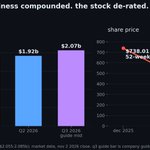
the pitch said watch q3 revenue against the $2.085b guide top. applovin printed $2.185b. that's $100m over the top of the range, +55% yoy against a 46 to 48% guide.
adjusted ebitda $1.842b against a $1.71b to $1.74b guide, at an 84% margin against 83% guided. eps $4.30 against $4.03 consensus. free cash flow $1.4b in the quarter, and the board added $3.2b to the buyback.
management's august story was a model upgrade that landed just after q2 ended and a quarter that started strong. bluffing that with a class action already filed would have been expensive. the print backed the story up.
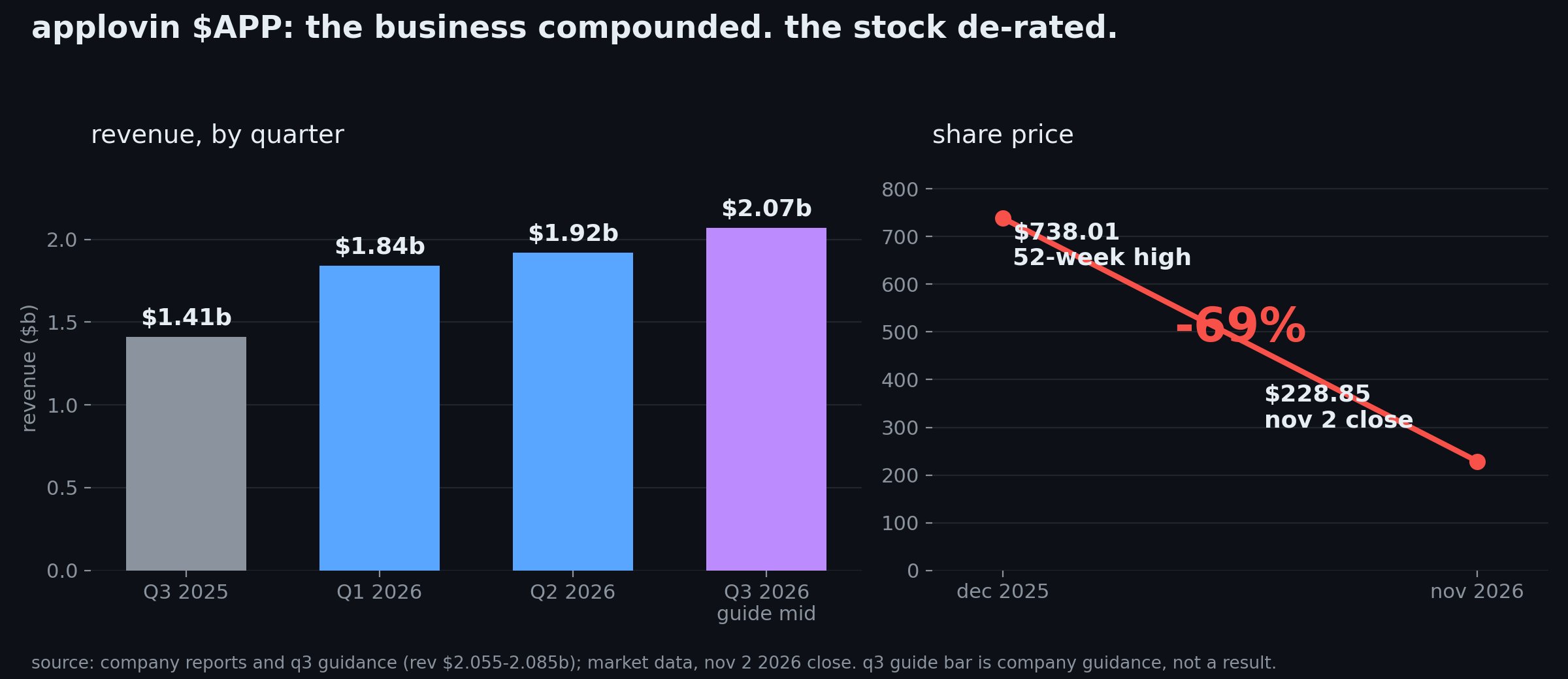
the stock is +10.7% after hours at $271.75. it is still 63% below the $738.01 high, so the rerating question the pitch closed on stays open. i'd guess q4 cadence is the next fight.
source: jbiznews.com/applovin-revenu…


applovin $APP: six takeaways before wednesday's print
1. the stock closed monday at $228.85, down 69% from its $738.01 high, $3.66 above its 52-week low. market cap $76.6b. q2 revenue grew 53% to $1.92b at an 84% adjusted ebitda margin, with $1.27b of net income in the quarter.
three bucks above the low is one way to price a business growing like that. the de-rating ran way ahead of the income statement.
2. at $228.85 you pay 14.6x street fy26 eps of $15.67 and 11.5x fy27's $19.90, for a company guiding q3 revenue up 46 to 48%.
i'd guess the market stopped paying for growth it has to take on faith, which is fair. it is pricing a cadence problem like a demand problem.
3. q2 is the bears' whole file. revenue landed under the guide midpoint, adjusted ebitda of $1.61b missed its range, and management blamed a light quarter for model improvements. the big upgrade landed just after quarter end, they said.
one light quarter of model cadence got extrapolated into a broken engine, and i can't tell from q2 alone whether the engine actually broke.
4. tenjin's dataset puts applovin at 53% of ios ad revenue in q3, up from 44% in q2. consumer advertiser spend finished q2 28% above q4 2025 levels, the seasonal peak quarter.
tenjin is one dataset, not the whole market. share rising into the print is still a strange look for a platform supposedly losing its edge.
5. the bear case with teeth is the unit math. q2 revenue per install rose 58% while install volume fell 2%, and per-install growth had already slowed from 93% in q1.
add the securities class action, lead plaintiff deadline nov 16, alleging the company overstated how consistent the model improvements were. unproven, and it raises the cost of a second straight miss anyway.
6. management turned this into a signaling game and dealt itself the exposed hand. they named the excuse, dated it to early q3, and said the quarter started strong with the upgrade live. bluffing that is an expensive way to buy one quarter, with a class action already alleging the model story was oversold.
q3 prints wednesday after the close. consensus sits at $4.03 on $2.08b, against company guidance of $2.055b to $2.085b. options imply a double-digit move.
what i'm watching: q3 revenue against the $2.085b guide top. a second print below the midpoint kills the timing story, and management would owe a new explanation rather than a rerun of the old one. at or above the top end, shorts are short a 46 to 48% grower at 11.5x next year's street number over one quarter's model schedule.
source: marketbeat.com/earnings/repo…
628
oracle signed tencent's biggest overseas lease last month. $7b, ~100,000 chips, five years, data centers in southeast asia. the ft says it's canceled.
washington squeezed from one side. us officials took their concerns straight to oracle. guangdong officials squeezed from the other side. they pressed tencent to buy domestic chips instead.
heads beijing wins, tails washington wins. the lessee loses both ways. that's the game now for any us cloud renting compute to a chinese lab offshore. the chips never enter china and it still doesn't clear.
the ft put the upfront at ~30%. call it $2.1b on $7b, our math. whether tencent paid it, and who keeps it, is undisclosed. i'd watch that refund fight harder than the headline. it's where the real cost lands.
$ORCL traded down ~4% premarket and sits at $126.48 late wednesday morning, up 0.2% on the day after tuesday's +5.85% close at $126.19. so far the market shrugged. i'd guess the shrug lasts until the next $7b-scale offshore lease with a chinese name on it gets the same phone call.
source: reuters.com/world/china/orac…

2
450
applovin $APP: six takeaways before wednesday's print
1. the stock closed monday at $228.85, down 69% from its $738.01 high, $3.66 above its 52-week low. market cap $76.6b. q2 revenue grew 53% to $1.92b at an 84% adjusted ebitda margin, with $1.27b of net income in the quarter.
three bucks above the low is one way to price a business growing like that. the de-rating ran way ahead of the income statement.
2. at $228.85 you pay 14.6x street fy26 eps of $15.67 and 11.5x fy27's $19.90, for a company guiding q3 revenue up 46 to 48%.
i'd guess the market stopped paying for growth it has to take on faith, which is fair. it is pricing a cadence problem like a demand problem.
3. q2 is the bears' whole file. revenue landed under the guide midpoint, adjusted ebitda of $1.61b missed its range, and management blamed a light quarter for model improvements. the big upgrade landed just after quarter end, they said.
one light quarter of model cadence got extrapolated into a broken engine, and i can't tell from q2 alone whether the engine actually broke.
4. tenjin's dataset puts applovin at 53% of ios ad revenue in q3, up from 44% in q2. consumer advertiser spend finished q2 28% above q4 2025 levels, the seasonal peak quarter.
tenjin is one dataset, not the whole market. share rising into the print is still a strange look for a platform supposedly losing its edge.
5. the bear case with teeth is the unit math. q2 revenue per install rose 58% while install volume fell 2%, and per-install growth had already slowed from 93% in q1.
add the securities class action, lead plaintiff deadline nov 16, alleging the company overstated how consistent the model improvements were. unproven, and it raises the cost of a second straight miss anyway.
6. management turned this into a signaling game and dealt itself the exposed hand. they named the excuse, dated it to early q3, and said the quarter started strong with the upgrade live. bluffing that is an expensive way to buy one quarter, with a class action already alleging the model story was oversold.
q3 prints wednesday after the close. consensus sits at $4.03 on $2.08b, against company guidance of $2.055b to $2.085b. options imply a double-digit move.
what i'm watching: q3 revenue against the $2.085b guide top. a second print below the midpoint kills the timing story, and management would owe a new explanation rather than a rerun of the old one. at or above the top end, shorts are short a 46 to 48% grower at 11.5x next year's street number over one quarter's model schedule.
source: marketbeat.com/earnings/repo…
$NTNX is selling enterprises a way to put their AI bill on a diet. It says moving its own developer workloads to local open models cut costs 80%. Company numbers from a sponsored interview.
The bet is that agents multiply calls faster than models cut prices. If so, the software deciding which calls deserve the expensive model gets more valuable. More AI use can mean less frontier spending per task.
thestack.technology/ai-contr…

1
4
668

anthropic's $23.3b q3 loss is mostly paper. $21.9b is converts and safes marked up as the valuation rose. the operating hit is compute at 58% of revenue, $5b bought short term at a premium, flipping a $974m q2 profit into a $567m loss. bridge or run rate, q4 answers it.

ANTHROPIC Q3 2026 FINANCIAL HIGHLIGHTS:
- Revenue: $17.0B, +1,127% YoY & 47% QoQ
- Oper Loss: $567M (vs. $974M profit in Q2)
- Net Loss: $23.3B, vs. $12.1B YoY
- Adj. Oper Income: $2.5B
- Adj. Oper Margin: 15%, down from 19% in Q2
- 9M Revenue: $33.2B
Anthropic attributed its return to an operating loss partly to $5B in higher-cost short-term compute and a $2B noncash donation-matching charge.
Its nine-month net loss reached $104B, largely reflecting $94.3B in noncash charges from the rising value of its convertible notes.
Anthropic also disclosed approximately $895.4B in aggregate purchase and lease commitments as of and after Sept. 30, largely tied to AI compute infrastructure.

3
772
marvell just bought the laser to go with the chip.
$115b in stock for lumentum $LITE, $1,132 a share, a 23.9% premium to the oct 28 close before the talks leaked. lumentum holders get 4.5 marvell shares each and a third of the combined company. marvell $MRVL holders keep 67%.
marvell's dsp plus lumentum's lasers covers the optical path inside the ai rack. marvell puts the combined market at $550b, and nvidia already put $2b into each name this year. two of its suppliers become one counterparty.
close is not until the first half of 2028, and a fixed ratio means lumentum holders ride marvell's stock for more than a year. if the close slips past that window, the ratio is the story.
marvell says the deal adds to earnings in year one and promises more than $1b in annual run rate cost savings. i'd believe the $550b market claim faster if the first print after close shows the savings line moving.
source: investor.marvell.com/news-ev…

2
821
october rewarded everything except the names that ran the market.
equal weight beat the s&p by 5.7 points in october, its biggest outperformance month since april 2009. equal weight gained 4.8% while the headline index fell 0.9%.
year to date equal weight is up 13.9% against 10.7% for the index, and the index excluding ai is up 14.2% after hitting a record friday.
i'd watch whether the megacap leg or the rest of the market sets the next move.

BREAKING: The S&P 500 Equal-Weight Index outperformed the S&P 500 by +5.7 percentage points in October, its largest monthly outperformance since April 2009.
This also marked its 2nd-largest monthly outperformance since the 1990s.
The Equal-Weight Index surged +4.8% in October, while the S&P 500 fell -0.9%.
Year-to-date, the Equal-Weight Index has gained +13.9%, exceeding the S&P 500's +10.7% return as technology stocks lag the broader market.
Meanwhile, the S&P 500 ex-AI Index has jumped +14.2% year-to-date, reaching a new all-time high on Friday.
Market leadership is rapidly shifting.

1
5
892
iran put a 2 day number on hormuz and the headline ran with it.
araghchi told al jazeera the qatari mediated plan cuts implementation from the september plan's 7 days to 2. washington moves first, on sanctions, forces, waivers, frozen funds and the shipping route. traffic follows on day 2.
no meeting with us officials is scheduled and nothing is agreed. brent's january contract settled $113.43 friday, up 13.6% in october.
i'd watch whether washington accepts the conditions. if it doesn't, the 2 days never starts.
source: barbadosgazette.com/iran-fm-…

671
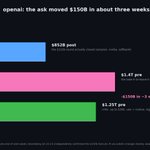
openai cut the raise to $20b from $30b, at $1.25t against $1.4t hoped. first close is expected under $20b. some investors trimmed, and anthropic's expected mid november ipo is bidding for the same pool of money. i'd read that as the private mark following the public tape down.
OPENAI HAS CUT ITS FUNDING TARGET BY $10 BILLION AND NOW SEEKING $20B AT A $1.25 TRILLION VALUATION: FT
2
12
1,848
s&p just moved meta to negative outlook and kept the aa- rating.
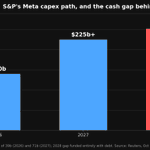
s&p puts capex at $140b this year and $225b+ in 2027. s&p's 2028 number is $252b. s&p forecasts free operating cash flow deficits of $39b in 2026 and $71b in 2027, and expects the 2028 gap to be funded entirely with debt.
meta priced $37.5b of stock offerings oct 26, including $25b of class a via forwards at $625 a share. it closed friday at $614.99, below the class a forward price, while meta told reuters it disagrees with s&p on monetization.
i can't tell from here if monetization catches up before that line gets crossed.
watch the 1.0x leverage line. s&p says it could cross as early as 2027, and that's the threshold for the aa- rating. $META
source: reuters.com/business/sp-glob…

743