

🚀We are the world’s preeminent launch complex for government and commercial space access. We usually post in ET.
- Tweets19.7K
- Following189
- Followers3M
- Likes6.2K






ALT NASA’s Vehicle Assembly Building at Kennedy Space Center stands beneath a clear blue sky, displaying a large American flag, NASA insignia, and Artemis logo. To the left of the building, two aircraft create a large heart-shaped pattern.



ALT Two jet aircraft fly overhead, trailing white smoke streams against a clear blue sky with the bright sun creating a starburst effect.

ALT Visitors gather beneath a large exhibit tent to explore NASA displays, including a full-scale lunar rover mockup.

ALT A parachutist descended beneath a yellow canopy while carrying a large American flag over a grassy field. Spectators stand behind a safety barrier, watching and photographing the demonstration against a clear blue sky.

ALT A child participates in a virtual reality experience wearing a NASA branded VR headset and holding a handheld controller raised overhead.


ALT NASA scientist Julie McEnery stands on a stage beside a large screen displaying a slide titled “WFI Focal Plane Array,” featuring a close-up image of a blue segmented detector array. Several audience members are seated in the foreground watching the presentation. The auditorium is dimly lit with blue accent lighting and space-themed imagery visible above the screen.

ALT NASA's Suzanne Bell stands on a stage holding a microphone beside a large NASA presentation slide titled, “How Is NASA Preparing Astronauts to Live and Work on the Moon?” The slide features an illustration of a lunar astronaut and a close-up view of the Moon's surface. Blue accent lighting illuminates the auditorium, and the presenter is positioned in front of the screen while addressing an audience.

ALT A young child wearing a spacesuit costume seen from behind looking into a space exhibit.

ALT A young child wearing a red and white hat peers into an encased space rover exhibit.

ALT A child wears a virtual reality headset with a red NASA “worm” logo on the front of the visor.

ALT A futuristic vehicle is shown in a static display at a technology expo.

ALT Up-close view of a small-scale, tabletop model of the Moon Base, which includes lander vehicles, power stations, and astronaut habitats.

ALT People are seen viewing Apollo-era exhibits.

ALT A wide shot of the outdoor exhibit space. People are seen viewing large, static aircraft displays.


ALT Two people are seen speaking in an exhibition hall. Small-scale models of spaceflight technologies and vehicles are displayed on a pedestal nearby.

ALT A golf-cart-sized futuristic aircraft is shown in a static display at a technology expo.

ALT Two people look up and raise their phones to the sky as military aircraft fly over in formation during an air show.

ALT Several people mingle within an exhibit hall. Table displays and exhibit banners are seen throughout the event space.
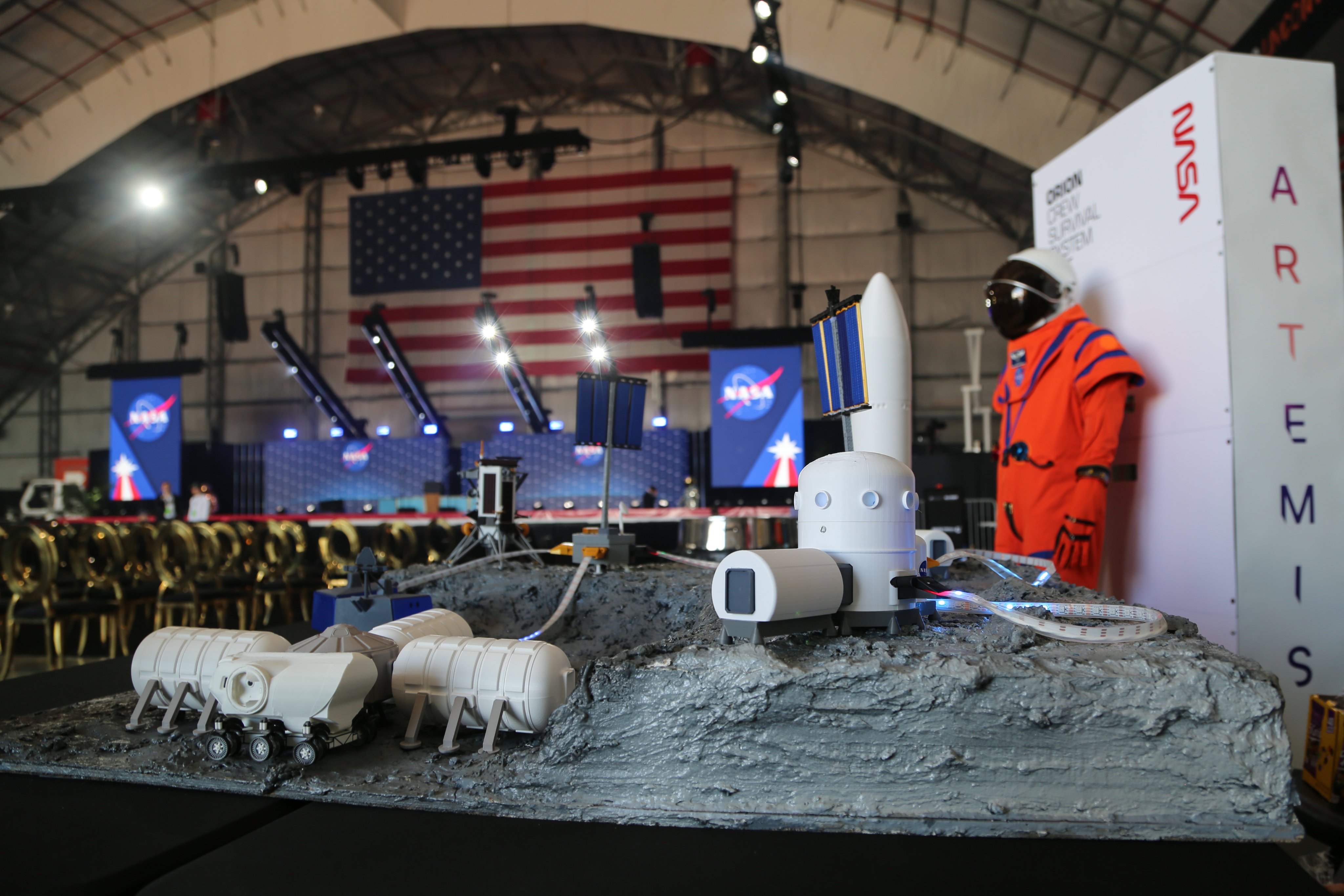
ALT A NASA exhibit at UP.Summit during MAX POWER on Nov. 6, 2026, features a conceptual lunar surface display illustrating the power infrastructure needed to support longer-duration missions on the Moon. In the foreground, miniature habitation modules and other lunar surface assets sit atop a gray, rocky terrain model, demonstrating how infrastructure could support sustained lunar exploration. The display is illustrative and does not represent a finalized Moon Base design. Behind the model stands an orange Orion Crew Survival System suit, with a stage and large American flag visible in the background. Credit: NASA/Briana Zamora


ALT NASA ORBIT logo

ALT A team of three college students pose next to their presentation poster during a NASA ORBIT Challenge competition

ALT NASA’s X-59 experimental supersonic aircraft in flight over the ocean, seen from the side with its long, needle-thin nose pointing left. The aircraft is silver-white on top with a dark blue underside. Puffy white clouds and a strip of coastline fill the background.

ALT A close-up view of the Moon captured by an Artemis II crewmember using an iPhone on April 6, 2026, during flight day six of the mission. The image reveals the Moon’s rugged, gray-white surface, covered in countless impact craters of varying sizes. Some areas appear relatively smooth, while others are densely packed with overlapping craters. Along the right edge, sunlight casts deep shadows across the cratered terrain, sharply contrasting with the blackness of space. Credit: NASA


ALT NASA astronaut and Expedition 75 flight engineer Anil Menon smiles for a portrait while conducting spacesuit maintenance inside the International Space Station's Quest airlock.
ALT NASA astronaut and Expedition 75 flight engineer Anil Menon smiles for a portrait while conducting spacesuit maintenance inside the International Space Station's Quest airlock.

ALT An image that shows the "MAX POWER Kennedy Space Center" app as it appears in the iOS App Store.