The Official *NASA* Webb X account. The world's most powerful space telescope. Launched: Dec. 25, 2021. First images revealed: July 12, 2022.
- Tweets11.6K
- Following63
- Followers3.5M
- Likes4.5K





ALT Mid-infrared image of the Cat’s Head Nebula by Webb. A bluish-gray filament of dust is in the center, stretching from the bottom to almost the very top. It has a narrow, irregular shape that resembles a cat sitting with its back toward the viewer and a tail extending downward. The cat’s head is turned toward the right, revealing a white glowing eye. (middle) Near-infrared also by Webb. An orange-brown filament of dust is in the center, stretching from the bottom to almost the very top. On the cat’s left are ghostly filaments of dust. (center) Visible-light image by Hubble. A dark brown, opaque filament of dust is in the center, stretching from the bottom to almost the very top. Approximately halfway down, cutting diagonally across the frame, the background color changes from blue to yellow, orange, and finally red near the bottom.


ALT Image description: A quote by Captain Jean-Luc Picard, played by Patrick Stewart. "I've come to believe that the stars have always been in my favor." - Jean-Luc Picard. The image shows a dense cluster of bright stars, each with six large and two small diffraction spikes, due to the telescope’s optics. They have a variety of sizes depending on their brightness and distance from us in the cluster, and different colors reflecting different types of star. Patches of billowing red gas can be seen in and around the cluster, lit up by the stars. Small stars in the cluster blend into a background of distant stars and galaxies on black.

ALT A nebula made of clouds of gas and dust with stars forming within. In the center and out to the left it is filled with thin, wispy blue gas that forms delicate layers. Around this are thicker orange clouds with dark ridges. Thin red filaments of gas cross the center of the nebula. Glowing bubbles in the gas contain dense, very bright clusters of stars. In the edges, distant stars are visible as bright points on a dark background.

ALT A field full of small galaxies of all shapes against the blackness of space. A few bright white stars show 8 prominent diffraction spikes. A small galaxy at lower right is highlighted with a white box. A shaded triangle extends upward to the corners of a larger box showing a zoom in of the region. Two fuzzy, light blue blobs are at center, with a larger and brighter one at top. Just above the top blob is a white crosshair showing the location where a fast radio burst was detected.


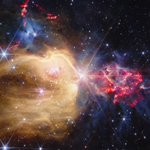
ALT A young star cluster filled with many stars that display Webb’s unique eight-pronged diffraction pattern. At its center is a yellow star which sports the largest diffraction pattern. To the left of the star, there is a region filled with yellow dust and gas that extends from the star to the left border of the image. This yellow region extends from the bottom, covering about two-thirds of the image. The yellow region has several blue stars of different sizes embedded within. The top third, which lies outside of the yellow region, holds a few bright protostars, within dense gray gas. Those stars illuminate the gas, making it appear blue. A few red outflows from other protostars are visible above this grayish-blue region. To the right of the central star, there is a clumpy, flame-like plume of red dust and gas with protostars that emit a soft white light within. The plume is surrounded by more dense gray gas and dust. Image credit: NASA, ESA, CSA, STScI, Processing: Alyssa Pagan.
ALT A young star cluster filled with many stars that display Webb’s unique eight-pronged diffraction pattern. At its center is a yellow star which sports the largest diffraction pattern. To the left of the star, there is a region filled with yellow dust and gas that extends from the star to the left border of the image. This yellow region extends from the bottom, covering about two-thirds of the image. The yellow region has several blue stars of different sizes embedded within. The top third, which lies outside of the yellow region, holds a few bright protostars, within dense gray gas. Those stars illuminate the gas, making it appear blue. A few red outflows from other protostars are visible above this grayish-blue region. To the right of the central star, there is a clumpy, flame-like plume of red dust and gas with protostars that emit a soft white light within. The plume is surrounded by more dense gray gas and dust. Image credit: NASA, ESA, CSA, STScI, Processing: Alyssa Pagan.

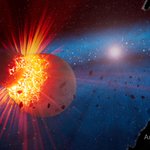
ALT Artist’s concept of a star and its debris disk against the black background of space. The star is in the background, right of center, and depicted as a small, luminous sphere. The debris disk is a large blue ring that encircles the star. The debris disk is angled toward the viewer, so that the portion nearest to the viewer extends beyond the bottom frame of the illustration. Many dark, rocky fragments are scattered throughout the debris disk. In the foreground, toward the left, is a small planetary embryo colliding into the left side of a larger spherical object. The impact site glows bright yellow and orange and has a mottled appearance, as though chunks of both colliding bodies are breaking up and being destroyed. Orange-yellow streams of vapor extend outward from the collision area. Behind the debris disk and its star are many small stars in the background. A label in the bottom right corner reads “Artist’s Concept.”

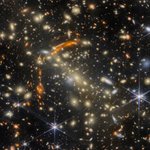
ALT A massive galaxy cluster, made of many golden elliptical galaxies with the largest, brightest one in the center. Heavily distorted orange galaxies appear all around the cluster, the largest concentrated in a large arc around the cluster's center; these are images of very distant galaxies, created by gravitational lensing. A few galaxies are large and bluish-white in color; bright, nearby stars are the same color.

ALT A horizontally oriented poster with an image of Centaurus A against a black background. The galaxy is brightest at its center, where a brilliant white and pink glow radiates outward. Wispy, 'S'-shaped ribbons of pink arc above and below the center of the image. A parallelogram-shaped band of gray and white dust cuts across the middle of the galaxy. The galaxy’s outer edges fade into soft textures that stretch toward the left and right sides of the image. Along the bottom is a series of thin vertical bars ranging from purple at left to blue, green, yellow, orange, and red at right. Bars are separated slightly, with black in between. Bar colors are brightest at the bottom, fading up to black. Brightness varies from bar to bar, giving the array an undulating feel. At upper right is text that reads, "National Aeronautics and Space Administration" and NASA’s blue, white, and red meatball insignia. Title text appears at lower left that says, "James Webb Space Telescope: Centaurus A."

ALT A star-forming region. The left two thirds of the image is blanketed in thick clouds of green and yellow gas and dust that form swirling patterns. Some of the gas is spread into thin, thready wisps. The right third of the image is the black background speckled with stars and multi-colored dots that represent distant galaxies. Bright stars are scattered throughout the clouds, with the densest cluster situated in the center of the scene. Each is crowned with six long spikes and two shorter spikes created by the optics of the telescope’s mirrors.

ALT An irregular galaxy, appearing like a broad band of tiny stars. It is denser on one side, with a faint cloud of gas among the stars. Clumps of brighter points are newly formed stars, with the largest lights being star clusters, and with many surrounded in glowing blue gas clouds. Plumes of red dust surround the galaxy. A foreground star appears

ALT A bright, densely populated star cluster lies near the centre of the image. One yellow star is labeled IRS 3. A spot in the middle is labeled Sgr A*.

ALT A bright, densely populated star cluster lies near the centre of the image, surrounded by intricate clouds of glowing gas and dust in shades of red, pink, orange, and blue. Dark lanes of dust weave through the nebula, contrasting with the luminous central region. Countless stars are scattered across the field, with a few brighter foreground stars showing Webb's characteristic diffraction spikes. A white box surrounds the region of interest. White lines extend from the box and point to the image at right, which is an enlarged image of the region of interest. One yellow star is labeled IRS 3. A spot in the middle is labeled Sgr A*. .

ALT A region of space filled with bright stars and clouds of gas. In the center, the densest clouds form the shape of a chest with its lid open. The chest appears to glow from within. At its base it breaks apart into long pillars of thick gas. Many of the gas clouds in the background are dark orange globules, while others form large, pale hazes. A few brightly shining stars lie in the foreground, the biggest and brightest in front of the chest’s lid.

ALT Webb’s near and mid infrared combined image of planetary nebula NGC 2392, the Lion Nebula, against the black background of space. The nebula is at center, circular in shape, and looks like a male lion’s head. In the center is a small, pinkish-white circle with eight-point diffraction spikes, a white dwarf star. Surrounding the star are purple-pink cavernous bubbles and shell-like rings. The bubbles and shells collectively form an oval with two small, wide arcs near the top, reminiscent of a lion’s face and its ears. What appears to be extended outward from the lion’s face is a thick ring of purple-blue material. The width of the ring is consistent throughout and resembles a mane. The area closest to the lion’s face looks cloudy, while the edges of the mane look like there are clumps of dust with comet-like tails. In the background are distant galaxies and stars. Some galaxies are yellow and orange points of light and others have spiral structures. Some stars have diffraction spikes.

ALT A prototype of NASA’s James Webb Space Telescope’s NIRISS (Near Infrared Imager and Slitless Spectrograph) non-redundant mask with seven hexagonal pinholes with outlines of the telescope’s primary mirror segments and secondary mirror support struts. When light passes through these pinholes, it creates a pattern of overlapping light waves. Similar to overlapping waves in water, these light waves can interfere constructively (combine together) or destructively (cancel out) with each other, creating a complex pattern of light and dark spots known as fringes.


ALT A rectangular image with thousands of galaxies of various shapes and colors on the black background of space. Some are noticeably spirals, either face-on or edge-on, while others are blobby ellipticals. Many are too small to discern any structure. One prominent foreground star at top center features Webb’s signature 8-point diffraction spikes. At upper right, a box shows a zoomed in portion of the image. The pullout features a spiral galaxy labeled “WISEA J123635.56+621424.2.” The galaxy has a bright yellow center and faint brown arms speckled with regions of blue that appear to wind clockwise around the galaxy’s core.