
The Official *NASA* Webb X account. The world's most powerful space telescope. Launched: Dec. 25, 2021. First images revealed: July 12, 2022.
- Tweets11.6K
- Following63
- Followers3.5M
- Likes4.5K


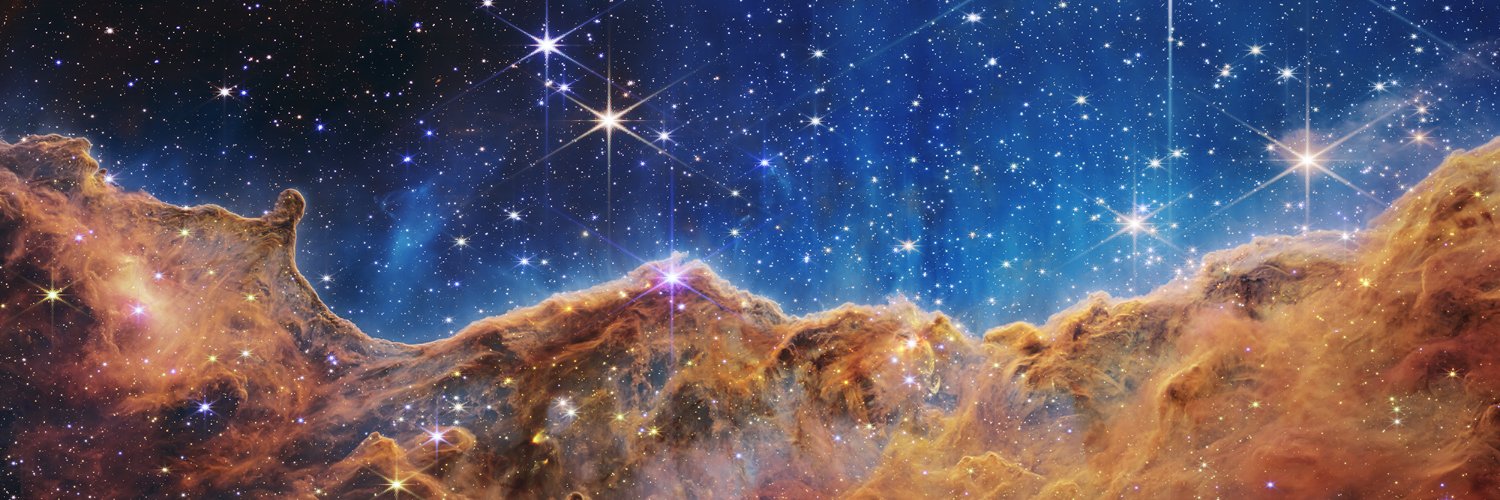
ALT This is a composite image of a small portion of the Carina Nebula reveals a striking golden-orange cloud of gas and dust that loosely resembles a ghostly figure. Its glowing hooded head and a sweeping cape-like tail stretch through a star-filled background of rich blues, reds, and greens. Brilliant blue-white stars sparkle in the scene, while bright pink dots of X-ray light reveal young stars scattered across this eerie stellar nursery.

ALT On an abstract purple space-inspired background, illustrations of 11 space telescopes form the shape of a heart around another. Each telescope is shaded in a monochrome blue palette, and they have a variety of different shapes and features. These spacecraft are not depicted to scale. Credit: NASA

ALT This is a multiwavelength image of galaxy NGC 1672. At its center are two thick, spiraling, dark purple arms that bridge a brilliant white and neon pink core. Those bridging arms create a bar, which channels gas to the core, making NGC 1672 a barred spiral galaxy, like our own Milky Way. Longer, wispier arms also spiral out from the core, dotted with gleaming white and pink stars.

ALT Three images of the Tarantula Nebula, each representing a different wavelength of light, presented in a different color. When layered atop one another, like sheets of colored cellophane, they combine to produce a vibrant and informative singular image. The base layer features a blanket of wispy blue clouds against a black backdrop. These clouds represent hot gas observed by Chandra. The second layer cuts diagonally across the cloudy blue square, tilted from our upper left down toward our lower right. This red layer represents infrared data collected by Webb. The third layer is a diamond-shaped image, with its points touching the edges of the big blue base layer. This green layer represents data captured by NASA's Hubble Space Telescope. In the center of the combined image, the three translucent layers overlap, resulting in an image of intermingled blue, red, and green clouds that blend to include lively shades of fiery orange, golden yellow, and deep purple.



ALT A person in a head-to-toe white clean room suit holds a large purple "boarding pass" for NASA's Nancy Grace Roman Space Telescope in Goddard's large cleanroom. The boarding pass includes an image of the 18 detectors, an artist concept image of the telescope, a QR code, and the NASA logo. "Roman Telescope" is written where the name would go.

ALT The plate attached to the Roman telescope, where a memory card containing names will be attached. It's a tall, thin, rectangular silver plate. At the top of the plate is the stylized Nancy Grace Roman name logo. Below is the silhouette of Roman's 18-square detectors in their iconic arch shape. Text below that reads "NASA's first chief astronomer, Nancy Grace Roman, persevered through barriers and made powerful space telescopes a reality. She envisioned a world where everyone had access to, and enthusiasm for, science. This observatory is the continuation of her legacy and dream." Below the text is an illustration of Dr. Roman looking up, next to her name and the years 1925-2018. Below the years is a small box where the memory card will be affixed. The plate is held down with two large bolts at the top and bottom.

ALT The fully assembled Roman telescope in the clean room, standing upright. It's a silver cylinder with solar panels peeking out from behind both sides like wings. The hood is deployed, like a black sun visor on a baseball cap. Orange lifts and people in white cleanroom suits surrounded the telescope, highlighting how large it is. The unfolded lifts only reach about one-quarter of the way up the telescope's body. Instrumentation and cables are visible in a section about one-third of the way up the body. Thousands of tiny squares on the wall behind the telescope are air filters for the clean room.

ALT This is a composite image of the young star cluster known as Westerlund 2. Here, scores of gleaming white specks ringed in neon pink are scattered across the image in a band that stretches from our lower right to our upper left, and beyond. Clouds of brick-orange dust enter the image from our lower left, and spread along the bottom edge of the frame, showing off the raw materials of this active stellar nursery.

ALT A close up image of spiral galaxy NGC 1365 and the supermassive black hole at its center. Here, the galaxy is shown at a dramatic angle, as if the bright pink core is gazing past our right shoulder. Swirls of pale, grey-blue material, resembling waves in a dark ocean, spiral toward the radiant pink core, which hangs at our upper left. Glowing pink circles, and flecks of red, dot the churning spiral galaxy.



ALT A spiral galaxy shines in the background, with a white circle around the disk, with a few smaller circles throughout. The Webby Awards logo is at center in black text.

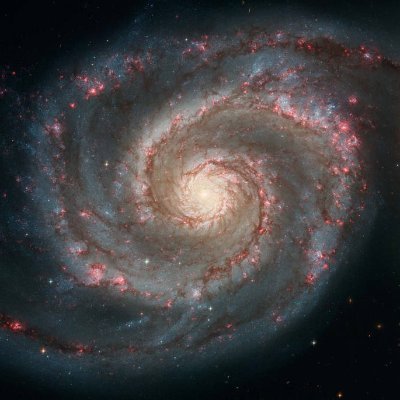
ALT A massive spiral galaxy glows with a yellow core, surrounded by arms full of orange-brown dust and pink and blue patches of star formation. Framed by a haze of dark dust, the galaxy shines against black space dotted with a few stars.\n

ALT In this composite image of the Cat's Paw Nebula, pockets of starry blue sky appear behind thick, overlapping rings of dark orange cloud. At the center of the image, tucked amongst the clouds, is a mottled patch of purple.

ALT A close-up view shows a galaxy\u2019s bright, yellow center, surrounded by patches of glowing orange-brown dust and pink stars.\n


ALT James Webb Space Telescope engineering model and Parker Solar Probe full-scale model on display in a museum gallery. Space Shuttle Discovery can be seen in the background.


ALT A black-and-white drawing shows a banner that reads \u201CGo Artemis II!\u201D, with each corner of the banner held up by space telescopes: the James Webb Space Telescope at upper left, the Roman Space Telescope at upper right, the Chandra X-ray Observatory at lower-right, and the Hubble Space Telescope at lower-left.