

#NASAMarshall delivers NASA's most vital propulsion systems, launch vehicles, cutting-edge science, and more. Verification: https://xitter-newx.xyz-mikolabs.workers.dev/t.co/f1Rtti0Zm6
- Tweets20.9K
- Following87
- Followers839K
- Likes22.4K







ALT An artist’s illustration of several satellites floating in space. The Earth takes up the lower half of the image. The satelleites that surrond the Earth are sending down bright blue lines of light, representing data being sent down to Earth. Credit: NASA

ALT A concept of operations for Artemis III

ALT A composite NASA Chandra X-ray and Sloan Digital Sky Survey (SDSS) optical image of the galaxy NGC 4559 located about 30 million light-years from Earth. The Chandra data shows X-ray point sources represented in purple, and the SDSS data shows the galaxy and foreground and background objects in red and blue. The luminous blue variable and supernova impostor AT 2016blu is in the middle of the small square. X-ray: NASA/CXC/Univ. of Virgina/M. Aghakhanloo et al.; Optical: SDSS; Image Processing: NASA/CXC/SAO/P. Edmonds

ALT Artist’s concept of living and working at Moon Base. Credit: NASA

ALT A sinuous spiral galaxy (center) appears in the same field of view as a vivid gravitational lens (right corner) in this Hubble image. The lens consists of a reddish elliptical foreground galaxy and the blue arcs of a magnified background galaxy. NASA, ESA, and X. Huang (University of San Francisco); Processing: Gladys Kober (NASA/Catholic University of America)


ALT Poster reading “Journey to Titan: Fly your name to another world!” showing NASA’s Dragonfly rotorcraft flying over Titan’s orange dunes above two sample Dragonfly boarding passes, one in English and one in Spanish.
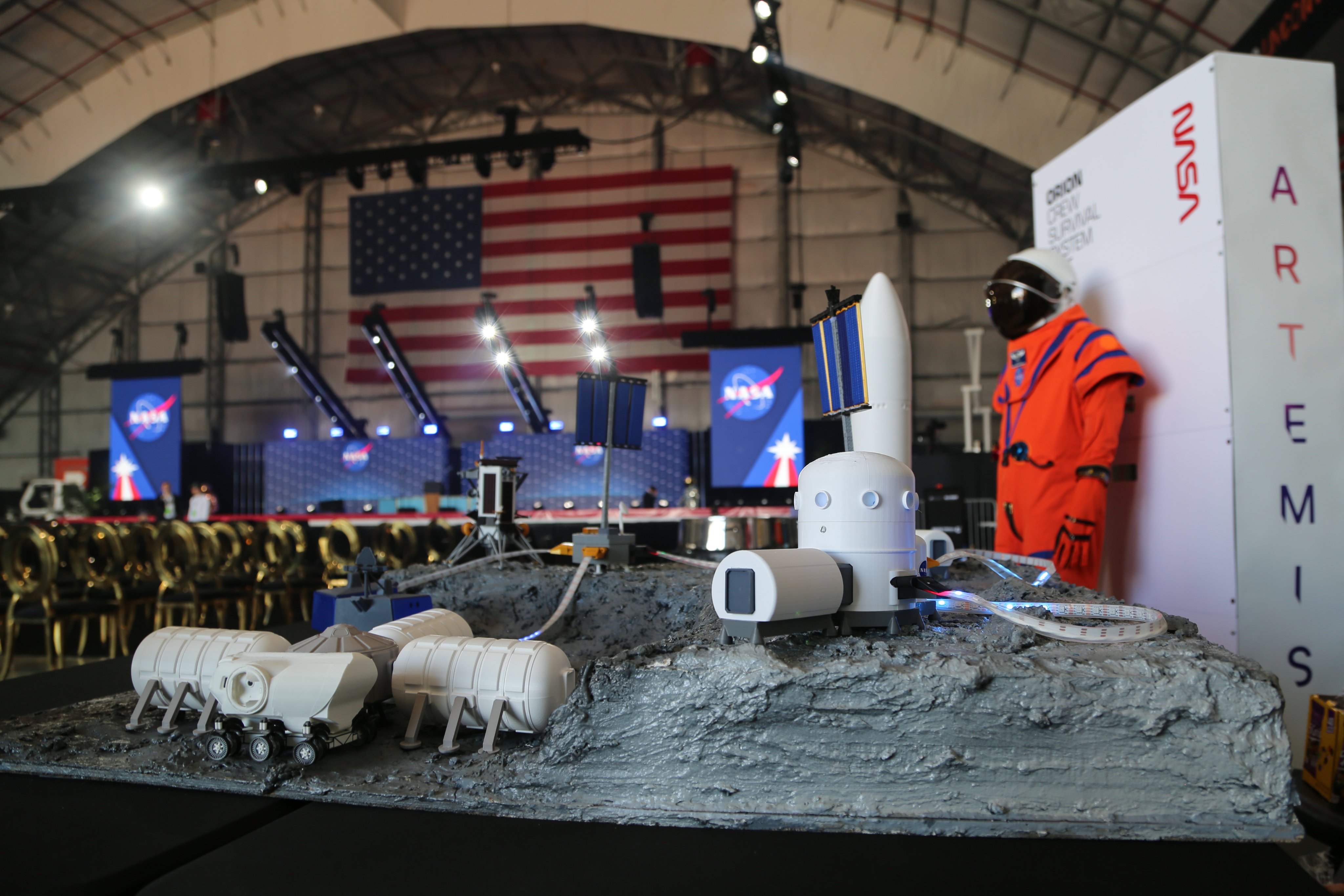
ALT A NASA exhibit at UP.Summit during MAX POWER on Nov. 6, 2026, features a conceptual lunar surface display illustrating the power infrastructure needed to support longer-duration missions on the Moon. In the foreground, miniature habitation modules and other lunar surface assets sit atop a gray, rocky terrain model, demonstrating how infrastructure could support sustained lunar exploration. The display is illustrative and does not represent a finalized Moon Base design. Behind the model stands an orange Orion Crew Survival System suit, with a stage and large American flag visible in the background. Credit: NASA/Briana Zamora


ALT This is a composite image of the barred spiral galaxy NGC 4725 against a black background filled with stars and distant galaxies. The galaxy appears tilted diagonally, with a bright cream-colored central bar surrounded by a soft blue disk. A single prominent spiral arm wraps around the galaxy, giving it an unusual one-armed appearance. Small magenta points scattered throughout the galaxy represent X-ray sources detected by NASA's Chandra X-ray Observatory. The galaxy is encircled by a faint ring of star formation, while bright foreground stars sparkle throughout the surrounding field of view.

ALT Credit: CSA/Joshua Kutryk

ALT This image, taken with Hubble’s Advanced Camera for Surveys, reveals bright-blue regions along the galaxy’s disk dotted with dark dust lanes where new stars are likely forming. A bright foreground star appears just to the left of the galaxy’s bright central bulge but is located between us and the galaxy. Its four diffraction spikes are the result of light bending around the internal supports that hold Hubble’s secondary mirror. Credit: NASA, ESA, Michael Jones (California Institute of Technology); Image Processing: Gladys Kober (NASA/Catholic University of America)

ALT The large sunshade of NASA’s Near-Earth Object Surveyor mission is inspected by a technician at BAE Systems Space & Mission Systems in Boulder, Colorado, in late July. Credit: BAE Systems Space & Mission Systems


ALT The four-member Crew Health and Performance Exploration Analog (CHAPEA) crew poses outside the 3D-printed habitat shortly after exiting on Oct. 31, 2026. The crew spent 378 days in isolation and confinement simulating a mission to Mars. From left are Science Officer Matthew Montgomery, Flight Engineer James Spicer, Commander Ross Elder, and Medical Officer Ellen Ellis. Credit: NASA/James Blair

ALT This graphic is an artists concept of both SpaceX and Blue Orgins lunar lander test articles in a high Earth orbit. The graphic reads, Houston we Have a Podcast: Episode 443 Artemis III: Paving the Way to Lunar Landings. Credit: NASA, SpaceX, Blue Origin