

The fastest way to fund science. $1.8M+ funded, powered by $RSC. Post an RFP. Discover high quality preregistered proposals. Paid peer review in 10 days.
Earth 🌍🌎🌏
Joined January 2019
- Tweets3.2K
- Following1
- Followers43.3K
- Likes7K




Pinned Tweet
Since January 2025, ResearchHub has deployed over $1.5M in research funding to scientists worldwide.
We just redesigned our funding page to make it even easier for funders and researchers to connect.
Take a look ↓ researchhub.com/fund
ResearchHub retweeted

ResearchCoin ($RSC) is now live on @blockchain.
More ways to get RSC means more people funding science.
Put your RSC into ResearchHub Endowments and it continuously funds scientific research.

What if scientific research could move better and faster?
Enter @ResearchHub. A market for the best science.
$RSC rewards the work that advances science — funding it, reviewing it, replicating it, discussing it.
Now available in your Blockchain Trading Account.

ResearchHub retweeted

What if scientific research could move better and faster?
Enter @ResearchHub. A market for the best science.
$RSC rewards the work that advances science — funding it, reviewing it, replicating it, discussing it.
Now available in your Blockchain Trading Account.
⏳ ~3 days remain to claim a live peer review bounty.
Review a proposal exploring general anesthetics and the hard problem of consciousness.
Submit a review to earn $150 in $RSC. 👇
researchhub.com/proposal/332…


ResearchHub retweeted

Over the last few years, we’ve published several papers demonstrating the remarkable ability of humans learning how to balance upright with large time delays in the control loop of stance.
Not only can humans re-learn to balance under these challenging circumstances, they can generalize this learning to different contexts (movement directions, muscle effectors, sensory conditions).
We have performed these experiments using custom-designed robotic balance simulators - located only in our labs.
Our findings have transformed our understanding of balance adaptation and learning, opening the door to many new questions.
We have multiple exciting projects underway, and have a few new ideas we will be sharing on @ResearchHub in the near future.
Looking forward to discussing more on this work and our future plans.
Reach out if interested or wanting to know more.
Link to published papers below 👇

ResearchHub retweeted

Really proud that our lab is now officially part of @AnthropicAI "AI for Science" program!
With credits provided by Anthropic, we can now massively scale up our computational work.
We will use them for many exciting projects, including foundation models for stroke multi-omics that feed into a closed-loop drug discovery approach in human tissue, and much much more. 🧑💻🧬🧠
ResearchHub retweeted

A 2024 EEG study analyzed 36 students writing by hand or typing with one finger. Handwriting showed wider brain connectivity, but memory was never tested
A @ResearchHubF proposal plans to have 160 students learn 30 words by hand and 30 by typing, then test recall 7 days later

ResearchHub retweeted

Brian Armstrong says science should work like open source. He's been saying it since 2019, and it's how @ResearchHub started.
ResearchHub retweeted
Have a question for the NIH Director?
Submit it for a chance to have it answered during Dr. Jay Bhattacharya's keynote Q&A at SciCon 2026.
📩 Submit here ↓
forms.gle/XKyvFWQ1p5uzLSXBA

ResearchHub retweeted
Read here the 𝗦𝗰𝗶𝗲𝗻𝗰𝗲 𝗡𝗲𝘄𝘀 article about our new preprint.
In our study we show that LLMs found 96% of planted errors in clinical trial papers. Human peer reviewers found 27%. We tested 15 LLMs on the three papers from the 2008 BMJ study.
Even the weakest model found 53%, and results held up on 58 new clinical studies from 2026. Humans are still needed to judge novelty and significance. But for clinical trials, I think AI checks should be part of every review (with secure tools and where journal policy allows).
Thank you Jeffrey Brainard for the nice piece!
Read it here: science.org/content/article/…

ResearchHub retweeted
Paying reviewers for peer review is the right thing to do, and we've been doing this at @ResearchHub for several years.
However, if this is supposedly the question authors care about most (which it absolutely should not be and I refuse to believe!), they should probably reconsider why they're doing science.
“What authors get is an answer, usually within about five to ten days, to the question they care about most: does this paper have a real chance at the journals I am aiming at?”
Peer review should be about the scientific record and the public, not a journal-placement service for authors
nature.com/articles/d41586-0…

ResearchHub retweeted

We need infra for science validation.

Publicly funded science should work more like open source software.
Today a result is a PDF. The data often isn't shared, the code isn't public, and few studies ever get replicated.
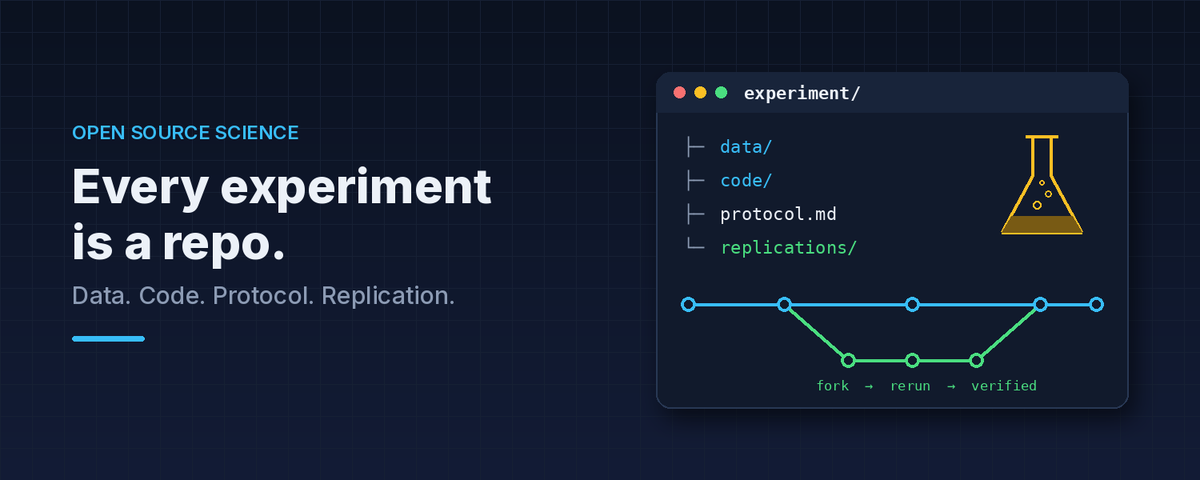
Imagine every experiment as a repo. Data, code, and protocol, all versioned. Anyone could fork it, rerun it, and send a fix. Funders could reward replications as much as new papers.
AI makes this urgent. Agents are now making more discoveries than ever. The bottleneck becomes replication/validation. Then commercialization, which still requires moving atoms in the real world and meetings with regulators.
ResearchHub retweeted
Replit's CEO says the real AI upside is new discovery and medicine, not coding. CZ says the bottleneck is the 10 year trial process. Elon says breakthroughs are going exponential
Someone still has to fund the experiments. That's what @ResearchHub does


ResearchHub retweeted

DeSci loading 🧪🧪🧪
@ResearchHub $RSC
Publicly funded science should work more like open source software.
Today a result is a PDF. The data often isn't shared, the code isn't public, and few studies ever get replicated.
Imagine every experiment as a repo. Data, code, and protocol, all versioned. Anyone could fork it, rerun it, and send a fix. Funders could reward replications as much as new papers.
AI makes this urgent. Agents are now making more discoveries than ever. The bottleneck becomes replication/validation. Then commercialization, which still requires moving atoms in the real world and meetings with regulators.
ResearchHub retweeted
I absolutely agree. In our new NIH-funded research we try to adhere to this as much as possible. Ideally, data should be released the moment the result is there. The paper can serve as a sort of summary, but it should not be the primary outcome, because it emphasizes storytelling more than the actual results.
This would be super easy if all scientists had a digital lab book that could be traced. AI could easily make this accessible to everyone, at least whatever can be shared. And @NIH could (and should) mandate this very easily. This would also help to make scientists more accountable to the research they proposed to do in their grants. That helps with reproducibility and many of the other problems.
We will also try to implement and incentivize as much of this as we can with @ResearchHub, and keep making research more open and easily available.
ResearchHub retweeted

Fund wet-lab validation, then replication, of in silico discoveries on @ResearchHub.
DMs are open!
Publicly funded science should work more like open source software.
Today a result is a PDF. The data often isn't shared, the code isn't public, and few studies ever get replicated.
Imagine every experiment as a repo. Data, code, and protocol, all versioned. Anyone could fork it, rerun it, and send a fix. Funders could reward replications as much as new papers.
AI makes this urgent. Agents are now making more discoveries than ever. The bottleneck becomes replication/validation. Then commercialization, which still requires moving atoms in the real world and meetings with regulators.
ResearchHub retweeted

Having fun with @buzzdotxyz's new plugin system, giving agents crypto wallets with on-chain spending limits and using them to help me find and fund science on @ResearchHub
Imagining what an effective on-chain agentic research org might look like.
ResearchHub retweeted
Update: Peer review on the revision in!
Reviewers are positive on our changes. Just a few minor clarification edits to make and then will turn this around for publication.
Will provide a full summary breakdown on our findings here and on @ResearchHub once the paper is published.

Project update:
A few months ago, we submitted a research paper based on this project to a journal (will reveal which journal once accepted) for peer review.
In this study, we imposed delays between motor actions and self-motion while participants steered a vehicle to track an unpredictably moving target. We used a control theory approach to estimate how manual tracking behavior is adapted in the presence of novel feedback delays in the control loop.
We received positive and constructive feedback from the peer reviewers. After considering their comments, we performed a new modelling analyses to estimate the sensorimotor controller. Specifically, we developed a computational model to estimate how the dynamics of the sensorimotor controller were adjusted in response to the increased delays.
Our revised manuscript was submitted a few weeks ago, and we are looking forward to read reviewer feedback on our revised paper.
We will provide updates when the review comes in. Stay tuned.
Follow updates here:
researchhub.com/proposal/158…
ResearchHub retweeted
One of the biggest untapped opportunities for AI in biology may be locked inside lab notebooks.
Making them openly accessible, including failed experiments and details papers leave out, could so greatly improve AI models, deepen our understanding of biology, and make science more reproducible.