

Editor + founder @ReadTransformer, covering AI policy. Prev: @TheEconomist, @Protocol, @finimize
London
Joined October 2009
- Tweets17.5K
- Following2.6K
- Followers9.4K
- Likes20.5K


Pinned Tweet
For the past few months, @ReadTransformer has been working with the incredible team at @NYMag on this: The AI Power List.
When NY Mag first reached out about collaborating on this, I was thrilled. Everyone knows the big names in AI: Sam, Dario, Demis, Elon, Jensen and the like. But so much of the *real* power in AI is inscrutable to the wider world. It is held by people well-known to insiders, but with little-to-no public presence — despite their outsized influence on the future of humanity.
NY Mag and Transformer profiled 26 of these powerful insiders. They're the people deciding how AI is used, developed, regulated, and thought about. They're remarkably intertwined, universally fascinating, and still have everything to play for.
These new power brokers will decide how AI shakes out, refashioning the world for the rest of us in the process.
It's time to get to know them.

AI has minted a new power structure. A handful of private companies command the might and wealth of small nation-states and are mostly left alone to self-govern. A few hundred employees are on the brink of becoming centimillionaires and considering which causes and presidential candidates they will funnel their vast resources toward.
One way to tell the story of how AI is changing our world is through some newly familiar names: Sam Altman, Dario Amodei, Jensen Huang. But an astonishing amount of power rests in the hands of a few dozen other people, some virtually anonymous.
For this year’s annual “Power” issue, we are surfacing 26 people whose influence on the AI landscape far outstrips their fame.
We partnered with @ReadTransformer, a publication with a command of the politics within transformative AI, whose team drew on its years of reporting, as well as new interviews with more than 50 high-ranking industry leaders, to help articulate what makes these people powerful.
The AI scene is small. Many are remarkably intertwined, sharing offices, homes, and funding. The list’s average age is 36. It is also overwhelmingly male. Read about the few dozen power brokers who will decide how AI shakes out, refashioning the world for the rest of us in the process: nymag.visitlink.me/AgEtqI


An important update and apology from Transformer regarding our AI Campaign Finance Tracker:
Today we discovered an error in our AI Campaign Finance Tracker. A bug in how our tracker deduplicates filings which has meant that we have undercounted spending from American Mission, part of the Leading the Future network, by about $9.6m, and double-counted about $1.4m of spending by Guardrails Alliance, a pro-safety PAC.
The bug was introduced in late June, and most of the error built up in late October. Since the bug was introduced, our headline figures have therefore been undercounting “pro-innovation” spending and overcounted “pro-safety” spending. Post-midterms, our headline figures were $44.4m pro-safety vs $27.9m pro-innovation, or 1.6 to 1. The corrected figures are about $42.9m vs $37.0m, about 1.16 to 1. Pro-safety groups still outspent industry, but by much less than we reported.
We know lots of people relied on our tracker as a source of truth in the midterms: as the editor ultimately responsible for it, I am very sorry that its numbers have not been accurate.
The tracker has now been corrected and checked against FEC filings, so it is now accurate. Going forward, if we run a similar project in 2028 we will implement better review processes to make sure an error like this cannot happen again.
My GOD.

Jensen Huang had a relationship with an Nvidia executive who reported to him.
nytimes.com/2026/11/11/techn…

Interesting, someone in Trump world trying to throw Lutnick under the bus?

In the Oval Office, Trump authorized China export controls on Nvidia's advanced AI chips — even consulting Elon Musk before giving the go-ahead Thursday
But Commerce Secretary Howard Lutnick has stood in the way
W/@m_ccuri on what happened
axios.com/2026/11/11/trump-l…


Hendrix is a smart AI thinker — bullish on good AI legislation coming out of Tennessee!

Building an administration that reflects the priorities of Tennesseans starts with having the right people in key leadership positions.
@michael_hendrix understands the policy challenges and opportunities facing our state. He brings a depth of experience that will be important to our team as we move forward.
I am pleased to appoint him as Chief of Staff and look forward to the leadership he brings to this role!
Fun, I was targeted by this!


I just unraveled the biggest AI astroturfing campaign I’ve found yet.
I found hundreds of fake accounts posing as Americans. The operation traces back to a supposedly defunct Israeli influence company.
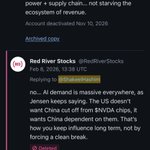
They posted thousands of times in the last year to support Nvidia, back chip exports and data centers, attack U.S. lawmakers, and dismiss concerns about AI.
When it broke that Jensen Huang, Nvidia's CEO, was romantically involved with an alleged spy (who runs a company accused of chip diversion and whom US officials believe was passing information to Beijing), dozens of these accounts rushed to Jensen’s defense.
These accounts have targeted people pushing for export controls that ensure advanced chips aren’t going to China. Chris McGuire, a former White House national security official, got more than 100 replies from the astroturf network attacking him and his position on chips. Lawmakers who criticized the chip sales were called “peabrains” and “pure evil,” and accused of spreading “anti-Trump propaganda.”
Throughout this yearlong pro-Nvidia campaign, the operators have been hiding their tracks. They quietly deleted nearly two-thirds of the pro-Nvidia posts that we found, something they seem to do for many of their campaigns.
These accounts have spent years running campaigns that appear to serve the interests of corporate and political clients — most recently supporting the Rapid Support Forces in Sudan’s civil war, a group the U.S. government has accused of genocide.
Many of them trace back to a supposedly defunct Israeli influence company, Koios. In 2025, Haaretz reported that Koios helped run a covert pro-Qatar campaign devised by aides to Benjamin Netanyahu. While Koios claims to have ceased operations in 2025, it looks to me that many of its associated people and accounts moved their work to a new company, IntellACT, that spun up just as the old one shuttered.
Nvidia told me it has no relationship with the Israeli team linked to these accounts, and that while it has recently become aware of the operation, it is also trying to find out who is behind it. So, who is funding a yearlong campaign to shape one of the most important policy fights in history? I’m not sure, but I think it deserves a formal investigation. And Congress has that power.
Read my full article:
xitter.twitterapi.xyz/TheMidasProj/status/21…


Interesting report — and note that the Newsom-commissioned working group on AI policy is due to report back next Monday.

Today, I'm delighted to share our report: Trust but Verify: Implementing Frontier AI Policy in California and Beyond.
Governing advanced AI is hard. Policymakers face an evidence dilemma: AI evolves so quickly that responding prematurely risks entrenching ineffective policies, while delaying action could leave society vulnerable to serious risks.
With no federal legislation focused on frontier AI safety, California is shaping frontier AI governance nationally. But passing legislation is only the first step. Whether California's approach succeeds depends on how it is implemented.
That's why, shortly after SB 53 passed, Carnegie assembled 13 world-leading experts to examine the most consequential implementation choices, identify issues for future legislation, and provide a blueprint for other jurisdictions.
"Trust but verify" AI governance approaches are dynamic by design: they allow governments to generate more evidence on AI capabilities and risks to inform what comes next. SB 53 was always supposed to be the first, not final, step in frontier AI policy. Assessing its strengths and weaknesses can clarify where frontier AI policy should come after—in California and elsewhere.

1
7
574

Well yes, isn't that in part because your administration decided not to tell him?

Trump says he spoke to Jensen Huang today: "I asked him today because I did speak to him today just to see if he's feeling all right. How you doing? And I asked him about that, and he he said he had absolutely no idea that the person in question was a spy."
1
9
1,091
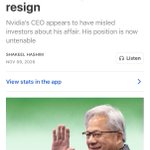
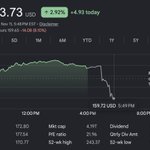
Jensen Huang appears to have misled his own employees, investors and the public.
He should resign.
transformernews.ai/p/jensen-…

Interesting who did (Pritzker, Emanuel, Booker, Khanna) and didn’t (Newsom, Ossoff, Harris, Buttigieg) come to this.

Inside Democrats’ 2028 brainstorm on AI safety politi.co/3WybUqR

I think it’s underrated that even if the spy/natsec stuff isn’t a factor, Jensen appears to have had an affair with a major customer for months — which violated Nvidia’s own conflict of interest policy.
Did he disclose it to the board? If not, that seems like a resignable offense in and of itself


remember when OpenAI said it was going to ditch side projects and focus?
(Also a bit gross for OpenAI to be partnering with Palmer Luckey on merch)

4
19
4,721