

Windward is the leading Maritime AI™ company, delivering mission-grade all-source operational intelligence across the maritime domain.
Washington, D.C.
Joined October 2014
- Tweets5.1K
- Following921
- Followers11.9K
- Likes1.5K




Windward retweeted

Was great to be for the third time (!) a guest at @aleph Invested podcast hosted by @mikeeisenberg !
We covered oil markets, geopolitics and gave some predictions which became true on the day .....
Tune in here:
- Youtube: youtube.com/watch?v=LsLpzhw5…
- Spotify: open.spotify.com/episode/15F…

Windward retweeted
I've been doing "ships" for 24 years now (almost 25!). The first days of AIS were exciting. You can finally see ships at scale. We were the first customer of ExactEarth satellite AIS, and of Orbcomm AIS (now part of S&P Global).
However there are two big changes that happened recently, both require a new way to think about maritime domain awareness:
1. Shipping became much more dark. Between the Russian Dark Fleet, the Iran - US War (where shipping became 83 % darker!) and the Ukraine-Russia war and the attacks on ships in the Black Sea, the same technology you were supposed to turn on for safety at sea - AIS - - now requires you to turn it off for safety at sea.
2. Agentic AI: Data is the new oil. More than ever organizations want (and can) build their own in house data lakes, repositories and platforms. They want high quality data.
This is why we're very proud today to announce the acquisition of Azimut.ai , led by Matan Saat, Tomer Marom, Shay Lavi and Yuval Kassif.
Maritime Visual Intelligence is the future of maritime domain awareness. The ability to identify and fingerprint ships from coastal or shipborne cameras at scale is a game changer, especially when combined natively with @WindwardAI data, activities , risk models and agents.
There is another point: if you care, you can make a difference. Hormuz woke up the world to how much shipping is critical for our livelihoods. If you're worried about safety at sea, you care about the oceans, if you are worried about the dark fleet, about oil spills or illegal fishing. If you own a seaside hotel or a fishing boat that roams the oceans. Become a site partner and reach out. Together we are stronger. 70% of the world is made of water. We can't do this alone.
Read more here: finance.yahoo.com/technology…

Windward retweeted

The @WindwardAI Q3 Risk Report is out. Since then Iran has attacked another 15 ships across the Middle East Gulf widening its range beyond Hormuz to Qatar and Sohar.
among the highlights:
* 87% of ships attacked were tankers (Q2: 28%).
* 47% belonged to Gulf energy companies’ national shipping fleets (Q2: 12%).
* 93% of attacks occurred in the Strait of Hormuz (Q2: 52%).
* Most attacks hit vessels transiting the southern corridor with AIS off.
The dark fleet went through its largest structural change since 2023 in Q3: tankers reflagged to Russia in record numbers.
Windward’s dark fleet (over 20,000 dwt) now contains 223 Russia-flagged tankers. Of those, 84 changed MMSI numbers between July and September, indicating a change of flag during the quarter. That is more than four times the reflaggings of Q2 and nearly equals the total tracked since the start of 2025.
Russia is now the largest flag in the dark fleet, with 18% of vessels by number and 14% by deadweight.
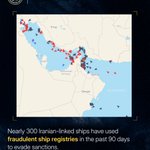
The number of falsely flagged ships listed by the International Maritime Organization reached 613 by the end of Q3, up 39% since the start of the year. Together they total 24.8 million gross tonnes.
A falsely flagged ship does one of two things: it registers with a fraudulent registry that has no authority to flag ships, or it broadcasts the flag of a legitimate registry whose maritime administration says it never authorized the vessel. Both appear in the IMO list.
Guyana is the most used false flag by tonnage, at 15% of the total. Comoros is the most used by ship count, with 81 vessels; Comoros is a legitimate registry whose flag these ships broadcast without authorization. Malawi and Nicaragua follow.
sign up for the Risk Report here: windward.ai/top-8-maritime-r…


Windward retweeted

Marseille is the 6th largest undersea cable connection point globally.

A sanctioned, Chinese-owned tanker has been loitering north of Algiers for 19 days. In ballast for 7 months, no cargo, no reason to be there.
Since Sep 29 it's run the same drift 3 times: 60–68nm at under 1kn, across 4 Europe–Africa–Asia cables, crossing EIG ~8 times (closest 0.24nm).
Windward assesses this as a possible cover case for seabed cable survey.

Windward retweeted
Katie defiantly sits in my suitcase as I pack early this morning, because this means only one thing: her human is heading off on a work trip.
I'm off to Fujairah for the @gulf_intel Energy Markets Forum, which is going to be one of the highlights of the year for me. Sean and the team have devised a packed agenda discussing live issues that are shaping the global economy.
If you're going to be there please come and say hello! I'm on two panels and moderating two sessions so deep in preparation and will deliver the latest and best analysis from @WindwardAI


Windward retweeted
On Thursday, I’ll be briefing live with my colleague @ Matt Mueller on both Gulf chokepoints: Hormuz, six months into the closure, and Bab el-Mandeb, where Houthi forces now hold strategic ports along the Yemeni coast and Perim Island.
We'll cover anchorage tanker counts and dark STS activity off Fujairah and Sohar, the U.S. strikes on Iranian tankers, daily transits vs. official claims, and where Gulf crude is being diverted.
45 minutes, then your questions.
Thursday, September 17 | 8:00 AM EDT | 1:00 PM BST | 8:00 PM SGT
Register: windward.ai/a-new-tanker-war…

Windward retweeted
There’s a lot of politically inspired figures about how many ships and how much oil is getting through the Strait of Hormuz. This depends on the average period cited and the size and type of all ships counted – which typically isn’t included.
Oil is going through on dark tankers via the southern corridor through Omani waters, permitted under SOLAS for safety and security reasons. AIS off. LRIT off. Even seafarers switching off mobile phones. Real-time numbers aren’t possible and it takes clever querying, multi-source intelligence and forensic sleuthing to get anywhere near accurate numbers.
My take: * preliminary * figures for August (crude only, minus Iran), is that exports are between 2/3 to 3/4 of pre-war levels. How do I arrive at this number? @Vortexa has west-of-Hormuz exports at ~6.2m bpd. That figure is likely to be revised upwards as more shipments become visible. Same thing happened for July figures which were at ~5m bpd at the beginning of August but now sit at ~5.5mbpd.
So let’s take August at 6.5m bpd (a conservative take). Then consider that Saudi Arabia was diverting ~3m bpd via the East-West pipeline to the Red Sea in July, but that also became less visible in August as the Houthis ‘blockade’ saw loadings at Yanbu also go dark. Plus there’s now a diversion to the diversion, as VLCCs from Yanbu shuttle to & from SUMED pipeline at the mouth of the Suez Canal.
August numbers exported from there according to Vortexa are at 2.6m bpd, but likely to be revised higher as visibility increases. (July numbers were 3.7m bpd), up from 800kbpd in February).
Pre-war, Vortexa estimated West-of-Hormuz crude exports (minus Iran) at 14.5 in Feb. So, adding up 6.5m bpd getting through plus Saudi diversions (anywhere from 2.6-3.7m bpd minus 800kbpd) you get about 57-65% of pre-war volumes.
Then add on any upward revisions and increased UAE exports via Fujairah pipeline, and it’s easy to see how the southern corridor has scaled and we could get to the 66%-75% figure.
Volumes shipped via Omani waters, under the right of transit passage are nearly four times higher than May when the US began offering military support and coordination via this route.
I’m seeing a steady stream of VLCCs sailing from waters off Fujairah and Sohar, Oman, where STS transfers are being done from tankers undertaking shuttle services to and from terminals inside the Middle East Gulf. (see @Windwardai image of VLCCs below). In addition to those with their AIS on, there are others that don’t switch their AIS back on until they are well clear in the Indian Ocean.
There are crazy numbers out there for VLCCs willing to do spot charters in the Middle East Gulf – a record $650k/day on Friday. That’s 27 times Frontline’s breakeven daily rate.
As always spare a thought for the seafarers on all these ships. We've just concluded one of the most intensive weeks of Iranian attacks since at least late June, with a Saudi-owned VLCC fired on by unknown projectiles overnight.

Windward retweeted
now known as Era, the infamous VLCC Bella 1/Marinera (IMO 9230880) is being tracked by @WindwardAI making its final voyage to the scrapyard, under OFAC license. now flying the flag of Comoros, which although isn't the best one in the world, at least is a legitimate end-of-life ship registry.
Bella 1 of course was the runaway tanker that turned Russian and painted a new name on its hull as it fled US forces that tried to board it while enforcing a US 'blockade' in Venezuela

Windward retweeted

Saudi traffic through Bab el-Mandeb has almost vanished.
Crossings fell to a lower baseline after the July 20 Houthi threat announcement, driven almost entirely by the collapse in Saudi-linked traffic.
Non-Saudi vessels have held steady for two weeks at an average of 37 crossings per day — roughly 22% below pre-announcement levels. Saudi-linked crossings dropped to just 0.86 per day last week, the lowest recorded so far, with zero crossings on three of the seven days. The data shows a clear split. Commercial operators not linked to Saudi Arabia are still moving, albeit at reduced volumes.
Saudi-linked traffic, by contrast, is being actively avoided. The threat is functioning as a selective pressure on Riyadh’s Red Sea export route rather than a blanket corridor shutdown.
This matters because Saudi Arabia had already shifted significant volumes to Yanbu and the Red Sea to bypass Hormuz. That alternative is now under direct commercial strain.
Bab el-Mandeb crossings dropped to a lower baseline after the July 20 Houthi threat announcement, driven by falling Saudi-linked traffic. However, the rest of the corridor has held steady for two weeks at an average of 37 crossings per day (~22% below pre-announcement levels), showing non-Saudi traffic continues to move.
Saudi-linked crossings fell to 0.86 crossings per day last week, the lowest yet, with zero crossings on 3 of 7 days.
Follow for daily updates: okt.to/nyBrsj

Windward retweeted

Hormuz and the Red Sea are becoming corridors of selective access, not free navigation
Iran and the Houthis appear to be selectively raising the cost of maritime trade for U.S.-aligned states while avoiding Chinese-linked vessels
#Oil #Shipping #Hormuz #RedSea #Energy #Geopolitics
Between July 20 and August 2, the Houthis declared all Saudi bound shipping a target and hit four Saudi tankers on three separate days.
In that window, 22 Chinese linked vessels crossed Bab el-Mandeb and called at Saudi ports, broadcasting continuously with no dark activity. None were touched, and some held position for days before crossing, consistent with a reported case by case understanding with the Houthis.
Vessel tracks shown below. Get the full breakdown by Windward: okt.to/O9We2k


Windward retweeted

Great catch. What’s it doing there? Certainly not exercising freedom of navigation I suppose. 🤔👇🏼
🚨🇨🇳 A Chinese government-owned research and survey vessel is loitering at slow speed directly over the Pacific Light Cable Network (PLCN) in the Philippine Sea.
PLCN is a roughly 13,000 km trans-Pacific fiber-optic system connecting the U.S. and Taiwan, and a geopolitical flashpoint since Washington blocked its planned Hong Kong landing.
This vessel has form. It has operated repeatedly in the disputed Paracel and Spratly Islands, surveyed the Bay of Bengal and waters off Sri Lanka, and was reported by local outlets inside the Philippine EEZ.
Slow-speed movement over critical undersea infrastructure is one of the clearest behavioral signals in maritime intelligence. Cables don't move. Vessels that hover over them get noticed.

Windward retweeted
It might be Friday but it’s always Catday for my loyal feline friend who is trilling quietly as she naps in my in-tray on my desk. There’s something very comfortable about working with your pets close by.

RT @AmiDaniel1: Iran has attacked three vessels in the last 24 hours in Hormuz, one of which is a Qatari LNG carrier (!). It is much more d…
Windward retweeted
The first real test of Hormuz normalization has arrived.
The IRGC turned back tankers on the southern route, signaling that Iran—not the market—sets the rules of transit.
Hormuz is open. Confidence isn't. #OOTT #Oil #Hormuz #Shipping #IranWar
A week of widening commercial confidence in the Strait of Hormuz has hit its first significant test.
On June 25, the IRGC ordered five tankers to turn back along the southern route, warning that unauthorized transits occur at their own risk. By targeting a lane operators viewed as unrestricted, Iran appears to be extending its oversight across the corridors.
While Hormuz remains operationally open with 43 transits recorded after the incident, the pace of normalization has slowed. okt.to/nO9qmj

Windward retweeted
Iran's oil exports are back to normal, and after yesterday's announcement of the IMO-led evacuation corridor, the Strait of Hormuz is looking as busy as I've seen it since March 1-2 (except for the very small false start on April 18).
Importantly, @WindwardAI is noting pathways are beyond the northern inbound and outbound Iran-controlled routes that have been used since early March, and the US-assisted southern corridor through Omani waters. there's a central corridor just up from the Traffic Separation Scheme that evolved in past 24-36 hours. and this morning I note a vessel going via the TSS.
all significant developments, as 11,000 stranded seafarers make their way out and work to make the strait safe and secure continues.


Kharg Island, June 24 | 04:32 UTC. Windward MSI confirms all three terminals empty. No vessel berthed since the June 23 clearout.
Five laden tankers sit dark in the eastern waiting area, AIS silent. The signal points to a pause in crude loading or a scheduling gap between outgoing and incoming traffic.
Windward retweeted

This may be Iran's first misstep--and proof that its leverage isn't total.
Iran announced the strait was closed, but it didn't *close* the strait.
Without the credible threat of force, Iran's sway over the waterway has limits.
Iran moved to re-close Hormuz on June 21. The market answered.
Windward Maritime AI™ recorded 25 transits on June 22, including French- and Qatari-linked LNG carriers moving openly with AIS active. Iranian exports hit a two-month high of 6.79M barrels.
Operators are testing the corridor, not retreating from it.
okt.to/mOn8Pj

Windward retweeted

The strait of Hormuz is closed for everyone except for dark Iranian tankers according to Windward
Iran's re-closure of Hormuz is already measurable in the data.
12 transits today, down from 21+ on June 20.
Neutral and European commercial tonnage: absent.
5 of 8 inbound vessels: dark.
The MOU-driven recovery that began June 18 has stalled within 24 hours of the announcement.
The current traffic profile: dark, sanctioned, Iranian-linked, resembling the late-blockade baseline more than a functioning open strait.
Watch the next 48–72 hours.


Windward retweeted

Windward Says "Zero AIS Transits" On Hormuz Chokepoint zerohedge.com/geopolitical/w…

Windward retweeted
Ask Me Anything at 1300 BST!
FYI after the MoU was signed last night and first-movers began transits (both AIS-visible and dark) Iran sent a ‘zombie’ ship through Hormuz.
A vessel falsely broadcasting the stolen identity of Gas Spirit I (IMO 7411569) transited the strait outbound. The liquefied petroleum gas carrier was broken up in February, 2023, according to the Equasis database. The identity of ship has yet to be determined.
The use of IMO numbers from dead vessels is a common deceptive shipping practice used by Iran’s dark fleet to obfuscate the identity of sanctioned ships. The ship is now within Oman territorial waters near the port of Liwa with irregular AIS signals. Iran still not playing by the rules

The U.S.-Iran agreement was signed last night in France.
The Strait of Hormuz is reopening.
We're going live in one hour to answer your questions.
Join Windward's @Michellewb_, the analyst tracking every vessel in the Strait since Day 1 of the conflict, for a live AMA on X Spaces.
1 PM BST / 8 AM EDT

Windward retweeted
I'm doing my first AMA (that's 'Ask Me Anything' according to my millennial colleagues) on X tomorrow at 1300 London time about the Strait of Hormuz.
The Strait of Hormuz is about to reopen.
But what happens next to shipping, to the dark fleet, to global energy flows?
TOMORROW: Live AMA on X Spaces with @Michellewb_, Senior Maritime Intelligence Analyst at Windward. Ask her anything.
Thursday, June 18
1 PM BST / 8 AM EST
