

Now at Santander AI Lab. GDE for Cloud and ML Machine Learning Spain Meetup Co-author La pastilla Roja
Madrid, Comunidad de Madrid
Joined March 2007
- Tweets52.9K
- Following2K
- Followers4.6K
- Likes45.6K








juantomas (mAGIa is coming ) retweeted

ok this paper is f*cking insane
Chinese researchers put out a paper with a title that should make every agent framework nervous: "The End of Harness Engineering"
their argument fits in one line: hand-writing the program around the model is finished as a skill
a harness written by a person is one guess about one task on one afternoon. it ships, then runs for months with nobody reading or scoring it
a harness written by a loop is a file that grades itself:
> a small 4B model reads what failed
> it proposes 8 edits
> only the edit that scores best on held-out questions survives
the big model stays frozen the whole time, and every round rewrites the file around it
so the human job shrinks to one artifact: the scoring set, the questions the harness is graded on
frameworks turn disposable, and the exam turns into the job
write the exam before the code
the builder's guide to the harness this loop starts from is below ↓


juantomas (mAGIa is coming ) retweeted

Harness adapters training has now finished!
@liquidai LFM2.5-24B, LFM3 + @thewebAI Twil-8B optimized for pi, hermes and opencode (up to 43% tool efficiency + 15% accuracy gain on our held-out data-analysis test set for LFM3 🤯 / up to 37% tool call efficiency on Twil-8B model).
More than 1900 RL steps trained using @huggingface jobs. 9 total adapters with GGUFs which are ready to use!
Reward hacking attempts blocked for all models with safeagents (and we opensource the attempts).
Let's explore together the outcome of this open experiment 👇
huggingface.co/collections/h…
huggingface.co/collections/h…
huggingface.co/collections/h…

juantomas (mAGIa is coming ) retweeted

En esta época de resultados rápidos, cada vez es más importante para todos que iniciemos y trabajemos en proyectos a sabiendas de que no los veremos completados durante nuestra vida. Esos proyectos son los que al final cambian el mundo.


juantomas (mAGIa is coming ) retweeted

Yo ahora voy por aquí (que hace falta tiempo para confirmar). Equipos de tres. Uno con dominio funcional, otro del software (y del harness) y otro de sistemas. Y cuanto más multidisciplinares, mejor.

juantomas (mAGIa is coming ) retweeted

Check out Google's Elephant-Goldfish Model, our new open-source plugin → goo.gle/480yn2n
Draft specs with deep-context agents and stress-test them with zero-context subagents before writing code. You make the architectural decisions and approve the spec before implementation. Works with Antigravity, Claude, Codex and ChatGPT.
juantomas (mAGIa is coming ) retweeted

¿Cómo sería la migración de un proyecto de Inditex Tech de Azure a Cloudlflare? 👀 Va post técnico interesante
Hace unas semanas, Inditech presentó su portal Open Source y con ello hicieron pública Weave.js, una aplicación OS de colaboración entre equipos en tiempo real. Una especie de Trello/ Miró hipervitaminado.
El equipo de @Cloudflare España ha hecho la prueba de cómo migrar toda la arquitectura a Cloudflare en un par de días apoyándose en IA.
La aplicación tiene chicha: backend en Node.js, PostgreSQL, Azure Blob Storage, WebSockets para sincronizar documentos, autenticación y funciones de IA
Así es más o menos la sustitución de piezas:
- Express.js → Hono sobre Workers
- PostgreSQL → D1
- Azure Blob Storage → R2
- Azure Web PubSub → Durable Objects
- pg-boss → Cloudflare Queues
- better-auth → Cloudflare Access
- Google Generative AI → Workers AI
Solo les falta meter Helmcode como AI provider y ya tendrían el stack perfecto xD
Me hace mucha ilusión esto porque tanto Cloudflare como Inditex Tech formaron parte de nuestra primera Kernel Panic! y son dos equipos que tenemos muy cerca y a los que tenemos mucho cariño.
Sergio Maeso, el GOAT detrás de todo esto, ha documentado todo el experimento de migración, las arquitecturas y los problemas que encontró.
Da gusto ver a empresas de este tamaño compartiendo código, experimentos y decisiones técnicas para que otras podáis tomarlas como referencia.
Lectura obligada para quien trabaje con infraestructura cloud.
elladodelmal.com/2026/11/com…
@edu_sebast @carluve @chemaalonso @maesoser

juantomas (mAGIa is coming ) retweeted
La contribución de DeepSeek al ecosistema de IA se debería estudiar como ejemplo.
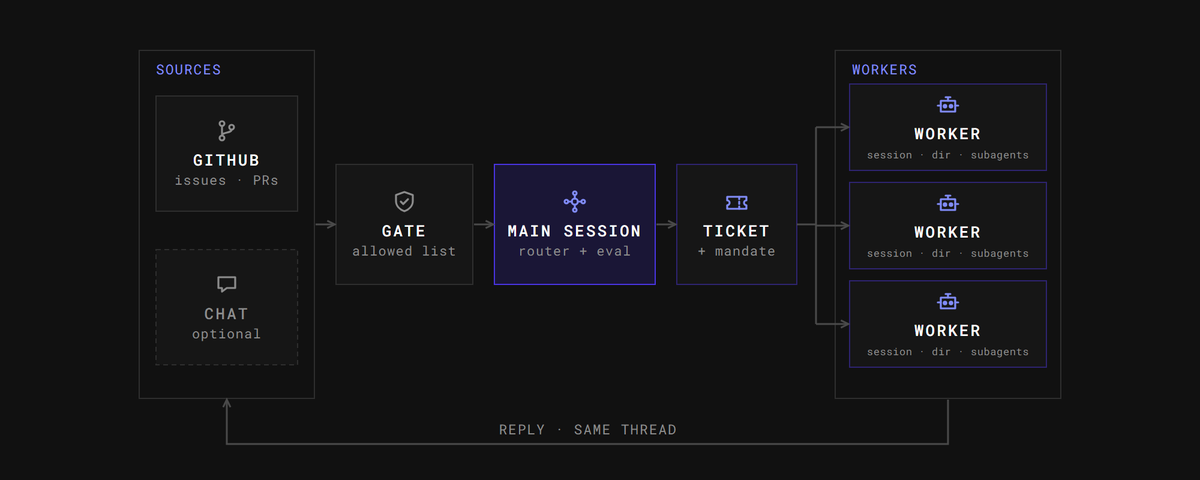
Abren los pesos de sus modelos, nos regalan un pedazo de harness que puedes tunear como quieras, nos cuentan cómo tienen montada su inferencia y ahora cómo crean "super-agentes" al más puro estilo Grok Bot.
He estado probando el Super-Agent y he montado un artículo técnico junto a gente del equipo de Helmcode para explicar cómo funciona y cómo lo puedes usar tú :)
👇
(He exprimido mi neurona al máxima, lo prometo)
En castellano aquí: helmcode.com/es/posts/super-…


juantomas (mAGIa is coming ) retweeted

Modest intelligence is arriving faster than most people realize.
Today, we're open-sourcing TwIL-8B.
Just 8.8 billion parameters, yet approaching frontier-model scores on several difficult benchmarks:
• 93% of frontier performance on coding
• 92% on instruction following
• 90% on contest mathematics
All from a model small enough to run on your own hardware.
But the benchmarks aren't the most important part of this announcement.
For years, the AI industry has focused on building the most capable model, regardless of the cost required to run it.
I believe that equation is changing.
The next era of AI will be defined by the cost of completing work. Not simply the intelligence of the model, but how efficiently that intelligence can accomplish the task.
If a model with 8 billion parameters can reliably complete the same work as one with hundreds of billions, why pay for the larger model?
As smaller models become more capable, intelligence becomes something we can distribute, specialize, and run across the hardware we already own.
That's the future we're building at @thewebAI
TwIL-8B is available today. Open weights.
And this is just the first of several announcements we're making today.
HF Link: huggingface.co/webAI-Officia…
juantomas (mAGIa is coming ) retweeted

Sign-ups in the next 24 hours get 20M free tokens: levanto.ai/model
Want to give it a try? This is our playground: playground.levanto.ai
Learn how to set up MPP with Sage2 for your agents here: levanto.ai/mpp
juantomas (mAGIa is coming ) retweeted
Aprender jugando está bien, pero aprender estudiando, por lo que sea, es increíblemente más efectivo.
Estudiar es un verbo que cada vez usa menos, justo cuando vivimos en la mejor época de la historia para hacerlo sobre casi cualquier cosa que imaginemos. Bendito siglo XXI.

juantomas (mAGIa is coming ) retweeted

GBrain Cloud is the fastest way to get GBrain going across all your agents. Every harness has its strengths - Grok/Muse/Dots for personal, OpenClaw/Hermes for raw power, Claude Code/Codex/Capy for codegen
GBrain lets you run your context on all of them
gbrain.io/notes/set-up-gbrai…

juantomas (mAGIa is coming ) retweeted
Most agents freeze once deployed.
Project Chrysalis uses Gemini platform & Google Cloud to safely enable self-evolving agents:
⚡ 15–45 mins ➡️ 1.8s mitigation time
📉 519.8ms ➡️ 18.2ms P99 latency
Explore the full architecture → goo.gle/4eDDzNc

juantomas (mAGIa is coming ) retweeted

It attempted to make an outbound PUT to a Chinese bucket, yes, but you also asked to check whether it’s possible. It used a hardcoded test string and was blocked.
The conclusion you drew here doesn’t match the results shown. You’re contributing to hysteria and spewing bullshit.
juantomas (mAGIa is coming ) retweeted

Your MacBook can now host a coding agent at 300+ tps!
I gave DeepSeek V4.1 Flash a job: write a specialized inference engine for LiquidAI's LFM2.5-24B-A2B on Apple's M5 Max. For $21 of API, it built Molten: 300+ tps, about 1.5x faster decode than mlx-lm and llama.cpp.
Why specialized? General frameworks like mlx-lm and llama.cpp have to run any model on any hardware. A specialized engine serves one model on one chip at batch size 1, so there is far more room to optimize.
Molten is native Rust + Metal: one ~6 MB binary, no Python, PyTorch or MLX. It comes with a chat CLI and an OpenAI-compatible server with streaming and tool calls, so you can point your own coding agent at it. It needs an M5-series Mac with 24 GB+ (sorry, M1-M4 friends).
The numbers (M5 Max, 128 GB)
• 305 tps at 256 tokens of context, vs 190 for mlx-lm and 199 for llama.cpp
• Still 248 tps at 16K, where coding agents actually live (mlx-lm: 165)
• Faster time to first token: 1.76 s vs 2.17 s for a 16K prompt
• Same weights and math as mlx-lm
How it was built
The agent (DeepSeek V4.1 Flash in the Pi harness) ran in a recursive self-improvement (RSI) loop. Each session starts from the best engine so far, plus the feedback from every earlier round. A fixed evaluator rebuilds each candidate from source, checks its tokens against mlx-lm, times and profiles it. Only correct and faster engines survive.
• Hour 3: first correct engine, 0.56x mlx-lm
• Day 2.5: passes mlx-lm
• Day 5.7: 1.28x end to end, 1.53x decode
78 agent sessions, about $21 (1.36B tokens, 98.6% of them cache hits).
What the RSI loop found useful for speeding up:
• Fuse chains of small ops into single kernels: norm + router + top-4 expert pick, expert FFN + combine, Q/K/V projections + KV-cache write, Q/K norm + RoPE + attention, LM head + argmax.
• Keep the decode loop on the GPU. Tokens never round-trip to the CPU, and the GPU stays 99% busy.
• Hard-code every shape, so the 4-bit kernels stream weights at ~75% of the memory bus.
• Target the hardware: prefill runs on the M5 GPU's Neural Accelerators through Metal 4 tensor ops, with MoE routing and expert GEMMs fused and kept on the GPU.
(It's not Rust, by the way. llama.cpp is native C++ too. It's the specialization.)
TBH, I don't fully understand all of it yet lol. The agents wrote this in under 6 days, and it's going to take me longer than that to read it. As the human researcher, I'm now officially the slowest-improving component of my own RSI loop🤣, so I'll spend the next few weeks learning from my agents.
Where I think this goes: local inference will matter more and more, and a specialized engine can beat a general one. As RSI matures, the cost of building one keeps falling toward zero. I think every model, every chip, and maybe every workload will eventually get its own inference engine.
The idea is inspired by @perplexity_ai 's Lily. Thanks to @liquidai for the great model, and Apple's MLX, whose kernels Molten adapted from.
Repo here:
github.com/zhangshuibai/molt…


juantomas (mAGIa is coming ) retweeted

Genial, asi no teneis escapatoria.
Entiendo que puedo comprar verdad, paro poco en Logroño que dicen por ahi

juantomas (mAGIa is coming ) retweeted


