

co-founder & ceo @concurrencehq
New York City
Joined December 2013
- Tweets740
- Following559
- Followers4.2K
- Likes2.7K




Pinned Tweet
Today, we’re introducing the next chapter of Concurrence and the world’s greatest leap toward Superintelligent Care.
When I was 13 I lost my mom to cancer that should’ve been caught earlier.
We’re building a system that sees every patient’s future in time to change the outcome
Had a great time on the Founded & Funded pod! Huge mindset shift happening right now toward AI adoption in healthcare, but it comes down to whether you can help patients and health systems today.

How do you know if your startup idea is too early or the wrong thing? @khookhar is building AI for health systems, where the stakes are high, and buyers are slower to move. Madrona has been an investor in Concurrence from day one, and Ali’s test for timing applies to founders in any market.
In this episode of Founded & Funded, Madrona Partner Sabrina Albert spoke with Ali, co-founder and CEO of @concurrencehq, about how he builds toward a future that isn’t fully here yet.
What other founders can take from it:
▶ Check the conditions around your idea. Ali treats being too early as the same as being wrong, so he looked at industry mindset, regulation, and foundation model progress to decide whether it’s the right time to start building toward the future he’s betting on. Then he asks whether the product delivers value today along the way. If you’re building ahead of the market, identify what has to be true about your market for your timing to hold, and check what a customer gets from you today.
▶ Test “go narrow and deep” against what your customer needs. In healthcare, driving patient outcomes means touching many problems across the patient journey, often across industries. Companies that automate one workflow get stuck in that short-term ROI, and Ali calls that a “small poisonous pond.” He built for the whole industry instead. If you’re weighing a narrow wedge, map your customer’s full journey first and count how many other problems you’d have to solve to deliver the outcome they came for.
▶ Treat skepticism as useful and build trust into how you sell. In healthcare, trust has to be deeply earned wherever you engage with patients, so Ali welcomes skeptical customers and lets them shape how the systems are trained and behave. If you sell to cautious buyers, bring them into how the product is built and tested, so they can see how it behaves before they have to take your word for it.
YouTube: youtu.be/oGBfen64HJw
Madrona Site (Transcript): madrona.com/is-your-startup-…
Spotify: open.spotify.com/episode/2dI…
10
464
Pleased to announce that Concurrence is now a Microsoft Partner.
The Concurrence Health World Model and AI agents are available in Microsoft Marketplace starting today.
Healthcare organizations on Microsoft Azure can now deploy Concurrence directly inside their existing Azure environment, with no data migration required.
Our platform is interoperable with Epic on Azure, extends Microsoft Fabric deployments, and eligible Marketplace spend applies toward your Microsoft Azure Consumption Commitment (MACC).
Thank you to the @msPartner team for their partnership!

Read the full announcement here: prnewswire.com/news-releases…

1
2
278
Introducing Concurrence Research in pursuit of Superintelligent Care.
A patient’s health is recorded in fragments, spread across different systems with long gaps between visits. The medical record shows what happened but very little about why, so by the time a pattern becomes evident, a better outcome has often slipped away.
Our research asks what becomes possible when we connect those fragments and understand a patient well enough to:
1/ Forecast the probable futures of their health before they unfold
2/ Find actions that change their trajectory
3/ Provide support beyond the encounter
4/ Carry learnings forward to every patient on a similar path
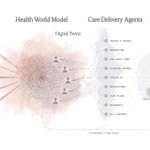
We believe the foundation of Superintelligent Care will be built on a Health World Model that provides a unified picture of every patient’s life and health, with AI applications that have access to their living context.
Each patient will be represented as a digital twin, updated with every interaction to reflect their health and the circumstances that shape it.
Our goal at @concurrencehq is to push for deeper understanding on how clinicians and AI can work together to improve care for every next patient, and to build the systems that make it possible.
When I was 13, I lost my mom to breast cancer. I still wonder if it could have been prevented.
When she found the lump, she did everything right.
She went to her primary care doctor, and he told her it was nothing. My mom wasn’t convinced, so she went to a women’s health specialist for a second opinion and was told the same thing. A year passed before she saw a third doctor who was shocked that nothing had been done and ordered tests the same day.
By the time she was diagnosed, the cancer had already spread.
For the next three years, she went through chemo, surgery, and radiation. Specialist after specialist, asking the same questions again and again.
After she passed away, there were two thoughts I couldn’t out of my head:
(1) Somewhere, a doctor must have seen a case like my mom’s and caught it early.
(2) Nothing that doctor learned had any way to reach her.
Healthcare runs in my family. All four of my sisters are nurses or pharmacists, and my fiancée spent the pandemic working in a multi-organ transplant recovery ward.
I’ve seen how hard clinicians work, and how much of that work requires understanding the patient and recognizing patterns from past cases.
That’s why a doctor can practice for 30 years and get better every year, while a hospital can treat millions of patients without getting much better at treating the next one.
What’s missing in healthcare is the infrastructure for it to learn from its own experience. If we don’t examine the cause and outcome of every interaction, how do we get better at knowing which signs to watch for?
I spent years at Google and Upwork building AI from human expertise, then eventually left big tech to work on the one problem I couldn’t stop thinking about.
I started a company called Concurrence (@concurrencehq) and raised $24M to build data and AI systems that enable healthcare orgs to learn from every patient they treat. Nothing learned is lost, and it reaches the next patient who needs it.
We’ve already supported care for over 10 million patients worldwide.
My mom deserved a doctor who had seen her case a thousand times. Every patient does.

BREAKING: Cofounder of Blind, Kyum Kim (@skyumk), joins @concurrencehq to lead strategic initiatives.

If you work in tech, you’ve heard of Blind.
In 2014, Kyum moved from Seoul to launch Blind in the US. He moved alone, and didn’t know a single person here.
He threw parties in Seattle to meet engineers and personally recruited his first 100 users from Amazon.
A few years later, Blind was the most popular social network in tech, used by millions of people.
1
11
2,946
Diagnosis is a small part of delivering care.
Most of the work happens around the boring stuff:
> Intake
> Scheduling
> Documentation
> Follow-ups
This work falls on healthcare workers who are already stretched thin.
It’s also where patients fall through the cracks.
A follow-up call never happens, or a medication change doesn’t make it from the specialist back to the primary care doctor.
That’s where AI should start, and the record it builds there makes every later clinical decision better informed.

3
18
2,504
This is happening everywhere, not just neolabs. We are seeing it at the application layer. All scribe companies are becoming “platform” companies that then serve voice and front office and back office etc.
“everyone is saying they can do everything for me” is something I hear from healthcare buyers daily.

Are all the neolabs converging on the same thing?
@togethercompute started with inference and is now offering sandboxes and RL training
@FireworksAI_HQ AI started with inference and is now offering RL training
@PrimeIntellect started with RL training and is now offering inference and sandboxes
@modal started with cloud compute and sandboxes and is now offering inference and RL training

3
1,963
If you think AI isn’t smart enough for healthcare, you’re wrong.
The models are more than capable enough.
What health systems lack is a way to learn from their own care.
Every day, health systems generate enormous amounts of knowledge.
Most of it is never captured.
The next wave of clinical AI will be built on that record.
The winners will build a system that turns vast amounts of healthcare data into actionable insights that continuously improve care delivery.

Let the healthtech talent wars begin

great turnout at our sf tech week event last night. the best questions came from engineers who have never touched healthcare, bullish
shoutout @meetshahdev and @nonlogic, excellent panelists


9
1,036
anyone building this pls dm me will fund. (Robot must run away within 30 mins of starting its shift or its not realistic)

Will AI replace healthcare professionals?
Here is an AI robot on its first day working in a hospital after finding out that:
• the EHR needs 17 clicks to order one test
• the medication list is different in three systems
• interoperability sometimes means making a phone call
• and fax machines are still critical infrastructure
What else?
The video is obviously AI-made.
8
876
All these simulation companies raising 100s of millions to predict human behavior… and then use it to help Pepsi do market research... what a waste

Trend I'm following: Teams using AI "simulations" to quickly test product ideas and flow tweaks.
Products like @simile_ai, @primitivelabsai, @syntheticusers, trytenera.ai, Seldon.com, and others.
If you've tried something like this, how'd it go?

8
644

Check out the @databricks case study on how @concurrencehq runs clinical AI at trillion-token scale!
databricks.com/blog/how-conc…

Everyone thought I was destined to fail.
The first company I built was selling AI clones to coaches, sourcing revenue from a $20/month Slack community.
People congratulated me when we hit $1M ARR
But the truth is, we were burning capital to retain consumers
The business model was unsustainable with a small TAM
When I started building in healthcare, one enterprise healthcare deal arrived that doubled our revenue
At that point, every advisor told me to keep the customers and revenue from AI cloning to fund the shift into enterprise
I told them no.
I knew dragging the old business along would ruin the new one
So I churned 100% of our customers that very afternoon.
I refunded every single customer so our engineering team could focus strictly on building AI infrastructure for healthcare
Within the same year, we rebuilt from no revenue to $2M ARR with zero churn.
Moral of the story: Don’t waste time saving a dead business. Bury it fast and move on to something better.

10,000,000 patients are already running on @concurrencehq.
we’ve raised $24M from General Catalyst, Madrona, and Optum Ventures.
we have more demand from major health systems and enterprise orgs than our current team can physically serve.
I’ll give you $10k if you help me find my next hire
roles:
> head of engineering
you will scale our infrastructure behind dozens of live clinical deployments.
you will build the core engineering org training our Health World Model.
clinical-grade reliability is the baseline here, not an afterthought.
> enterprise sellers
you will close health systems, payers, governments, and massive provider groups.
our inbound pipeline has completely outpaced our capacity to close deals.
> how we operate
high agency, low ego, and direct communication.
DM me if you know someone exceptional.

What do you get when you put a Stanford cancer surgeon, a Google DeepMind researcher, the engineering leader behind the world's largest clinical studies, and my co-founder in the same room?
Come find out at the @concurrencehq event during SF Tech Week on Wednesday, October 7th!
If you're an engineer or researcher curious about healthcare, RSVP here → partiful.com/e/RBjOKviZHlul9…

My mom lost her life to breast cancer when I was 13, but there's a world where she didn't
The clinical knowledge required to save her existed somewhere, but two doctors dismissed her case for a year before she got diagnosed
Over time, I realized they weren't evil or incompetent
They reasoned in good faith from the cases they had personally seen in their careers.
This is the unfortunate truth about modern medicine.
The care you receive based on a lottery of which clinician happens to walk into your exam room.
A doctor gets better over 30 years of practice. When they retire or leave the clinic, their clinical intuition leaves with them
A hospital can treat 10,000,000 patients and be no smarter on the 10,000,001st than it was on day one.
Healthcare doesn't fail because clinicians do not care, but because the system has no institutional memory.
Every patient starts from scratch.
After what happened with my mom, I made it my mission to make sure no one else has to go through this
We're building Health World Models that provide a unified foundation for clinical intelligence across clinicians and AI
Every act of care compounding across the entire network
If this work matters to you, DM me
Big announcement coming soon

I'm sitting down with @databricks and @nvidia tonight for a fireside chat on building at the intersection of AI and life sciences!
New York has the largest concentration of biomedical research institutions in the world and the country's biggest biotech workforce. It's also home to one of the deepest AI ecosystems anywhere. Come hang out if you're building or investing in the middle of that venn diagram :)
RSVP via Luma: luma.com/nyc-bgcx

