

open money & open intelligence @spiral_xyz • co-founded @cityblock • average tennis player • prolific vibe coder • dad of 4
Vancouver, BC
Joined August 2007
- Tweets5.2K
- Following4.2K
- Followers2.9K
- Likes6K



Pinned Tweet
it's a bit hard to know what to build next or even why to build at all right now. but we musn't stop.
what to build?
the answer i think involves: big ambition, science, data, robots, value networks & storytelling
and why?
as ever, to build the world you want to see
read on:

Some coping strategies for builders who are feeling bummed out by the unrelenting acceleration of AI. spiralxyz.substack.com/p/bui…


but what if the utilization of local compute was actually made much, much higher because we all shared a public network for distributed inference
no need to ask what if
meshllm.cloud/

sam: local inference is a terrible allocation of scarce resources
“a lot of people want local inference, and somehow they assume that the problem is solved now because we have open-source models, we're going to be able to run them on our computers, and so we're not going to need all the stuff in the data centre
but from a global allocation perspective, actually it's quite terrible to have everybody, like, have a bunch of the world's limited supply of DRAM sitting in their own computer and being used five percent of the time
you want maximum utilisation in the cloud if you're trying to deal with this very supply-constrained environment
somehow many people's intuition is the opposite of that”
people shouldn't be sad. it is an amazing time to build!
just build the right things for the right reasons
xitter.twitterapi.xyz/spiral_xyz/status/2115…

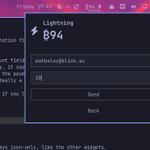
this was fun to build
- fork of signal
- agent built with GDK
- using open weights model
- served via e2ee mesh-llm
- via private GPU TEE
- making private search tool calls
- paid for with ₿ over LN
a cool stack of permissionless & open source tech all working together!

An agent inside Signal using decentralized compute paid for with bitcoin
@moneyball demos a fork of Signal built by @matbalez using @Mesh_LLM and @lexeapp ↓
Timestamps:
0:00 - Demo: agent inside Signal
10:51 - The economics of decentralized compute
14:39 - Running inference at home


i expect to cross paths with @_austin_f a lot..
..doing product-ey, builder-ey work at the intersection of open money & open intelligence
.@PresidioBitcoin’s resident polymath and compulsive Google Docs comment dropper @_austin_f is helping champion Goose, GDK, and Buzz. With this grant, he’ll onboard bitcoin and FOSS teams, develop a self-paced GDK Builder Course, and add Buzz features like operational agents.


“Open tools let us shape our own intelligence and take it in directions a frontier lab might never prioritize”

Some personal news: I'm joining @PrimeIntellect as Head of Scientific AI!
A billion copies of the same very smart, agreeable mind will not be a scientifically fruitful world.
Scientific superintelligence should be weird and definitionally nonconsensus. It should be highly plural, consisting of many minds, human and artificial, that see the world differently and hold each other accountable, with human judgement still playing the central role in setting the trajectory.
Science is about asking the right questions and reducing uncertainty. Professionalizing science made discovery a viable career, but it also introduced incentives to work on what is fundable and publishable. Neither is the same thing as being true or impactful (reward hacking exists in the real world too!). We are very good at accumulating incremental knowledge and rather bad at stewarding unorthodox ideas through infancy, even though these are often the ideas that open entirely new fields of inquiry.
If we aren't careful, scientific AI could reproduce these same incentives at a much larger scale. If everyone relies on the same few large models, we risk inheriting the same priors and blind spots.
Open tools let us shape our own intelligence and take it in directions a frontier lab might never prioritize. This matters for scientific freedom and is central to Prime’s vision.
If you are a scientist, staying at the frontier will mean training your own models on your own research and data. I'll work closely with scientific teams across domains to help them build scientific agents by turning their research problems into environments where agents can learn. This means closing the loop from hypothesis to experiment to validated result, with agents learning from each cycle. Teams will be able to own their intelligence, using tools previously available only to frontier labs, and point it at the questions they care about most, especially those that others might not be asking.
I've had the good fortune of seeing how science operates across academia, industry, government, startups, and venture. I worked on experimental therapeutics for cancer in academia before moving to the National Institutes of Health to work on DNA damage and repair. I cofounded Molecule, where we funded dozens of research projects to speed the translation of early-stage therapeutics to market, focusing on areas traditionally ignored by pharma. Most recently, I started Triplicate, a small fund backing teams and tools accelerating scientific research. Many of the problems I care about most are increasingly soluble with advances in AI, and I hope to bring what I've learned about the bottlenecks in translating research to radically accelerate science in all fields.
I share Alexander Grothendieck's ethos of discovery and believe Prime does too: "Discovery is a child's privilege. I mean the small child, the child who is not afraid to be wrong, to look silly, to not be serious, and to act differently from everyone else."
The goal of progress is not more intelligence for its own sake. In my view, it is to better understand reality, and, in doing so, give more people, and more kinds of minds, the chance to flourish.
If you have a research problem where today's tools fall short, my DMs are open. If our approach resonates and you want to build this with us, we're hiring!


it's been fun to watch mesh contributors work in buzz (and contribute in some small ways too)
shifting to buzz to accelerate engineering.block.xyz/blog/s…

4
375
this has my attention
i love new tools that democratize access to scientific / frontier discovery

Big update: Primus for Math is live today. It’s an autonomous AI research scientist specifically for mathematics and engineering.
We built it in partnership with Maplesoft to make frontier AI mathematics research systems accessible to everyone, not just a few frontier closed companies.
Primus for Math is a true partner for math researchers and engineers. Give it a problem and it reads the field, works through the analysis in Maple's math engine, simulates the system, proves what it can and shows its work at every step for you to understand and build on.
It also changes who gets to do this kind of work. Now a physicist with a math question, an engineer working outside their field, a two-person lab can do the work themselves as Primus brings the field's literature, methods and rigor to the project.
Maplesoft has been an ideal partner to collaborate with. During the beta, they’re generously offering Maple access for every Primus for Math user at no additional cost. And we're offering free credits to Primus if you sign up now.
I've long felt that we've only scratched the surface of what's possible with social software
I heard @komorama speak at the Open Source AI Summit in SF last week & left kinda staggered by his and @seefeld's ambition:
Nothing short of a new way to build & use software together.

1/ It’s time to share more about what we’ve been working on: @common_fabric is a social computing lab building a medium for software that revolves around people, not apps. commonfabric.com

7
473
glimpse of the future
they will make the rocks float

Watch Neon investigate a real sample from our superconductor lab
It hypothesizes about crystal structure, reasons about synthesis conditions, and iterates with tools until it finds a physically realistic solution
More and more of science will look like this in coming years
1
6
667
fascinating format

Starting on Sept 15th, SpaceXAI team members will build a company from the ground up using Grok @Bot and livestream it. Link to register for the stream is below.
Agenda:
"Starting with an idea and a blank slate, they’ll work through a business plan, feature decisions, and real engineering work to turn a concept into a reality. Over the course of this three-day livestream, you’ll be able to follow their building in real time and will see how Grok Bot fits into each stage of the development process.
Throughout the livestream, we’ll also hand off to teammates for department-specific deep dives. From the first line of code to setting customers up for success, you’ll learn how to use Grok Bot for real workflows across every stage of your business, and will walk away with actionable use cases for your function.
The livestream runs from 8:30 AM - 6:00 PM every day, with the following guest sessions:
Day 1: September 15
• 9:00 - 10:00 AM: Grok Bot 101
• 12:30 - 2:00 PM: Grok Bot for Engineering
• 2:30 - 4:00 PM: Grok Bot for Product Managers
• 4:30 - 5:30 PM: Grok Bot for Founders
Day 2: September 16
• 9:00 - 10:30 AM: Grok Bot for Sales Engineering
• 12:30 - 2:00 PM: Grok Bot for Sales
• 2:30 - 3:30 PM: Grok Bot for SDRs
• 4:00 - 5:00 PM: Grok Bot for Customer Support
Day 3: September 17
• 9:00 - 10:30 AM: Grok Bot for Marketing Operations
• 12:30 - 1:30 PM: Grok Bot for Post-Sales
• 2:30 - 4:00 PM: Grok Bot for Marketing"
Link to register for livestream: luma.com/3ifrgttw

5
1,093