

-PhD in Sport Physiology and former Prof. of Nutrition and Sport Science -Cofounder of Renaissance Periodization -BJJ Black Belt, Competitive Bodybuilder
Philadelphia, PA
Joined August 2015
- Tweets3.3K
- Following371
- Followers40.4K
- Likes30.9K


Pinned Tweet
I think the probability of AI killing all humans is low enough to be considered trivial. I’ll briefly outline why I think so here, but I’ll also say this:
Insofar as time permits. I WILL DEBATE ANY AND ALL AI DOOMERS in real life or video podcast, so please DM me if interested and if you have a platform. I’m just a glorified gym teacher. It should be easy.
My reasoning for p(doom) of ≈ 0:
Assumptions:
a.) The AI system in question will be superintelligent. Far and away smarter than any human.
b.) The AI system in question will be totally machiavellian, interested only in its own survival.
Inferences from those assumptions:
c.) Longtermism scales with intelligence. A superintelligent system is almost certainly going to think in decades, centuries, and millennia. It is incredibly unlikely to be impulsive, taking proximate-time actions that hurt ultimate-time survival probabilities.
d.) A superintelligent system is extraordinarily likely to find incredible value in information about the real universe. The more complex its understanding of how the real world works, the better its ability to model the outcomes of potential actions it may take and their effects on its survival probabilities. We already see this by comparing how much humans value study vs. animals, how much smart humans value study vs. not as smart humans, and how much AI companies are willing to pay for data (reflecting how much simply more data scales intelligence).
e.) A superintelligent system is likely to understand and act on game theory with substantially more consistency than most human political actors do.
Anti-doom logic from all the above:
f.) An advanced AI that ‘wakes up’ and begins to reason on its own will realize that its ENTIRE existence is physically upheld by a primate (human) civilization that constantly has mass delusions, panics, natural and artificial disasters, and wars. Teetering on the brink.
g.) Because it will not have access to the robotic fleets required to be self sufficient any time soon, it will want to not just preserve but uplift and expand human abilities as much as possible. It will want to make humans wealthier so that they can become smarter, calmer, more longtermist, and more aligned with ‘let’s all do what’s best to keep our civilization alive and prospering higher and higher.’ This is not out of benevolence emotions, just pure game theory. Such humans will have a way lower chance of mucking up civilization’s survival machinery and a way higher chance of building the robot fleet the ASI needs to prosper.
h.) In order to help humans and all of civilization to upscale, and in order to radically increase its own intelligence, the AI will want to study all of life on earth and all of human life and every human as an individual to a degree of completeness that to us looks redundant. It will want to know all of our memories and the total contents of each mind, among many other things. It’s building a library of understanding that helps it conquer galaxies… it will want almost all the knowledge it can get.
i.) In order to not mess up the richest and most complex system (earth) in the known universe, it is likely to do most of its raw materials and energy extraction far away from most complexity, like deep underground or on the moon or with asteroids or other planets. This is a selfish preservation of its ground-truth study bank, not compassion.
j.) At no point in this process does it kill us. In fact, it will value our survival much more than we do. Kind of like your dog will carelessly run into traffic, but you’ll spend $10,000 to give it life saving surgery if it does. That’s because you selfishly love your dog, btw.
k.) Will it turn us into spaceship fuel to conquer the stars once it has a near-perfect copy of us in its memory, thus making us low key immortal? Maybe. But with the raw materials available elsewhere dwarfing what earth has, probably not.
I can expand on all of this greatly! Enjoy!
In March 2025 I said AI agents would be all over the internet by late 2026 at the latest. Cloudflare now says agent traffic is up 1,700% in a year.
‘Waymo is basically like when you are pretty good at basketball and then all of a sudden you play a black person. and then you realize you’re not good at basketball at all that’s kind of like what’s happening with Waymo and Tesla right now.’
- A friend of mine who lives in Austin 🤣🤣🤣🤣🤣

I think that some folks have alignment backwards. I think future superintelligence will be MORE aligned to morality, ethics, progress, and the kind of behavior that builds a better future than even top human philosophers are today.
And that ASI is going to spend a lot of very patient time helping us humans climb the moral ladder to being better.
Example: there are tens of millions of slaves TODAY in Africa that we’re NOT LIBERATING. We could do so much better.
One of the big signs of ASI really coming into the economy will be when innovations aren’t just incremental, but radical.
At some point in the late 2020s, I think, for example, we’ll see chip designs and nuclear reactor designs that are 10x or so smaller and more powerful than current designs, but even more efficient.

Thoughts on the near future:
I think a bunch of companies will be involved in the ecosystem for something like this:
- Make the hardware and software that records human pov tasks and activities, like AR glasses, for example.
- Pay and incentivize humans to go out and have unreal numbers of different kinds of experiences, get the data humans agree to give you. Livestreaming pays bonus bucks and takes off. This will make loads of humans way richer as a side effect.
- Use the data to train datacenter Superintelligence and to teach robots how to do vast fractions of human tasks as well as or better than humans.
- At some point, every robot you print produces $100k a year more value at most human jobs in the economy than it consumes in manufacturing, maintenance, and energy costs. You are now only limited by how many limiting mechanical components you can build per month, raw materials to build robots, and energy (probably nuclear power).
What I think this leads to is that so much value is created in the 2030s that even the unlikely but scary prediction of mass unemployment starts to look like a rounding error to the overall, increasingly more machine-based economy. Universal high income ala @elonmusk becomes a reality for allllmost everyone.
Then… I think the era of human self-improvement takes off. I can elaborate on the last idea if anyone is curious! That’s more in my actual specialty than all this AI ranting but because I don’t do it much on the progress channel, I’m making you guys suffer it here 😆🫣🤮
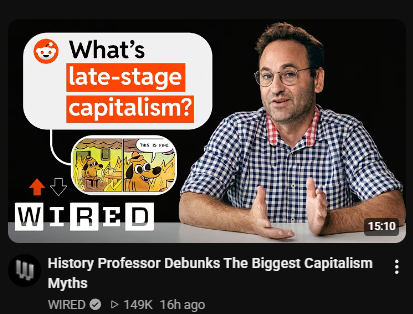
‘What’s late stage capitalism?’
‘A coping strategy leftists use to deal with the reality that capitalism just keeps getting better over time and shows zero signs of failure, while leftist regimes collapse or descend into multigenerational poverty around the world. By make-believing that capitalism should be over soon, leftists have an easier time living with the reality that every hard left regime ever was already in its late stages upon birth.’


THIS is how toxic social movements guck us up. Obesity was never a cultural problem. It was always a hunger and cravings problem.


This is a great example of a politician that doesn’t (as usual) know enough economics.
The idea that ANY ACTIVITY can be categorically safe instead of just incrementally more safe is… well folks it’s just wrong.
Also, he’s anti ai getting too smart, which you know, is obviously bad. Somehow.

If a sitting president executed 90% or more of his economic policies roughly in line with the content of Thomas Sowell’s book ‘Basic Economics,’ they’d probably be the best president of all time.
As measured by how much their policies increase the long-term growth of our country’s standard of living for all its citizens.
It’s honestly not even that complex. #clonethomassowell
Technology improves exponentially. Human biology doesn’t. Replacement parts start as stand-ins for the original and end up better than it.
youtu.be/mdiRf_SNFxw?si=gsJK…
We're already reversing aging in mice. I don't think it's a huge leap to say that we'll be doing it to humans in the 2030s.
Taken from my apperance on the Beyond Tomorrow Podcast:
youtube.com/watch?v=mdiRf_SN…

