

x-Apple / x-Rivian (tech team founder) Disruption happens. Optimism ahead. 🚀🇺🇸 Starlink https://xitter.twitterapi.xyz/t.co/XczBaeai1C
Silicon Valley
Joined January 2008
- Tweets32.7K
- Following833
- Followers34.4K
- Likes54.4K





phil beisel retweeted

Wow, Nvidia's board is preparing to oust
CEO Jensen Huang - WSJ
What a wild few days.

Robotaxi hits 5 million unsupervised miles.
philbeisel.com/robotaxi?m=44…

The remaining 11% want an introduction to Alice.

88% of surveyed $NVDA employees reportedly want Jensen Huang to remain CEO while just 1% want him removed.
Would've been pretty wild if Nvidia employees turned on the guy who made half of them millionaires.


Another 2+2 with @CernBasher
A shocking list of things to talk about this week.


Two Guys, Two Weeks Video
Here is a summary of the topics @pbeisel and I talk about in the video:
Tech Espionage and Nvidia
Scandal and Infiltration Concerns: We open by discussing reports involving Nvidia CEO Jensen Huang and a woman named Alice, raising questions about potential Chinese espionage targeting top U.S. tech executives.
Policy and Competition: We examine Jensen's historical advocacy for selling chips to China and note reports that Nvidia hired a crisis PR firm a year prior, while emphasizing that nation-state espionage threatens the entire U.S. technology sector.
Starship, Starlink V3, and "Star Mind"
Starlink Capacity Surge: Upcoming Starship Flight 15 will deploy 26 Starlink V3 satellites (Group 31-2), adding 26 terabits per second of downlink capacity - equivalent to 10 Falcon 9 launches!
In-Network Orbital Compute: Using inter-satellite laser links (ISLs) that carry four times the downlink capacity, SpaceX is building out a space-based compute layer referred to as "Star Mind". This allows data to travel directly to orbital GPUs and remain inside the Starlink network without routing through terrestrial fiber gateways.
Disrupting Telecom: Following Elon's comments at the Ron Baron conference and talks with Qualcomm regarding 6G, we speculate on SpaceX's ambitions to disrupt legacy mobile carriers - or potentially acquire one - to maximize spectrum efficiency for Starlink Mobile.
Exponential AI Compute Demand & Space Data Centers
The AI Compute Curve: Comparing the previous mobile/CPU era (which grew roughly 60% per year) to the current AI era, Phil highlights that AI compute demand is growing at an exponential 2.2x to 3.4x+ annually. Unlike human-driven internet traffic, autonomous AI agents query and process data continuously, further accelerating demand.
Overcoming Power and Chip Bottlenecks: Because terrestrial data centers face severe electricity and chip constraints, Elon is pursuing Terafab for chip supply and Starship for orbital power and compute.
Orbital Cooling Physics: We push back against critics who claim space data centers cannot dissipate heat, citing Elon's explanation that the required radiator cooling surface is only one-fifth the surface area of the solar arrays. We also contrast SpaceX's rapid, hands-on "founder mode" culture with the bureaucratic slowness of legacy tech giants.
Google and SpaceX: "Competing with Yourself"
Board Departure: Alphabet executive Don Harrison stepped down from SpaceX's board on November 4 due to increasing conflicts of interest between the two companies.
Deep Financial Ties: Google invested $900 million in SpaceX in 2015 - a stake now valued at roughly $84 billion - and in Q3 purchased an additional 3.85 million shares for roughly $540 million.
Co-opetition: Despite competing in AI, autonomous driving (Waymo vs. Tesla), and space compute (Google's Project Suncatcher), the two rely on each other. SpaceX houses ground stations at Google data centers, while Google signed a massive cloud deal paying SpaceX $920 million per month (from October 2026 through June 2029) to rent GPUs and compute infrastructure.
Consumer Hardware Disruption: We also speculate that Elon could eventually challenge Apple and Google's smartphone duopoly with a lightweight AI consumer device powered directly by orbital Star Mind compute.
SpaceX's Terrestrial Data Center Expansions
Tombstone, Arizona: Operating through Tombstone Resources, SpaceX is proposing a 747-acre, 4.4-million-square-foot supercomputing campus near Tombstone, Arizona. The project includes a $3.6 billion energy infrastructure investment, closed-loop cooling that uses minimal water, 1,000 permanent jobs, and promises to lower local residential electricity rates by 10% to 40%.
Starbase, Texas: SpaceX wants to build a permanent $24 billion gas-fired power plant on 444 acres in Starbase to replace temporary portable gas turbines, while aggressively acquiring surrounding land parcels to potentially support future data center campuses.
The Rise of the Automated Economy
The Fourth Economic Sector: I break down how the economy has evolved from extraction (primary), transformation/manufacturing (secondary), and services (tertiary - currently 80% of the U.S. economy) into a fourth category: the automated sector, which operates with zero human labor.
Capital vs. Labor: Within a few decades, 70% to 99% of the economy could be automated across both blue-collar and white-collar roles. Because the financial rewards of full automation flow to capital owners rather than wage earners, shrinking wages risk triggering a deflationary spiral unless households gain new income streams.
Portfolio of Solutions for the "Messy Middle": To bridge the transition toward "sustainable abundance," we discuss diversifying household income beyond traditional wages (currently 60% of household income) through sovereign wealth funds (like those in Alaska and Norway) , employee stock ownership plans (ESOPs), negative income taxes or UBI, and child equity accounts.
20 more Model Y's registered in the Texas Robotaxi fleet.
philbeisel.com/robotaxi?y=1

This is exactly the kind of optimization you'd expect from an engineering organization like SpaceX or Tesla.
Basically, it's a move toward a more bare-metal approach.
The software frameworks, harnesses, and pipelines supporting inference and reinforcement learning can become bloated over time. Abstractions accumulate, processes get layered on top of one another, and inefficiencies become embedded in the system.
When engineers go deep and really understand what the software is doing (and often they don't go deep enough), they discover plenty of "oh my God, it's doing THAT?" moments.
Rewriting it in C/C++ isn't necessarily what makes it faster (not the only thing). It's often the process of rewriting it that forces engineers to understand the entire system, identify unnecessary work, and rethink how best to use the underlying hardware.
The payoff can be enormous.
Not only can you get faster inference and higher throughput in reinforcement learning, but you develop a team with an expert-level understanding of how to extract the maximum performance from the hardware.
Inference can run faster, consume fewer GPU/CPU resources per request, deliver faster results to customers, and free up compute for other users.
On the RL side, greater throughput means more training iterations and more useful work from the same hardware.
Sometimes exercises like this can effectively give you back a massive amount of compute without adding a single GPU.

We have dumped JAX/SGLang and rewritten the entire RL and inference stack from scratch in C/C++, which took some extra time.
Training (aka pre-training) is done. Lot of cleanup was needed on the SFT data to get that mostly right. Now, 4.8 is in RL and the evals are starting to climb. We will do a soft rollout to Bot users later this week and see how it goes.
Grok 4.8 will bear no resemblance to 4.7 (thankfully). It is not yet incredible, but, this time, the foundations are built right, so I expect it to evolve to be something special.


Introducing Mini 2, the next-generation portable Starlink. Get up to 4.5 hours of connectivity on a single charge with the quick-swap battery, or plug in with USB-C.
With built-in Wi-Fi, all you need is a clear view of the sky to get online in 60 seconds.
Preorders are now open by invitation in the US. Be the first to know when it's available → starlink.com/mini-2
3
862
The NetP site now shows Starlink sats overhead.
Just flip the Satellites toggle ON.
Pick your home state/country and see what's overhead in real-time.
The NetP app does this as well. In fact, it's better at it! 🚀
netp-app.com/starlink?geo=us…


Anthropic's compute reality.
I think its SpaceX commitment is going to climb. SpaceX will be the place to find GPU supply.

Excellent summary of how these companies coexist in a competitive technological landscape. They benefit from each other, but they also compete.
Vertical integration throws a wrench into the classic competitive analysis (e.g., chip design).
In the end, I think SpaceX benefits the most.
It will provide launch services to whatever becomes of Google's space-based data center ambitions. And I suspect it will increasingly capture more compute contracts from Google.
SpaceX's superpower is its speed of execution. Don't underestimate that.
Google is incredibly powerful, but it is also slow. That difference matters enormously in a market evolving this quickly.
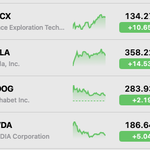
$SPCX $GOOG
