x-Apple / x-Rivian (tech team founder) Disruption happens. Optimism ahead. 🚀🇺🇸 Starlink https://xitter.twitterapi.xyz/t.co/XczBaeai1C
Silicon Valley
Joined January 2008
- Tweets32.7K
- Following833
- Followers34.4K
- Likes54.4K
Another 2+2 with @CernBasher
A shocking list of things to talk about this week.


Two Guys, Two Weeks Video
Here is a summary of the topics @pbeisel and I talk about in the video:
Tech Espionage and Nvidia
Scandal and Infiltration Concerns: We open by discussing reports involving Nvidia CEO Jensen Huang and a woman named Alice, raising questions about potential Chinese espionage targeting top U.S. tech executives.
Policy and Competition: We examine Jensen's historical advocacy for selling chips to China and note reports that Nvidia hired a crisis PR firm a year prior, while emphasizing that nation-state espionage threatens the entire U.S. technology sector.
Starship, Starlink V3, and "Star Mind"
Starlink Capacity Surge: Upcoming Starship Flight 15 will deploy 26 Starlink V3 satellites (Group 31-2), adding 26 terabits per second of downlink capacity - equivalent to 10 Falcon 9 launches!
In-Network Orbital Compute: Using inter-satellite laser links (ISLs) that carry four times the downlink capacity, SpaceX is building out a space-based compute layer referred to as "Star Mind". This allows data to travel directly to orbital GPUs and remain inside the Starlink network without routing through terrestrial fiber gateways.
Disrupting Telecom: Following Elon's comments at the Ron Baron conference and talks with Qualcomm regarding 6G, we speculate on SpaceX's ambitions to disrupt legacy mobile carriers - or potentially acquire one - to maximize spectrum efficiency for Starlink Mobile.
Exponential AI Compute Demand & Space Data Centers
The AI Compute Curve: Comparing the previous mobile/CPU era (which grew roughly 60% per year) to the current AI era, Phil highlights that AI compute demand is growing at an exponential 2.2x to 3.4x+ annually. Unlike human-driven internet traffic, autonomous AI agents query and process data continuously, further accelerating demand.
Overcoming Power and Chip Bottlenecks: Because terrestrial data centers face severe electricity and chip constraints, Elon is pursuing Terafab for chip supply and Starship for orbital power and compute.
Orbital Cooling Physics: We push back against critics who claim space data centers cannot dissipate heat, citing Elon's explanation that the required radiator cooling surface is only one-fifth the surface area of the solar arrays. We also contrast SpaceX's rapid, hands-on "founder mode" culture with the bureaucratic slowness of legacy tech giants.
Google and SpaceX: "Competing with Yourself"
Board Departure: Alphabet executive Don Harrison stepped down from SpaceX's board on November 4 due to increasing conflicts of interest between the two companies.
Deep Financial Ties: Google invested $900 million in SpaceX in 2015 - a stake now valued at roughly $84 billion - and in Q3 purchased an additional 3.85 million shares for roughly $540 million.
Co-opetition: Despite competing in AI, autonomous driving (Waymo vs. Tesla), and space compute (Google's Project Suncatcher), the two rely on each other. SpaceX houses ground stations at Google data centers, while Google signed a massive cloud deal paying SpaceX $920 million per month (from October 2026 through June 2029) to rent GPUs and compute infrastructure.
Consumer Hardware Disruption: We also speculate that Elon could eventually challenge Apple and Google's smartphone duopoly with a lightweight AI consumer device powered directly by orbital Star Mind compute.
SpaceX's Terrestrial Data Center Expansions
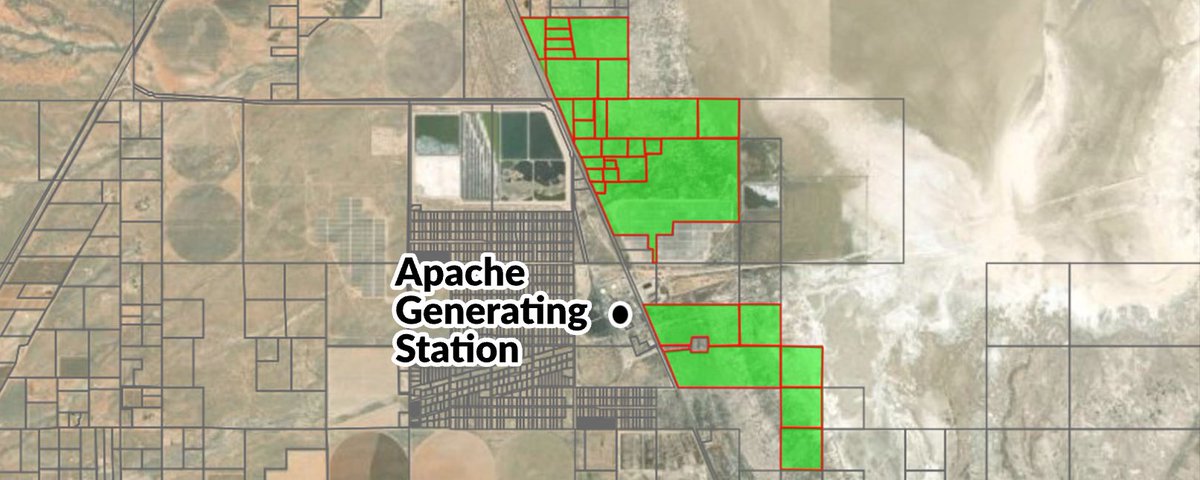
Tombstone, Arizona: Operating through Tombstone Resources, SpaceX is proposing a 747-acre, 4.4-million-square-foot supercomputing campus near Tombstone, Arizona. The project includes a $3.6 billion energy infrastructure investment, closed-loop cooling that uses minimal water, 1,000 permanent jobs, and promises to lower local residential electricity rates by 10% to 40%.
Starbase, Texas: SpaceX wants to build a permanent $24 billion gas-fired power plant on 444 acres in Starbase to replace temporary portable gas turbines, while aggressively acquiring surrounding land parcels to potentially support future data center campuses.
The Rise of the Automated Economy
The Fourth Economic Sector: I break down how the economy has evolved from extraction (primary), transformation/manufacturing (secondary), and services (tertiary - currently 80% of the U.S. economy) into a fourth category: the automated sector, which operates with zero human labor.
Capital vs. Labor: Within a few decades, 70% to 99% of the economy could be automated across both blue-collar and white-collar roles. Because the financial rewards of full automation flow to capital owners rather than wage earners, shrinking wages risk triggering a deflationary spiral unless households gain new income streams.
Portfolio of Solutions for the "Messy Middle": To bridge the transition toward "sustainable abundance," we discuss diversifying household income beyond traditional wages (currently 60% of household income) through sovereign wealth funds (like those in Alaska and Norway) , employee stock ownership plans (ESOPs), negative income taxes or UBI, and child equity accounts.


The NetP site now shows Starlink sats overhead.
Just flip the Satellites toggle ON.
Pick your home state/country and see what's overhead in real-time.
The NetP app does this as well. In fact, it's better at it! 🚀
netp-app.com/starlink?geo=us…

Anthropic's compute reality.
I think its SpaceX commitment is going to climb. SpaceX will be the place to find GPU supply.

Tesla Robotaxi.
Austin gets bigger. San Antonio comes online.


Another 38 Model Y's added to the Robotaxi fleet in Texas. Now at 1,282.
Tesla is 3 vehicles behind Waymo in Texas now.
philbeisel.com/robotaxi


Here an interesting thought...
How big is 1 GW of compute?
About 1 to 2 million human brains worth. 💡💡
A common central estimate (from Joseph Carlsmith’s Open Philanthropy report) puts the human brain at about 10¹⁵ FLOP/s.
1 GW of AI compute delivers on the order of 1-2 × 10²¹ FLOP/s.
1 × 10²¹ ÷ 10¹⁵ = 1 million human-brain equivalents
2 × 10²¹ ÷ 10¹⁵ = 2 million human-brain equivalents
In other words, we need roughly 4,000–8,000 GW (4–8 terawatts) of AI compute to equal the 8 billion brains on planet Earth.
That's a lot of data centers. Or just 1 Starmind.
Take this with a massive grain of salt, most humans are pretty dim bulbs, as witnessed by recent voting in the US elections. 💡

The macro read on this is that SpaceX has, and continues to, build optionality.
The political overhang is real, and the environment has tightened considerably in recent weeks. But let's not get ahead of ourselves: all politics are local.
SpaceX is building optionality across multiple sites and does not need every location to proceed on its original timeline. There are projects in the Memphis/Southaven area, Texas sites near Starbase and Brownsville, an Arizona proposal, and others (coming). Then there is the longer-term orbital compute opportunity.
That geographic spread is intentional.
The political opposition is no longer hypothetical. Voters have rejected or supported restrictions on data center development in an extraordinary number of local ballot measures. Existing projects face noise and emissions complaints, water and power concerns, lawsuits, and growing scrutiny over the impact on local communities. Even Texas, one of the most important planned capacity locations, is seeing a meaningful shift in the political conversation.
We shouldn't dismiss any of this.
But neither should we assume that every community will reach the same conclusion. There are enormous economic incentives for communities and states to compete for the jobs, tax base, and infrastructure investment that come with these projects.
The question is whether operators can address the local costs: power prices, water, noise, pollution, and infrastructure.
This is where I think SpaceX has an advantage.
It can negotiate, move toward relatively more advantaged locations, contribute to infrastructure, transition away from temporary power solutions, and innovate around constraints. Spreading the risk across multiple locations preserves negotiating leverage and gives the company room to maneuver.
There is a macro 'decel' argument in play about the threat of AI. But the train has left the station. The fight now is over where the train stations get built, who builds them, and who captures the economic value.
Demand for compute isn't going away. Nor is the geopolitical competition to build it. Capital and engineering talent will continue looking for workable locations. Politics can slow terrestrial capacity, raise costs, and stretch timelines. That's a real headwind.
But pressure to become more responsible operators, particularly around water, power, pollution, and infrastructure, can also favor companies that know how to innovate around the problems.
And this is where I think SpaceX is particularly interesting.
Musk's companies have a history of taking on problems that others view as constraints and turning them into engineering challenges.
Consider Tesla Superchargers. Building a global charging network is extraordinarily difficult. Every location requires local approvals, utility coordination, power interconnects, and often municipal and state support. Yet Tesla has built a network of well over 80,000 charging stalls across a remarkably diverse set of political and local environments.
To be clear, hyperscale data centers are a different proposition. They are industrial-scale facilities with much larger and more continuous local impacts. The Supercharger comparison isn't about equating the two. It's about the operational capability required to navigate thousands of local infrastructure decisions and execute at scale.
SpaceX is aggressive by design. But it is also an extraordinarily capable engineering and infrastructure operator.
I think it is both aggressive and responsible. Those things may seem opposed, but Elon’s companies have repeatedly demonstrated an ability to innovate around the problems in front of them.
The near-term terrestrial path is narrower and more contested than it was a few weeks ago. I wouldn't underestimate that.
But SpaceX isn't betting everything on one location, one political environment, or even one way of building compute.
It's spreading risk, moving toward advantaged areas, preserving negotiating leverage, and ultimately pursuing the orbital path.
That's what strategic optionality looks like.
And I would argue that few companies are better positioned to execute on it. $SPCX