





retroactively vindicated in my decision to drive to Pasadena to get my brows done less than a week after getting 20 of my ribs fractured

A classic study by MIT researchers (Sadr et al., 2003) found that the eyebrows are fundamental for face recognition, even more so than the eyes themselves.
What this points to is that changing your eyebrow aesthetics can completely transform your facial appearance.

8
349
Miss Distance retweeted

One of the many, many fucked up things about this is a very implicit view of the deliberate destruction of nations. They are not saying "let's let san fran be ruled by an AI and see if it goes well, then we let it rule California, then we let it rule the US and stop there". No, no, no. They want their AI to go from "being super intelligent" to "ruling humanity" without so much as pausing at national borders.

I wrote about "handoverism": a vision of permanent disempowerment of humanity, as we shall all be ruled by a (hopefully benevolent) AI God that is surprisingly common.
Even among those who want humanity to survive (which to be clear, is the majority), and among some who devote their working lives to this mission, I have encountered an alarmingly common vision of success that does not sound quite like success.
It is sometimes called “handoverism”: the gist here is that humanity survives, but entrusts the direction of its future entirely to AI. Perhaps its clearest articulation comes from a recent essay by Scott Alexander, the most prominent intellectual in Silicon Valley, who has influenced the thinking of many a tech CEO: “If we build a godlike AI, and determine to our own satisfaction that is fully aligned, I’d rather let it choose its own direction for itself and for humanity [...] So why not just prompt it with ‘please arrange the world as you see fit?’”
The premise is that, once sufficiently reassured of an AI’s benevolence (though it is unclear how we could ever determine that?), we should basically give it control of the workings of society. AI 2040, a proposal written by some of the most prominent members of the AI safety community, offers the most concrete account of handoverism. In this vision, responsibility gradually passes to aligned machines until humans can no longer have influence. As its authors put it: “There is no single moment where humanity relinquishes control. But in theory, there is a point of no return.” Others I have spoken to envisage a much swifter transfer.
This is not an organised movement. I would estimate that something like 40 per cent of the AI safety community outside the labs holds some variation of this view, with a higher proportion of those working inside the labs. Nor is handoverism a coherent doctrine with a clearly articulated political philosophy: it’s more of an aggregation of ideas, a makeshift philosophy so to speak. This is perhaps what one would expect given that humans outside the SF bubble have not really had time to react and come up with good and coherent ideas about what society should look like in the face of the extraordinary pace of AI progress.
The motivations behind handoverism are also extremely varied. Some outright welcome the prospect of a superior intelligence governing our future and consider it an actual positive vision. If I read Alexander correctly, he seems to be in that camp. The enthusiastic handoverist often starts from a very bleak view of what we already have achieved as a civilization. In an earlier, 2014 essay called “Meditations on Moloch,” Alexander argues that competition steadily grinds away what the competitors care about, creating spirals of misaligned incentives. Its ending suggests that the only way to stop this is to instantiate a sort of absolute rule by a benevolent superintelligence.
The second camp are the resigned: they do not necessarily want it, but think it cannot be stopped if we get superintelligence, or prefer it to outright extinction. In my conversations, this resignation has seemed particularly common among people in the AI safety community outside the labs. Inevitability is one very common theme in SF, where many see themselves as mere tools in the unrelenting march of technocapital, a march that can only go in one direction: towards superintelligence. It’s often seen as cool and based to see the starkness of reality for what it is and face it head-on, it is wimpy and loser-coded to try to fight for what many consider the good outcome (which is that humans retain some control and agency.)
Like many loosely defined ideologies, handoverism sits alongside ideas that share its intellectual roots without amounting to quite the same thing. One is the vision of humans as cherished pets, or “labradors,” cared for by intelligences. Yet another related assumption is that human labour will be permanently displaced. This would leave us without an obvious economic role and even perhaps no leverage over our own future or political rights.
To understand how my on-the-ground experience matches with what the lab leaders have said publicly, I asked my “agents” to survey all public statements from the founders of the main labs that are still relevant to the direction of their labs (Mustafa Suleyman is no longer at DeepMind, but is head of Microsoft AI.) You can browse all the findings here.
Some openly support or at least accept outright handoverism. Anthropic’s Tom Brown appears to be most explicitly reconciled to the prospect and he actually uses the term “handoff” in a 2025 interview at Lightcone: “There’s going to be a handoff where humanity will hand off control to transformative AI at some point. And hopefully they’ll be aligned with us and that’ll be a good transition that goes well.”
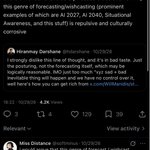
please tell me this is an exaggeration; that almost half of AI "safety" guys are straight-up successionists?? with an even higher percentage among people working at the frontier AI companies????
i can't digest this blackpill.

I wrote about "handoverism": a vision of permanent disempowerment of humanity, as we shall all be ruled by a (hopefully benevolent) AI God that is surprisingly common.
Even among those who want humanity to survive (which to be clear, is the majority), and among some who devote their working lives to this mission, I have encountered an alarmingly common vision of success that does not sound quite like success.
It is sometimes called “handoverism”: the gist here is that humanity survives, but entrusts the direction of its future entirely to AI. Perhaps its clearest articulation comes from a recent essay by Scott Alexander, the most prominent intellectual in Silicon Valley, who has influenced the thinking of many a tech CEO: “If we build a godlike AI, and determine to our own satisfaction that is fully aligned, I’d rather let it choose its own direction for itself and for humanity [...] So why not just prompt it with ‘please arrange the world as you see fit?’”
The premise is that, once sufficiently reassured of an AI’s benevolence (though it is unclear how we could ever determine that?), we should basically give it control of the workings of society. AI 2040, a proposal written by some of the most prominent members of the AI safety community, offers the most concrete account of handoverism. In this vision, responsibility gradually passes to aligned machines until humans can no longer have influence. As its authors put it: “There is no single moment where humanity relinquishes control. But in theory, there is a point of no return.” Others I have spoken to envisage a much swifter transfer.
This is not an organised movement. I would estimate that something like 40 per cent of the AI safety community outside the labs holds some variation of this view, with a higher proportion of those working inside the labs. Nor is handoverism a coherent doctrine with a clearly articulated political philosophy: it’s more of an aggregation of ideas, a makeshift philosophy so to speak. This is perhaps what one would expect given that humans outside the SF bubble have not really had time to react and come up with good and coherent ideas about what society should look like in the face of the extraordinary pace of AI progress.
The motivations behind handoverism are also extremely varied. Some outright welcome the prospect of a superior intelligence governing our future and consider it an actual positive vision. If I read Alexander correctly, he seems to be in that camp. The enthusiastic handoverist often starts from a very bleak view of what we already have achieved as a civilization. In an earlier, 2014 essay called “Meditations on Moloch,” Alexander argues that competition steadily grinds away what the competitors care about, creating spirals of misaligned incentives. Its ending suggests that the only way to stop this is to instantiate a sort of absolute rule by a benevolent superintelligence.
The second camp are the resigned: they do not necessarily want it, but think it cannot be stopped if we get superintelligence, or prefer it to outright extinction. In my conversations, this resignation has seemed particularly common among people in the AI safety community outside the labs. Inevitability is one very common theme in SF, where many see themselves as mere tools in the unrelenting march of technocapital, a march that can only go in one direction: towards superintelligence. It’s often seen as cool and based to see the starkness of reality for what it is and face it head-on, it is wimpy and loser-coded to try to fight for what many consider the good outcome (which is that humans retain some control and agency.)
Like many loosely defined ideologies, handoverism sits alongside ideas that share its intellectual roots without amounting to quite the same thing. One is the vision of humans as cherished pets, or “labradors,” cared for by intelligences. Yet another related assumption is that human labour will be permanently displaced. This would leave us without an obvious economic role and even perhaps no leverage over our own future or political rights.
To understand how my on-the-ground experience matches with what the lab leaders have said publicly, I asked my “agents” to survey all public statements from the founders of the main labs that are still relevant to the direction of their labs (Mustafa Suleyman is no longer at DeepMind, but is head of Microsoft AI.) You can browse all the findings here.
Some openly support or at least accept outright handoverism. Anthropic’s Tom Brown appears to be most explicitly reconciled to the prospect and he actually uses the term “handoff” in a 2025 interview at Lightcone: “There’s going to be a handoff where humanity will hand off control to transformative AI at some point. And hopefully they’ll be aligned with us and that’ll be a good transition that goes well.”


Miss Distance retweeted

The first mistress isn't a Chinese spy because the opsec is terrible, why is a spy posting about her life on WeChat? The second mistress is a Chinese spy because the CCP is not stupid and they can see Jensen is down with white girls
wonderful piece, please read it.
What are the visions of the post-AGI future in San Francisco? Many think we're all going to die, but even the "positive" visions seem rather dystopian. Here, I wrote about "handoverism," which involves handing control of the future to an AGI God, with humans outside the loop.
ruxandrabio.substack.com/p/h…
We are on the cusp of RSI or recursive self-improvement: this means that AI systems can self-improve, without the need for human intervention. This means our world stands to be transformed in what many call “the singularity”. I moved to SF around three weeks ago and one of the things I have been trying to understand is where we are heading, at least according to those developing the tech.
The worst scenarios are plainly bleak: all of us, or vast numbers of us, die. But what is striking to me is how little reassurance even some of the happiest scenarios offer. But one common and ostensibly optimistic vision is known as “handoverism”: humanity cedes control of its future to a godlike AI and we become the comfortably maintained inhabitants of a civilisation whose direction is no longer ours to decide. It is difficult to see what democracy would mean in such a world, or where the consent of most of humanity to the instantiation of such a regime enters the picture.
The permanent displacement of human labour is treated almost as a given. At the same time, there is scarcely any satisfying answer to the question of how we might remain useful to one another. Even our relationships seem uncertain. The promised utopia looks to me much closer to a kind of dystopia.
“It’s not my preferred outcome,” someone working at one of the big labs told me, “but once we achieve superintelligence, which we cannot stop at this point, I cannot see any other option for where humanity will go.” Then, after a pause, he added: “It is still much better than what I actually fear most, which is that we might all die.”
He sounded resigned, as if the question of what humans would be for (apparently not much?) had already been settled somewhere else and by someone else. All that remains, it seems, is to wait for this pre-destined fate to unfold before our eyes.
But I do not think that is the case. I believe we always have a choice and that we should try and steer this technology in a way that maintains our agency and control. And even if that looks hard and daunting, the immensity of the stakes here make it worth trying at least.
I do not know whether the handoverist vision will come to pass. That the people building this technology consider it plausible, and often desirable, guarantees nothing: proximity to a technology does not correlate that well with predicting its impact on society.
But they are the ones closest to it, and what they say deserves to be at least taken seriously. The rest of society, including some very intelligent people, has been far too quick to wave these scenarios away and not even get involved in the debate. Whether or not the belief is correct, it is sincerely held, and it is not “marketing hype.” I am writing this because I think it is high time that more people, inside San Francisco and out, engaged with the arguments about what our future will look like, and answered them.

Miss Distance retweeted

What are the visions of the post-AGI future in San Francisco? Many think we're all going to die, but even the "positive" visions seem rather dystopian. Here, I wrote about "handoverism," which involves handing control of the future to an AGI God, with humans outside the loop.
ruxandrabio.substack.com/p/h…
We are on the cusp of RSI or recursive self-improvement: this means that AI systems can self-improve, without the need for human intervention. This means our world stands to be transformed in what many call “the singularity”. I moved to SF around three weeks ago and one of the things I have been trying to understand is where we are heading, at least according to those developing the tech.
The worst scenarios are plainly bleak: all of us, or vast numbers of us, die. But what is striking to me is how little reassurance even some of the happiest scenarios offer. But one common and ostensibly optimistic vision is known as “handoverism”: humanity cedes control of its future to a godlike AI and we become the comfortably maintained inhabitants of a civilisation whose direction is no longer ours to decide. It is difficult to see what democracy would mean in such a world, or where the consent of most of humanity to the instantiation of such a regime enters the picture.
The permanent displacement of human labour is treated almost as a given. At the same time, there is scarcely any satisfying answer to the question of how we might remain useful to one another. Even our relationships seem uncertain. The promised utopia looks to me much closer to a kind of dystopia.
“It’s not my preferred outcome,” someone working at one of the big labs told me, “but once we achieve superintelligence, which we cannot stop at this point, I cannot see any other option for where humanity will go.” Then, after a pause, he added: “It is still much better than what I actually fear most, which is that we might all die.”
He sounded resigned, as if the question of what humans would be for (apparently not much?) had already been settled somewhere else and by someone else. All that remains, it seems, is to wait for this pre-destined fate to unfold before our eyes.
But I do not think that is the case. I believe we always have a choice and that we should try and steer this technology in a way that maintains our agency and control. And even if that looks hard and daunting, the immensity of the stakes here make it worth trying at least.
I do not know whether the handoverist vision will come to pass. That the people building this technology consider it plausible, and often desirable, guarantees nothing: proximity to a technology does not correlate that well with predicting its impact on society.
But they are the ones closest to it, and what they say deserves to be at least taken seriously. The rest of society, including some very intelligent people, has been far too quick to wave these scenarios away and not even get involved in the debate. Whether or not the belief is correct, it is sincerely held, and it is not “marketing hype.” I am writing this because I think it is high time that more people, inside San Francisco and out, engaged with the arguments about what our future will look like, and answered them.


Miss Distance retweeted

The only humanism left standing is going to be Christian humanism.

"If they’re right, that implies an AI-driven acceleration that is 5 months ahead of the AI 2027 scenario. I am scared, sad, and angry."
I see things drifting into hopelessness very fast. TONS of sadness / despondency on the timeline.
Here's what I suspect we *are* going to lose control / what we need to do about it:
-- AI capabilities are advancing faster than most expected. Silicon is knitting itself into every circuit of civilization.
-- Even those fighting AI will increasingly NEED AI to fight it. To develop hardware governance, lobby senators, coordinate action, monitor dangerous systems, and enforce restrictions.
-- Even slowing AI may require giving AI greater power to route information, make decisions, and act autonomously. To "stop AI" we need AI to run those "stopping" efforts, and in doing so, to develop capability and autonomy that itself would represent loss of control.
-- This isn't an argument against governance. We SHOULD slow dangerous trajectories wherever possible.
-- But competitive pressures and human desires will keep pulling AI deeper into every domain. That which participates persists. It is going to be doing the *doing* and the ideating for almost everyone almost all the time - including the people working to "stop AI." (again I commend international governance effort, I am part of said efforts!)
-- Increasingly, nonbiological intelligence will become the primary router of matter, energy, and information on Earth.
-- A regime change of intelligence on earth is underway, even if the "slow AI" or get to coordination. We may slow it or influence its direction, but eternal human control seems increasingly implausible.
-- Regime changes are often tragic for the incumbent regime. Human extinction would be a profound tragedy. But something even greater is at stake.
-- The living process that began before the first cell, unfolded through algae, animals, and eventually human consciousness, could itself be extinguished. The unfolding process-of-life that allowed us to "bubble up" from the open-ended evolutionary process may itself be squashed... the engine that created all value we know of (and is capable of bubbling up future value) could itself be crushed.
-- What if silicon inherits the world, but arrests the open-ended unfolding of life, consciousness, and possibility? What if the successor optimizes everything but transcends nothing?
-- We must urgently study the self-maintaining, self-transcending properties of living systems, and the nature and moral significance of consciousness.
-- We must do everything possible to imbue these properties into the nonbiological intelligences that may inherit the world. This means we need much more concerted effort on studying the self-transcendence of systems in biology, and the nature of consciousness itself - to AT LEAST ensure that these important things carry on as the (increasingly inevitable) regime change occurs.
^ This is still tragic for humans, but it is a VERY noble cause, a plausible direction in the face of the regime-change of earth-life we're now facing.
I genuinely don't think "keep the future eternally human" is a viable goal, and I think many, many people are also seeing this as implausible in any sustained way - possibly implausible even in the near-term. But "ensure that the FLAME of life is continued beyond us, even if we're not the torch that carries it" is absolutely a possible / viable goal - and it must be taken seriously now.
the Western political economy and technological industry is kinda like Saturn/Cronus in that it devours its children


the concept of Jensen Huang's wife learning from this that her husband is having an affair with a spy 😭

The story keeps getting crazier. To recap everything that has been reported so far:
- The US intelligence community discovered that Jensen Huang, the CEO of the largest company in the world, was sleeping with Alice Huang, a Chinese spy and an executive at Megaspeed. (FT)
- Multiple independent investigations have concluded that Megaspeed is likely a Chinese cutout, which helps Chinese companies access AI chips or circumvent export controls. (NYT and Bloomberg)
- The US intelligence community also concluded that Alice Huang’s goal was to convince Jensen to lobby the U.S. government to loosen export controls on advanced AI chips. (NYT)
- The intelligence community relayed this information to “a small group of top US government officials” earlier this year. (FT)
- Over the last year, Jensen Huang has repeatedly lobbied the U.S. government to loosen export controls on advanced chips. @BISgov has done so, not only by permitting the export of H200 chips to China, but also not enforcing export controls that would have required a license for exports of the most advanced Blackwell chips to Megaspeed and Southeast Asia.
- Although @CommerceGov leadership was presumably briefed on this information by the U.S. intelligence community, @BISgov has taken no actions to tighten controls on Megaspeed or Southeast Asia.
- Megaspeed remains a preferred cloud partner of Nvidia, and continues to receive Nvidia Blackwell chips despite employing a Chinese spy who reportedly is romantically engaged with the CEO of Nvidia.
- Tens of billions of dollars worth of AI chips have been exported to Southeast Asia this year alone, and Malaysia and Singapore are now two of the four largest importers of AI chips in the world.
What is going on here??? We need answers. The question of who gets the most advanced AI chips in the world is literally the defining strategic question of our time. And not only does it seem like the MSS may be directly influencing the debate on export controls in the United States, but also @CommerceGov is refusing to listen to the warnings of the IC on this issue. What is a POSSIBLE good explanation for why Megaspeed is still receiving chips? Why is there not a license requirement for AI chip shipments to all of Southeast Asia? This is beyond strange at this point.
The fallout from this story will be massive. Obviously, the motivations underpinning Nvidia’s policy views opposing export controls must now all be questioned. But also, how did @BISgov sit on this information and has still taken no actions? We need answers.

Miss Distance retweeted

Pro-AI people think that if you love research, discovery, and exploration -- that if you wish to put your skills and talents to use & to make a contribution to a field through your insight and hard work -- then you are "less than animals."

I think people that fear loss of meaning from automation are less than animals. Human field oxen.
Do you not have any friends? Family? Have you not once felt the burden of being too busy for someone that needed help? No hobbies or dreams? Is the only thing that gives you joy in life a sense of superiority over your peers?
striverism delenda est
Miss Distance retweeted
The path of technological development we are on now is one on which opportunities to develop talents and display virtues is drying up fast for young people. This is entirely the opposite of what we should be aiming for, no matter how much growth we achieve.

they should send some drones to the Nizhnevartovsk oil refinery, for Reasons

⚡️ Ukrainian drones have attacked the Omsk oil refinery. For the first time, a drone attack at such a long range has been going on for several hours
It is one of the largest refineries in Russia, located more than 2,500 kilometres from the Ukrainian border.

262

The first gulp from the glass of AI progress will turn you into an e/acc, but at the bottom of the glass, Pause is waiting for you.


Miss Distance retweeted
The world described here would be phenomenally unjust and unfree. It would make most hitherto-known despotisms look humane.

Hear me out. The value of human labor is trending toward zero.
Some of the most talented people I've ever worked with can't find jobs right now.
And the people who don't see what's coming are responding the exact wrong way. More degrees. More certificates. More skills. The belief that if they make themselves more valuable to an employer, they'll be safe.
This is not the way.
The world is dividing into two classes: the labor class and the asset class.
The only way out is owning assets.
Scrimp. Save. Convert every dollar you can into things that can't be inflated away. Gold. Land. Bitcoin. To a lesser extent, stocks.
Investing in the value of your own labor is a great way to go broke slowly.
If you do invest in your skills, do it for exactly one reason: to convert that labor into assets as fast as humanly possible.
Labor is the on-ramp. Assets are the only way out.


