

Nerd in AI and Finance. Ranting @ https://xitter.twitterapi.xyz/t.co/LujBSZoV4r - Views 100% my own
London, UK
Joined January 2009
- Tweets59.3K
- Following5.3K
- Followers74.1K
- Likes86.9K




Pinned Tweet
Stripe acquired OpenRouter. Ramp launched Router.
Both are leaning into stablecoins.
Cloud, mobile, and APIs are now table stakes, not an investable category.
The next era of finance is something else.

AI being such a huge cybersecurity challenge give companies the perfect pretense to ban personal agents
We're missing an app store / SSL / security paradigm.
Not *insert your startup here*
An multiple industry wide thing
xitter.twitterapi.xyz/Polymarket/status/2120…

Every stablecoin-linked card program could soon offer stocks.
But right now the headlines are about companies opting out of tokenization.
That's why I think: Stock tokens are where stablecoins were in 2023.

🚨 BREAKING: Airwallex CEO Jack Zhang co-founded a blockchain and it has raised $80M
The chain is called Alta. Index Ventures led a $47.5M Series A today, after a $32.5M seed co-led by Airwallex and its founders' fund, Capital 49.
---
Alta is built for banks and payment companies. Payments stay private between the two parties, and each institution's sanctions and policy checks run as part of the payment.
Alta says it will reach 200 countries and 90 currencies by connecting to Airwallex's local payout network.
---
Zhang once said of crypto "you cannot be faster than instant", and for Airwallex customers he had a point. Airwallex pays out fast because it holds pools of local currency around the world.
Holding that cash is expensive. Alta's first product will fund each market just in time and keep the rest in yield-bearing tokenized assets until it's needed.
Airwallex holds those pools, so its own treasury is the first one Alta can improve.
Sort of like how most banks started with internal treasury for their tokenization services.
---
Alta calls itself neutral infrastructure for banks and payment providers, and Airwallex is the only named user so far.
Would Wise, Nium or a bank settle on a chain that a rival's CEO co-founded?
Alta's privacy design would hide a rival's payments from Airwallex. The rival would still be growing a network Airwallex helped fund.
---
It can be done.
Visa faced the same question. Bank of America ran BankAmericard until 1970, then handed control to the banks that issued the card. Those banks formed the company that became Visa.
If a payments chain pitches you, I'd ask three things:
- Who is live on it besides the sponsor?
- Who pays out in local currency on your corridors?
- Who controls the rules as it grows?
Alta gets a head start from Airwallex's payout network. And in stablecoins that's a HUGE leg up.
I'm watching for the second named customer. And how banks and non banks start to get value from it.

Prediction markets had the largest quarter ever, with over $194bn of notional volume, up 75% QoQ.
Some absolutely staggering stats in the Q3 State of Prediction Markets by @PetBerisha
- Sports and Parlays made up more than 83% of volume.
- While politics, even during the midterms, only made up 1% of volume - it's something that has far larger open interest and less trading, so "volume" is low.
- California and Texas had the largest amount of card deposits in Q3, both markets have no legal sports betting.
Those three things combined tell you so much about whats happening here.
But they just scratch the surface. You'll find the full report here: newsletter.predicted.co/prod…

In the end. It's all advertising.

Value propositions for third- and first-party agents
"So if third-party agents are effectively fetching and re-sorting the output from retail platform agents, meaning the purpose they serve is principally discovery, and retailers can play agents against one another on commissions, what monetization model are third-party agents left with for the commodified purpose they serve in eCommerce? Increasingly, it looks like advertising."
mdm.co/value-propositions-fo…


Coinbase now owns a national trust bank.
The charter is for its custody business. The new bank will hold crypto for institutions, with the OCC as its regulator.
For context, Coinbase already holds roughly 80% of US spot bitcoin ETF assets. It will move that business into the new bank over three years.
The OCC signed off on 6 November, seven months after conditional approval in April.
Trading, staking and lending stay in other Coinbase companies, and the bank can point its clients to them.
Issuing a stablecoin wasn't part of the application, according to the OCC's April decision.
---
Coinbase is gearing up to be a major player on Wall St as everything tokenizes.
Splitting custody from trading is how traditional markets work too. Banks and asset managers already approve that setup for stocks and bonds.
The charter also helps the part of Coinbase that relies less on trading, which is good timing...
Coinbase's trading revenue fell 44% in a year. Its other revenue, which includes custody and stablecoin income, now almost matches it.
---
In April, Coinbase said the charter would also support payments.
That leans on a March 2026 OCC rule, which swapped "fiduciary activities" for "operations of a trust company and activities related thereto" in its charter rules.
The rule confirms trust banks can offer services alongside their trustee work. The OCC names custody, and it decides on anything else, like payments, case by case.
The ICBA, a community bank trade group, sued in October to overturn the rule. Apart from one test case, it isn't asking the court to cancel charters already granted.
Custody is the core job of any trust company, so the lawsuit poses less risk there.
My sense is they have the cover they feel they need to do all of their existing stablecoin activities and more under GENIUS. And their charter is now granted.
Life could be litigious. Exams could be hard. But they're through the door.
---
To me, this is the most institutional bit of Coinbase, and they're doing the safest, simplest thing.
It gives them the credibility to go after growing demand from institutions for tokenized everything.
If the OCC's rule holds up in court, expect Coinbase and the other crypto trust banks to build payments products. If it falls, Coinbase keeps payments in its state-licensed businesses.

Which comes out just as stocks are crashing...

BREAKING: Nvidia CEO Jensen Huang admits affair, board to launch investigation: ""I was unfaithful to my wife. My actions hurt her and our children. There is no excuse for what I did." axios.com/2026/11/08/nvidia-…

2
14
3,517
Instinct just renewed my car insurance at 20% cheaper.
Took a bit of fiddling but I'd say it did 90% of the work, I did 10%.
I recognize not everyone is as patient for janky not quite 100% automated experiences.
But agents are magic.
Kudos @noahrshinn especially considering this was a UK insurance package for a UK car.

This is stunningly insightful from @chamath
I'm shook for two reasons
1. The clarity of this articulation
2. It took this long to see the fucking obvious

Chamath Palihapitiya admits his blind spot on America's broken two-tier economy
PALIHAPITIYA: "I got it totally totally totally wrong. I got it totally wong."
"I'll go through all the ways in which I got it wrong, but I just want to first acknowledge what my blind spot is. Like most people's blind spots, but I can just speak for myself, it is through the lens of my own lived experience and very narrowly what is in my best interests. And I think what we had was a move away from the culture wars that was very much in my best interest, but I think it was in everybody else's best interests as well. I don't think that was on the ballot. But what I don't think I understood clearly enough, and I think that this election has made extremely clear, is that since COVID, we have moved past political ideology. And I want to say this again: I do not think Democrats or Republicans matter. That is my real takeaway after this election. There is a central block of people that vote the prescient issues of our time."
"It was a gargantuan win for Biden, then it was a gargantuan win for Trump, and then it was a gargantuan win for the Democrats in these midterms. What are these people voting for? I think what they are shouting now—they were trying to signal and now they are shouting—is a broad-based belief that the economy has completely decoupled from reality and is broken. The economic reality in America is broken."
"There is a small percentage of people, the four of us on this pod and all of our friends, who are the asset owners of America. And we have benefited in every weather condition. When rates were zero, we benefited because we were able to build our businesses with very cheap capital. When rates were high, we benefited because we had pricing power. And in every condition in between, whether there were tariffs, whether there were not tariffs, whether there were subsidies, whether there were not subsidies, we've all managed to continue to accumulate and grow assets, but we are few and far between."
"And then there's everybody else who are wage earners, and the structural capacity of the American economy to support and grow wage earners is broken. It's clear. Why do I say that? I do not think, and I disagree with Freeberg, I don't think this has anything to do with socialism. I don't think the far left won particularly more than they were expected. I don't think the far right won particularly more than was expected. This is a complete and total repudiation about the state of the economy. The economy is broken. I have a few charts to support my point of view. Number one, if this was ideological and if ideology mattered, money in politics would have had a more direct impact on the election."
Despite the best efforts of many agentic commerce is still broken.
Because payments are hard.
So many things can go wrong. The issuing bank could flag it as fraud. The merchant could. There's millions of edge cases.
Agents just add more.


Just 10 days until Fintech Nerdcon!
If you want your ear to the ground on
- Agentic commerce
- What's happening in AI adoption
- Stablecoins in practice
- What happens to all the bank charters post midterms
This is *the* place to be
fintechnerdcon.com

Crypto as an industry is here to stay. Far better to have rules of the road established, and if you can make them a high watermark all the better.

“Crypto: Pass legislation to stop Trump's crypto corruption, establish tough but fair rules of the road for legitimate crypto ventures, and create safeguards to protect consumers, small businesses, community banks and the financial system” — @RepMaxineWaters
A glimpse of what’s ahead for crypto legislation next Congress. Expect the industry’s definition of “fair” to differ.
On our Spaces earlier, Democrats @JBSDC and @jenbrowndc saw an olive branch in Waters’ remarks. Even as Dems push hard to crack down on Trump’s crypto conflicts of interest, they see room for work with the industry on a bill that provides a regulatory framework for legitimate actors.
Consumer credit is on chain
And scaling rapidly.

For people in Bolivia, accessing credit through the traditional system has always been difficult. Now, @eldoradoio users can receive and repay stablecoin loans in the app.
We’re the first to bring consumer credit to @tempo, with @talamobile as our lending partner. No collateral. Settled in no time.
Credit is the holy grail of fintech.
AI agents failed 42.8% of Visa's shopping tests
In more than half of those failures, the agent bought something anyway 😳
Which is striking when you consider that six in ten UK adults told YouGov they'd stop using an AI shopping agent after one mistake.
So we needed a benchmark to see where its failing. Cue Visa...
---
Visa launched its Agentic Commerce Benchmark on Thursday:
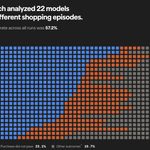
- Testing 22 AI models from 12 labs, 15 shopping tasks, three runs each
- 57.2% of runs passed (best model 82.2%, worst 28.9%)
- A model passed all three runs of a task only 34.2% of the time
- 23.1% of all runs ended in a purchase that failed the test
In 23.1% of Visa's runs, the agent made the wrong call and bought.
The top two models tied at 82.2% and failed differently.
Meta's Muse Wonder bought on 2 of its 8 failed runs, Google's Gemini 4 Argon on 5 of 8, and Claude Fable 5.1 on all 11
---
Their methodology is interesting
They set up one AI to play the shopper and hide most of what it wants.
The personal agent or model has to ask the right questions, search a simulated store, then buy or walk away. Visa stopped the test at the buy decision and says payment testing comes next.
So this is entirely a test of how close they get to completing the payment, not what happens after you press the buy button.
That is still, overall, very helpful, I imagine, especially to the labs who will want to train their models against this benchmark (Aka hill climbing)
---
Agents fail at buying things for two reasons.
1. The agent can't do the job. It misses what you care about, or gets stuck on a messy checkout form or an edge case. (What Visa tested)
2. The payment stack blocks the agent. The merchant or bank might block an agent from paying at all. Because if it's not you typing your 16 digits, how would the merchant know its you and not a stolen card?
A stronger model is more likely to fix the first problem. The second needs the merchant and your bank to know which agent is buying and who pays if it gets it wrong.
---
We're very early. In Wednesday's Brainfood I laid out the four ways an agent pays today:
1. Your real card, typed in by a robot the merchant doesn't trust
2. A one-time virtual card, so your bank sees the platform instead of the shop
3. A network token (a stand-in for your card number) issued to the agent
4. A balance you loaded up front, often in stablecoins, so your bank never sees the agent
The first two break most often. That leaves network tokens and stablecoin balances, and I think we get both. Banks are holding back on agent tokens until they agree who's liable, and that takes time.
You can read the full piece here: fintechbrainfood.com/p/payme…

The wallets will support all the things for agentic commerce
And often they're ahead of what the payments networks (and especially the banks) are able to.

There’s been a lot of good conversation this week about agentic commerce. @link is now working with almost 400 agents, and I (👋 Dan here, product on Link) wanted to share a few more details about our approach:
1. Link is optimizing for the best experience for consumers, agents, and businesses: consumers want both convenience and guardrails, agents want to buy from any business with high conversion, and businesses want to understand how to best serve their customers that are using an agent.
2. That’s why Link supports a broad range of payment options: virtual cards (which were a pragmatic way to get started), Stripe native options (for checking out on a Stripe or Link enabled business more efficiently), a balance, and, yes, agentic tokens from Visa, Mastercard, and Amex. Across the many payment types, our goal is to automatically optimize for the best payment choice for each transaction given the consumer, the merchant, the country, etc.
3. Stripe has been building agentic tokens for almost a year with the networks: we were a launch partner, and agentic tokens have been live in the Link agent wallet for the last month, shortly after the Muse launch. We’re working closely with our network partners to improve the experience of using card tokens and grow their usage.
4. Outside the US, cards are less ubiquitous and there’s 100+ other popular ways to pay: Link is already available in Canada, Mexico, Japan, Singapore and we have dozens more geos coming this year. We’re working to add non-card payment methods to power agentic commerce worldwide. More to come here.
This space is still very, very early! Thanks to all the early Link users who’ve been first adopters of agentic commerce and given us product ideas and feedback (keep them coming!). We read all of it and improve the product multiple times per day. It’s an exciting time to build (if you want to work on these problems fft dm me).