

Investing in economies in West and Central Asia by building @BourseBazaarFdn. Teaching about how sanctions are reshaping the world at @SAISHopkins.
Joined August 2014
- Tweets36K
- Following1.7K
- Followers46.2K
- Likes30.1K






Pinned Tweet
I share my opinions and analysis here in the hopes that they can be useful, in some small way, for people forming their own opinions or seeking to understand the situation in Iran.
When I started this account years ago, most people who followed me either knew me or my work. They didn’t have to wonder about my motivations. But that’s not the case for many people seeing my tweets today. Understandably, without any context, people might wonder about my “priors” and whether my opinions and analysis are presented in good faith. They might make assumptions about my politics or place me in a certain camp, especially in view of the polarized debate on Iran.
I’ll admit I don’t fully understand the motivations of a lot of people posting here. We are debating and discussing through tweets what would have in an earlier time been examined through essays and books, where the author could situate their argument more fully. This is also why I have begun to post longer tweets—hot takes don’t help in moments like this.
If you have any questions about my motivations, feel free to ask (you can reply to this tweet, for example). Explaining why we hold certain positions is a really important part of having a healthy political discourse and I believe this process of explication should be a bigger part of our engagement with the question of what Iran’s future should look like. Authenticity matters.
Good report from @ErikaSolomon and colleagues on why enforcing a “land blockade” to suffocate the Iranian economy probably won’t work—regional countries have their own dependencies on Iran and don’t agree with the blockade’s aims.
Gift link:
nytimes.com/2026/11/11/world…

Back in 2022, I reviewed @IsabellaMWeber and @njtmulder's seminal books for @WarOnTheRocks.
I was thinking about the lessons of the pandemic and the global disruption caused by the Russia sanctions. Looking back, the conclusion has held up, especially as the world continues to adjust to the Iran war.
"It is likely that the expanded use of sanctions will spur countries to pursue models of economic development that increase friction for the global economy. These moves might be conspicuous, such as when countries pursue policies ranging from protectionism to autarky. But they could also be more subtle. China is an outlier in the global economy because its embrace of markets was circumscribed. Chinese policymakers realized that to win their own economic war — the battle for development — the iron fist needed to guide the invisible hand. Other states may come to that same conclusion, particularly if China fares better than more marketized economies at weathering the coming storm."
warontherocks.com/is-the-wes…

If the Trump admin steps back from fighting and instead decides to tighten the blockade and further increase economic pressure, Iran could use military escalation to raise costs.
But there's an alternative.
It's also possible that regional countries, which can't tolerate more instability, will quietly support the Iranian economy, including by breaking the blockade.
This is approach they have adopted since June. It has worked for around 6 months, it may work for another 24.
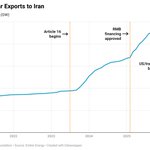
The war and blockade have had a significant negative impact on the Iranian economy, but the impact on economic output has been smaller than most people realize.
After six months of war, the decline in Iran's non-oil economic output was smaller than the impact of the pandemic on US economy activity after the same period.
The decline was also only about *one-seventh* of the contraction seen in Ukrainian economic output within six months of the Russian invasion.
Iran's economy is not on the verge of collapse, it is simply experiencing a deep recession caused by an external shock.
From our latest research note:
bourseandbazaar-substack.org…

Trump was at a dead end and kept driving into a wall.
The Qataris, to their great credit, have reminded him that he can put the car in reverse and turn around.

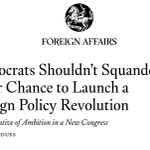
The midterms vindicated Bernie.
They also vindicated @mattduss.
This is a must read:
foreignaffairs.com/united-st…

The US-Iran War interrupted an accelerating solar build out in Iran.
Solar capacity rose from about 0.7 GW to 5.3 GW in the last two years, according to Iran's renewable energy agency.
The growth was unlocked through regulatory changes to spur demand and ease Chinese solar panel imports.
Read more: bourseandbazaar-substack.org…


This “research” says the war failed because Israel only killed 5,000 of around 500,000 military and police personnel in Iran.
So how many people need to be killed for the war to succeed? What’s the magic number?
10,000? 50,000? 100,000?
This is really unserious, Behnam.

Save this post and the critical open-source research by @FDD’s @JanatanSayeh for the next time people say why don’t the Iranian people rise up after they were last slaughtered in January.
Answer: Their butchers were barely targeted. 210 out of 24,000 US and Israeli strikes were dedicated against the “apparatus of repression.”


"The recourse to the brick should not be understood as an appeal to tradition or environmental efficiency. Iranian architects use the inherent modularity of bricks to create volumetric systems or panel systems that cannot be imported from abroad or commissioned from domestic suppliers. Bricks are the only building material available in the country that allows for formal innovation."
My essay on Iranian brickwork for @thebafflermag.
thebaffler.com/salvos/brick-…

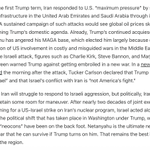
Considering the message and the messenger, we have a strong contender for the most "forever war" post of all time.

Mr. Vice-President,
Please allow me to present a different perspective.
The problem was not the Iran War. It was the cease fire.
If you start a war, you need to win it and finish it – otherwise don’t start it.
This war should have been over six months ago, with the Strait of Hormuz wide open and oil flowing. The second and third tiers of Iranian leadership should have been destroyed, and we should have supported the pro-western forces who could have taken leadership. We stood on the brink of a new, more peaceful Middle East - and then we blinked. We had a chance not only to deny Iran nuclear weapons, but to get rid of the world’s biggest supporter of terrorism.
Instead, we had a cease fire, which was followed by months of will we or won’t we finish the job. Every day was a different message. There still is. Is the war over? Is it about to begin? No one knows. There is confusion and inconsistency.
In June 2025, America was not involved. This was an Israel vs Iran issue.
No one forced the United States to attack Iran then, or in February of 2026. It was a decision made by President Trump. In my opinion, it was the right decision.
Once the decision was made, we should not have stopped until the regime fell. But instead, you negotiated a cease fire that didn’t last, didn’t work and left us in no man’s land, with higher prices and our troops still deployed.
Our troops could have been home, the Navy returned to its bases, a peaceful regime in place , new alliances forged, and gas prices below $3.00 a gallon.
No, Mr. Vice President. It’s not the war. It’s the so-called cease fire.
For too long, most Iranian-Americans have anchored their politics in some combination of foreign interventionism, Islamophobia, and blindly pro-Israel and anti-Arab sentiments.
In this election, American voters rejected exactly those kinds of cynical beliefs.
Iranian-Americans need to rethink their values and their civic duties. We ought to be a constructive, progressive force in U.S. politics.
2028 will be a chance to make amends.


The huge result for Democrats might set the stage for a deal to end the Iran war, both in Washington and Tehran. The risk of major military escalation has diminished.
Hegseth is totally discredited and will be forced to resign before the Democrats come in and impeach him. CENTCOM isn’t going to let him go scorched earth if he isn’t even going to be around in two months.
Bessent sees the writing on the wall and will try to resuscitate his reputation by distancing himself from the war. The organizations feeding bad policy advice into Treasury, like FDD, have been exposed as being arsonists who don’t care about American voters or American interests.
Rubio realizes he won’t be president any time soon and will devote all of his energy to Cuba, the issue he cares about most of all.
Kushner and Witkoff are going to be subject to huge congressional scrutiny next year and will want to tie things up and step back from mediation.
Vance is somewhat vindicated in his opposition to the war and will be able to take more control over the file. His only pathway to a viable run in 2028 is to fix the disaster Trump waltzed into.
Trump will want to pretend the Iran war never happened and go back to building his ballroom. Even if he is angry and vengeful, as some had suggested he would be, there will be more resistance within the administration for further escalation. He is weak and erratic and easily manipulated—he was goaded into the war and now he’ll be chided out of it.
For Iranian leaders, the election results give them their big and decisive victory. They can create a narrative that they won the war and destroyed Trump’s political project—the postmortems published in the next few days in U.S. papers and broadcast on TV will give them plenty of fodder.
This narrative of a Trump defeat will actually make it easier to build consensus over a deal with the US, especially one that requires the types of concessions being pushed by mediators.
Maybe, just maybe, the strong antiwar vote across the US gives us a generational opportunity to end the cycle of sanctions and violence that has driven the US and Iran to a senseless conflict. The American and Iranian people can be united in that hope.
"A comprehensive Iran deal is not feasible today. A Gulf-brokered outcome on the Strait of Hormuz is. In fact, it may be the only way to stop a mutually hurting stalemate that is poised to last years and cause mounting damage to global markets."
Great piece from @njswanson and @AllisonMinor_.
foreignaffairs.com/united-st…

Sharp piece from @ahandjani that explains why exactly the Gulf states are working so hard to prevent Trump from resuming the Iran war.
foreignpolicy.com/2026/10/30…
