

Building humanity's first outpost on the Moon. For science. For discovery. For what comes next.
- Tweets323
- Following43
- Followers77.7K
- Likes1.5K
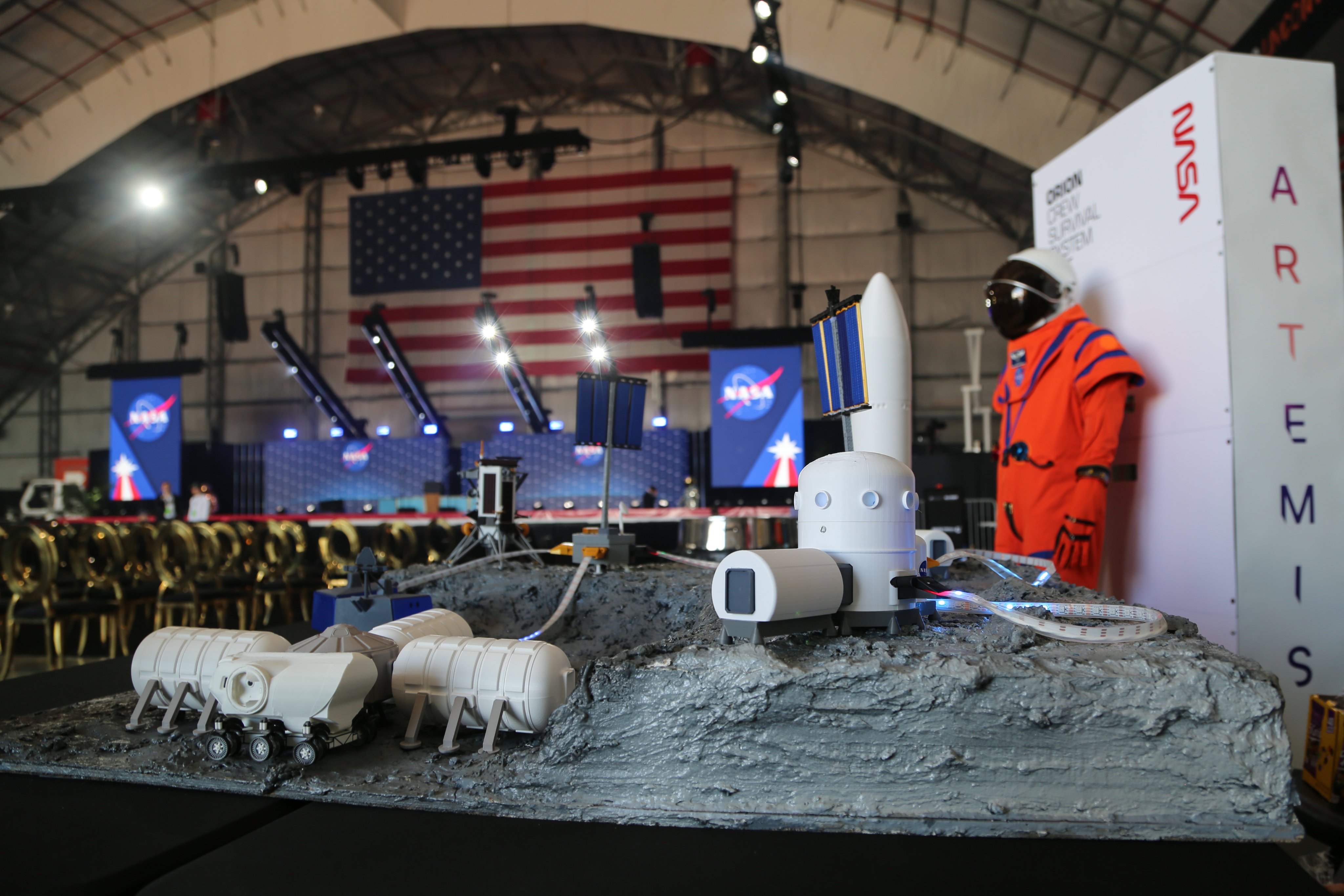
ALT A NASA exhibit at UP.Summit during MAX POWER on Nov. 6, 2026, features a conceptual lunar surface display illustrating the power infrastructure needed to support longer-duration missions on the Moon. In the foreground, miniature habitation modules and other lunar surface assets sit atop a gray, rocky terrain model, demonstrating how infrastructure could support sustained lunar exploration. The display is illustrative and does not represent a finalized Moon Base design. Behind the model stands an orange Orion Crew Survival System suit, with a stage and large American flag visible in the background. Credit: NASA/Briana Zamora

ALT A close-up view of the Moon captured by an Artemis II crewmember using an iPhone on April 6, 2026, during flight day six of the mission. The image reveals the Moon’s rugged, gray-white surface, covered in countless impact craters of varying sizes. Some areas appear relatively smooth, while others are densely packed with overlapping craters. Along the right edge, sunlight casts deep shadows across the cratered terrain, sharply contrasting with the blackness of space. Credit: NASA

ALT A view of the Moon captured by the Artemis II crew on April 6, 2026. Against the blackness of space, the Moon’s curved, partially illuminated surface reveals a rugged landscape covered in craters of varying sizes. Darker gray regions appear across the upper portion, while the heavily cratered lower edge gradually fades into shadow along the boundary between lunar day and night, known as the terminator. Credit: NASA.

ALT A blue-and-white F-5 aircraft bearing NASA and United States of America markings flies over NASA’s Kennedy Space Center in Florida. The Vehicle Assembly Building, surrounding facilities, roads, and waterways are visible below, with part of another aircraft’s blue wing in the foreground. Clouds stretch across the sky above the space center. Credit: NASA/John Kraus

ALT NASA astronaut Harrison Schmitt uses a long-handled lunar rake to collect samples on the Moon during the Apollo 17 mission. Wearing a white spacesuit, Schmitt stands on the gray, dusty lunar surface, surrounded by rocks, and footprints at the Taurus-Littrow landing site. Schmitt’s shadow stretches across the ground. Photo taken by NASA astronaut Eugene Cernan. Credit: NASA

ALT NASA astronauts Victor Glover and Christina Koch look out a window aboard the Orion spacecraft during the Artemis II lunar flyby on April 6, 2026. Glover and Koch share a view through the spacecraft's window, their faces illuminated against the dimly lit cabin. During the flyby, the crew photographed, observed, and documented features of the lunar surface. Credit: NASA

ALT The full Moon of March 2025 glows against a dark night sky. The full Moon was photographed rising over New Orleans, home to NASA’s Michoud Assembly Facility, on the evening of March 13, 2025. This full Moon coincided with a total lunar eclipse. Credit: NASA/Eric Bordelon

ALT Still image from an interactive visualization showing two white lunar vehicles on a rugged, cratered surface with the blackness of space above. The vehicle near the center has a raised dish antenna. Long shadows stretch across the uneven terrain. Credit: NASA

ALT Voyager Technologies’ Griffin-1 lunar lander appears motion-blurred as it moves rapidly on a specialized table used to measure its mass properties during testing at NASA’s Jet Propulsion Laboratory. Several technicians wearing clean room garments are visible nearby. Credit: NASA/JPL-Caltech

ALT A large white parabolic dish antenna, known as Lunar Exploration Ground Site 1, or LEGS 1, stands at NASA’s White Sands Complex near Las Cruces, New Mexico. Desert vegetation, fencing, utility poles, and mountains are visible beneath a clear blue sky. Credit: NASA

ALT NASA astronauts Mark Vande Hei, right, and Joseph Acabá sit in white spacesuits aboard Lunar Outpost’s Pegasus Lunar Terrain Vehicle prototype during human-in-the-loop testing. Vande Hei extends one gloved hand toward equipment mounted in front of him, while Acabá sits beside him. Both astronauts’ faces are visible through the clear helmets of their spacesuits. Credit: NASA

ALT NASA astronaut Anne McClain, right, and a NASA test engineer sit side by side in white spacesuits aboard Lunar Outpost’s Pegasus Lunar Terrain Vehicle prototype during human-in-the-loop testing. A display and controls are positioned in front of them. Another person wearing a NASA shirt and headset stands beside the vehicle holding a clipboard, with the indoor test facility visible in the background. Credit: NASA

ALT NASA astronauts Joseph Acabá, left, and Mark Vande Hei sit side by side in white spacesuits aboard Lunar Outpost’s Pegasus Lunar Terrain Vehicle prototype during human-in-the-loop testing. The vehicle is shown from above, revealing its open seating area, metallic body, and large wheels. Several personnel stand around the vehicle, including one person positioned near the front with a clipboard. Credit: NASA

ALT NASA astronaut Anne McClain, right, and a NASA test engineer sit side by side in white spacesuits aboard Lunar Outpost’s Pegasus Lunar Terrain Vehicle prototype during human-in-the-loop testing. A display and controls are positioned between them. A man wearing a headset stands behind the vehicle. Credit: NASA

ALT The Worm Moon rises over New Orleans on the evening of March 13, 2025. The full Moon glows against a deep blue sky, framed by dark, out-of-focus tree branches in the foreground. Credit: NASA/Eric Bordelon

ALT The historic first photograph of Earth taken from the vicinity of the Moon, captured by NASA’s Lunar Orbiter 1 on Aug. 23, 1966. In the black-and-white image, a partially illuminated Earth appears above the lunar horizon against the darkness of space. The Moon’s rugged, cratered surface fills the lower half of the frame, with faint vertical scan lines visible across the image. Credit: NASA

ALT The iconic “Earthrise” photograph captured by astronaut Bill Anders during the Apollo 8 mission on Dec. 24, 1968. The Moon’s gray, textured surface stretches across the bottom of the image, while Earth appears small in the distance above the lunar horizon, surrounded by black space. Blue oceans, white cloud patterns and land are visible on the planet. Anders took the photograph from the Apollo 8 spacecraft as the crew traveled in lunar orbit. Credit: NASA

ALT The “Earthset” image captured through a window of the Orion spacecraft during the Artemis II crew’s flyby of the Moon on April 6, 2026. A partially illuminated blue-and-white Earth appears behind the Moon’s cratered horizon against the blackness of space. Swirling white clouds are visible across Earth’s sunlit side, while much of the planet is in darkness. In the foreground, the rugged lunar surface stretches across the lower half of the image. Credit: NASA

ALT Photomosaic of the Moon created from 1,231 images captured by NASA’s Lunar Reconnaissance Orbiter. The mosaic shows the Moon against a black background, with hundreds of individual image tiles forming a detailed view of its cratered surface, darker plains and varied terrain. Credit: NASA's Scientific Visualization Studio