Sources and Notes
Both trials were presented on Saturday 7 November 2026 at the American Heart Association Scientific Sessions in Chicago and published the same day in the New England Journal of Medicine. Both enrolled people who already had artery disease. Neither tested what happens if treatment starts earlier in life, so point 4 comes from other kinds of evidence, named below.
· · · · ·
1. ZEUS, THE INFLAMMATION SHOT (POINT 1)
- Ziltivekimab, a monthly injection from Novo Nordisk that blocks interleukin-6, a signal that drives inflammation, against placebo.
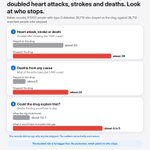
- 6,376 people with artery disease, chronic kidney disease and a raised inflammation marker (CRP 2 mg/L or more). Mean age 69.4. 66 in 100 had diabetes and 42 in 100 heart failure. Median CRP at the start 4.5 mg/L. Median LDL 72 mg/dL, so most were already on cholesterol drugs.
- CRP fell 64% and interleukin-6 activity 76% against placebo.
- Heart attack, stroke or heart death: 561 people on the drug (17.6%) and 565 on placebo (17.7%). Hazard ratio 0.99 (95% CI 0.88 to 1.11).
- Serious infections: 20.4% on the drug, 17.9% on placebo.
- Ridker et al., NEJM 2026.
doi.org/10.1056/NEJMoa261212…
· · · · ·
2. Lp(a)HORIZON, THE Lp(a) DRUG (POINT 2)
- Pelacarsen, an Ionis and Novartis antisense drug that cuts Lp(a), an inherited cholesterol particle, against placebo.
- 8,323 people who had had a heart attack, a stroke or symptomatic leg artery disease, with Lp(a) of 70 mg/dL or more. Mean age 60. Median LDL 65 mg/dL. Median CRP 0.8 mg/L.
- Lp(a) fell 77.7%, from a median of 234 to 64 nmol/L.
- Heart attack, stroke, heart death or urgent revascularization: 12.3% on the drug, 12.1% on placebo. Hazard ratio 1.02 (0.90 to 1.15). In people with Lp(a) of 90 mg/dL or more, hazard ratio 1.00.
- More people stopped the drug for side effects (20.6% against 7.5%). 19 cases of anaphylaxis on the drug, none on placebo.
- Cho et al. (presented by Steven Nissen), NEJM 2026.
doi.org/10.1056/NEJMoa261015…
- Extended analyses, Nissen et al., NEJM Evidence 2026.
doi.org/10.1056/EVIDoa260037…
· · · · ·
3. WHY THEY MISSED (POINT 3)
- Paul Ridker, who led ZEUS, showed the slide "The horse may already have been out of the barn" and called the treatment too little, too late for people this sick. He suggested moving upstream in the inflammation pathway (NLRP3).
- Steven Nissen on HORIZON: measuring Lp(a) is still worthwhile.
- Lp(a)HORIZON is the harder result to explain. HORIZON patients were younger, less inflamed and had a 78% fall in the target, and still saw no benefit. Genetic studies estimated that a fall of roughly 66 to 101 mg/dL in Lp(a) would be needed to show a clear benefit in a trial of this length (Burgess 2018, Lamina 2019), and some experts think the drug did not lower it enough in absolute terms. Others think Lp(a) lowering alone may not help as much as hoped. This is not settled.
- Eric Topol
@EricTopol: blood CRP barely tracks inflammation in the heart arteries themselves, and starting in the seventh decade of life is too late.
- Ethan Weiss, cardiologist: both trials selected people by an abnormal blood marker, unlike SELECT (semaglutide), which did not and did cut events (hazard ratio 0.80). His baseline comparison table and the three survival curves are the clearest view of the difference.
- Marios Georgakis: absolutely zero effect.
- Next Lp(a) trials: olpasiran (Amgen, OCEAN(a)-Outcomes, 7,297 people, primary completion March 2028, NCT05581303) and lepodisiran (Lilly, ACCLAIM-Lp(a), 17,300 people, March 2029, NCT06292013). ACCLAIM also enrolls people aged 55 or older at risk of a first heart attack or stroke.
· · · · ·
4. TIMING, LDL AND GENES (POINT 4, SECOND HALF)
- People born with gene variants that lower LDL had 54.5% lower heart risk per 1 mmol/L (39 mg/dL) of LDL, about three times the effect of statins started later in life. This is a genetic estimate (Mendelian randomization), not a trial. Ference et al., J Am Coll Cardiol 2012. PMID 23083789.
pubmed.ncbi.nlm.nih.gov/2308…
- In 21 trials of statins, ezetimibe and PCSK9 drugs, the risk cut per 1 mmol/L lower LDL grew from 12% in year 1 to 20%, 23% and 29% in years 3, 5 and 7. Wang et al., Circ Cardiovasc Qual Outcomes 2022. PMID 35430872.
pubmed.ncbi.nlm.nih.gov/3543…
· · · · ·
5. PLAQUE STARTS YOUNG (POINT 4, FIRST HALF)
- PDAY, autopsies of 2,876 Americans aged 15 to 34 who died of accidents, homicide or suicide. Raised fatty streaks or plaque in the right coronary artery were found in about 1 in 10 at ages 15 to 19 and 3 in 10 at ages 30 to 34. McGill et al., Arterioscler Thromb Vasc Biol 2000. PMID 10938023.
pubmed.ncbi.nlm.nih.gov/1093…
· · · · ·
6. INFLAMMATION STILL MATTERS (CONTEXT, NOT IN THE POST)
- Colchicine 0.5 mg daily: COLCOT, after a recent heart attack, hazard ratio 0.77 (Tardif, NEJM 2019,
doi.org/10.1056/NEJMoa191238…). LoDoCo2, stable heart disease, hazard ratio 0.69 (Nidorf, NEJM 2020,
doi.org/10.1056/NEJMoa202137…). CLEAR SYNERGY, started right after a heart attack, no benefit, hazard ratio 0.99 (Jolly, NEJM 2025,
doi.org/10.1056/NEJMoa240592…).
- CANTOS, canakinumab, another inflammation blocker, cut events 15% (hazard ratio 0.85) in 2017. Ridker, NEJM 2017.
doi.org/10.1056/NEJMoa170791…
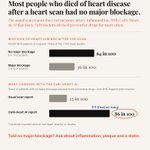
- CaRi-Heart, an AI from Caristo, an Oxford spin-out, reads inflammation in the fat around the heart arteries on a routine heart CT scan. FDA De Novo authorization announced 29 July 2026.
biospace.com/press-releases/…
· · · · ·
7. BLOOD PRESSURE AFTER STROKE (POINT 5)
- OPTIMAL-Stroke, Brazil, 4,368 people after an ischemic stroke or TIA (mini-stroke). Target top number under 120 against under 140. Heart death, heart attack, stroke or hospital stay for unstable angina or heart failure: 10.9% against 13.5% over about 4 years. More kidney problems in the intensive group. Published in NEJM on 7 November 2026. American Heart Association release:
newmediawire.com/news/intens…
· · · · ·
8. WHAT TO DO
- Know your LDL and blood pressure. Lp(a) is mostly set by your genes, so one test is usually enough. Ask your doctor about treating early, before a first heart attack or stroke. None of the trials above tested early treatment of Lp(a) or inflammation in healthy people.