

Reporting on AI and the future of the economy. CS masters degree from Princeton. Newsletter: https://xitter.twitterapi.xyz/t.co/MAwkvzSSr3 Podcast: https://xitter.twitterapi.xyz/t.co/aJSErfcE8Y
Washington, DC
Joined March 2008
- Tweets109K
- Following1.6K
- Followers53.1K
- Likes35.5K




Timothy B. Lee retweeted

Jensen moving this from “human advantage” into “AI advantage” at warp speed!

Timothy B. Lee retweeted

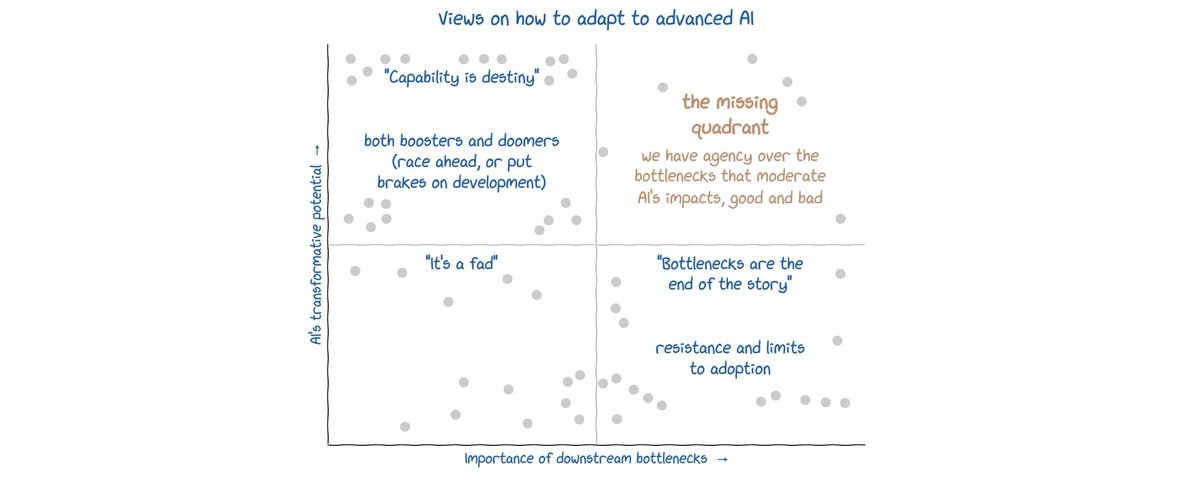
📢 We need more orgs that take AI’s transformative potential seriously *and* take downstream bottlenecks seriously. We have just launched STABL, and hope to lead by example. Read our launch essay below and check us out at stabl.ai.
The three of us have long felt that society’s responses to advanced AI are unproductively polarized. So we’ve decided to do something about it. Our work will have four pillars: Recursive Self Improvement, risks and resilience, steering AI’s economic impacts, and sectoral and professional adaptation.
We will bring our distinctive methods and approach to each of these workstreams. Our underlying worldview avoids the extremes that dominate the discourse, so building a movement and ecosystem around this work won’t be easy. But that is the task we have set ourselves and we are excited to try. The good news is that there are many others who share our views. The next step is to come together, better articulate our vision and agenda for research and action, and amplify each others’ efforts.

Steering AI's societal impact requires taking both AI development and downstream bottlenecks seriously.
Today @RishiBommasani @random_walker and I are starting a new non-profit: STABL @stabl_ai to guide societal adaptation and resilience to advanced AI.
Timothy B. Lee retweeted

Well, it was a rout. My full post-election analysis here: multistate.us/elections/gene…


Timothy B. Lee retweeted

What do voters want? It's time to stop focusing on giving voters the policies they say they want, and focus on giving them the outcomes they want. This is one reason why populism fails.
They want affordability. The solution is neoliberalism.
Timothy B. Lee retweeted

Weirdly, the biggest constraint to Waymo's growth might not be technological or regulatory, but rather its ability to acquire enough cars.
Waymo's deal with Toyota might be important for the company—especially as Tesla scales in Texas. From @binarybits:
understandingrobots.org/p/ho…

Timothy B. Lee retweeted

Tasklet now has an iOS app!
Delegate work to your team of AI agents, wherever you are. Put them to work across your tools and the web, set up automations, build custom dashboards, and collab with your team. All from your phone.
Here's what you can do with the app 🧵
Timothy B. Lee retweeted

I mean look, AI is hard. I’ve been wrong about many aspects of it and most of the smartest people I follow have been wrong about *something.*
But Ed has been claiming peak AI for more than two years. This is almost literally like covering the Intel IPO in 1971 by bringing on somebody who claimed that Moore’s Law (written in 1965) had peaked in 1966, 1967, 1968, 1969, and 1970. It’s not illegal to do this, but your source is confidently commenting on a phenomenon his previous commentary considered impossible.

“Is this just a big circle jerk?” Jon welcomes Ed Zitron (@edzitron), host of the podcast Better Offline, to make sense of the financial house of cards propping up AI and big tech. New pod out now!
Timothy B. Lee retweeted

I have no idea how these Robotaxi screenshots were taken, but I tested it just to see if they're true, and they're wrong 😂 These places have great drop-offs and the routes are great. @ethanmckanna I've taken quite a few rides now, and all my drop-offs were either right at the place or a 2 to 5 minute walk. I also edit the drop-off marker and sometimes it readjusts even closer


Timothy B. Lee retweeted

Another thing. Often AV service area maps advertised are kind of fake- they don’t actually go to everywhere in the polygon the provider publishes. Robotaxi Houston is probably by far the most egregious ‘fake’ AV service area I’ve seen
I get they were doing it so they could get the starship shape but again this is another poor experience point


Timothy B. Lee retweeted
How do you get access to the best robot models? For a while, the answer has been you don't.
Or maybe you partner with the companies making the models. Or make one yourself
That might be changing soon. Several companies recently announced APIs:
understandingrobots.org/p/wh…

Timothy B. Lee retweeted
I really think something like the IFP plan for equipping critical infrastructure to be ready for AI should be implemented urgently ifp.org/operation-patchlight…

Timothy B. Lee retweeted

The big surprise of the 2022–26 era for AI security policy is how cyber damages to the public don't seem to have increased much due to AI. In fact, they've stayed on-trend with the industrialization-of-cybercrime growth rates we've observed since around 2015, with perhaps a small AI-causal bump.
It's useful to think about the position of cybercriminals to develop an intuition for this:
* Imagine you're trying to build a cybercrime business and you want to take advantage of AI automation.
* How do you find and retain talented engineers who can build and operate the software/infra stack you'll need, given that they'll often have non-criminal alternatives with today's AI labor demand (even in middle-income countries where this demand also exists)?
* Where are you going to rent space for your workforce to work?
* Who are you going to hire who's willing to live there and live a life of crime?
* If you're running your business remotely, how will you ensure honor among thieves and manage hiring and firing?
* What's your strategy for evading law enforcement and bribing your way out of trouble?
* How can you access AI inference in a stable way that allows you to innovate your work processes and tech stack?
* Given all this, how will your quarterly automation goals compare to those of, say, a regional call center business in the American Midwest?
There's a lot of nuance here (e.g., state and state-sponsored cyber attackers are a very different group; capabilities can get built up there and then unleashed discontinuously, and this needs to be considered).
But overall, the demographic picture of cyber attackers means that folks should stop thinking of cyber attackers as a bunch of implicit MIT grads anxious to absorb the latest in automation to scale their businesses...
(Below are some related charts on the demographics of cyberattackers from a blog post I'm working on.)


Timothy B. Lee retweeted

"Profound to some but boring to most" is exactly the topic of my latest piece at Understanding AI
I call this "personal media," which has a very small audience -- sometimes just one person!
understandingai.org/p/ai-is-…

AI is ushering in an age of personal media
It may be AI slop, but it's my AI slop.
understandingai.org
Timothy B. Lee retweeted
In my defense, I didn't actually make this claim in the article. And @physical_int has a track record of being more open than its direct competitors
But I was still surprised to see the news. I'll be curious to learn more about how the API works

Timothy B. Lee retweeted
I was wrong recently.
When I was working on a recent article about the challenges of robotics evaluation, I thought we wouldn't see any top robot models offered through API: understandingrobots.org/p/wh…
Then @physical_int went and released a beta last week: pi.website/blog/api-beta

Timothy B. Lee retweeted
China is ahead of the US in industrial robot deployments. Does that mean China going to beat the US in robotics? If so, what should the US do about it?
I went to @scsp_ai's robotics summit on Wednesday to find out more. Here's what I learned:
understandingrobots.org/p/wa…

Timothy B. Lee retweeted

"instead of following a long complicated book of rules, just follow the law" thanks David, I can tell you've thought about this a lot.
Timothy B. Lee retweeted

Do we live in a world where AIs can be wildly superhuman at every single task? Or a world where different tasks have different inherent limits, and AI’s superhuman performance at cybersecurity and math won’t translate to many consequential tasks?
This is a key crux that distinguishes the normal technology worldview from the superintelligence worldview, and it has nothing to do with the pace of AI progress — it's about our different assumptions about the world.
Here's an intuition pump for why I think it's the second world: different tasks have different fundamental limits.
*Category 1: Some tasks are like making a building taller*: there is no ceiling to how well you can do. More compute and better algorithms can lead to wildly superhuman performance. The entire history of computing is the history of building tools that allow us to be “superhuman” at computational tasks.
For example, compilers are superhuman assembly code writers, and fuzzing tools are superhuman vulnerability detectors. AI builds on a long line of such improvements: solving math problems and finding exploits in code are two recent examples.
*Category 2: Some tasks are like making a ball rounder*: there is only so much room for improvement, and the best AI systems can’t wildly exceed humans. Take persuasion. Some people believe AI can persuade anyone of anything, even convincing military commanders to launch nuclear weapons. In fact, “superpersuasion” is one of the pathways through which many catastrophic risk scenarios unfold.
But the AI as Normal Technology thesis is that there are many consequential tasks that are limited by external factors, so such wildly superhuman performance is not possible. This is especially true against humans who use simple computational tools. Tasks like persuasion, or predicting the outcomes of social events (such as elections), fall into this category.
Other tasks, like writing, can’t be ranked on a single scale; different people find different writing styles compelling. AI writing also quickly wears thin: even if a user is impressed by AI writing at first glance, after reading thousands of words of the same type of prose, it becomes mundane and irritating.
All of these are different from Category 1 tasks like playing chess, where even expert humans can’t do much better than deferring to an AI system at each turn.
*Category 3: Some tasks require experiments in the real world*, and the bottleneck isn’t the computational task; it’s the data collection. One example is Moderna’s Covid vaccine: it took two days to design the vaccine, but almost a year to test and authorize, even during a record-breaking vaccine-development effort!
This is why a “superintelligence” won’t cure cancer from inside a datacenter: the bottleneck to many of AI’s most sought-after real-world impacts (such as developing cures to diseases) is in the real world, and requires experiments that we won’t (and shouldn’t) hand over to AI.
People concerned about AI risks often assume that we live in a world where almost everything fits into Category 1, and we might soon see AIs with wildly superhuman performance at all tasks. I agree it would be scary to live in that world.
One reason @random_walker and I are more optimistic about our ability to remain in control is that we don’t think we live in the Category 1 world.

ALT illustration of the three categories of AI tasks with examples